
Business Growth · UK Guide 2026
Record Why Quotation Conversations Stop
JASOTO · Updated 5 November 2026 · 1,582 words
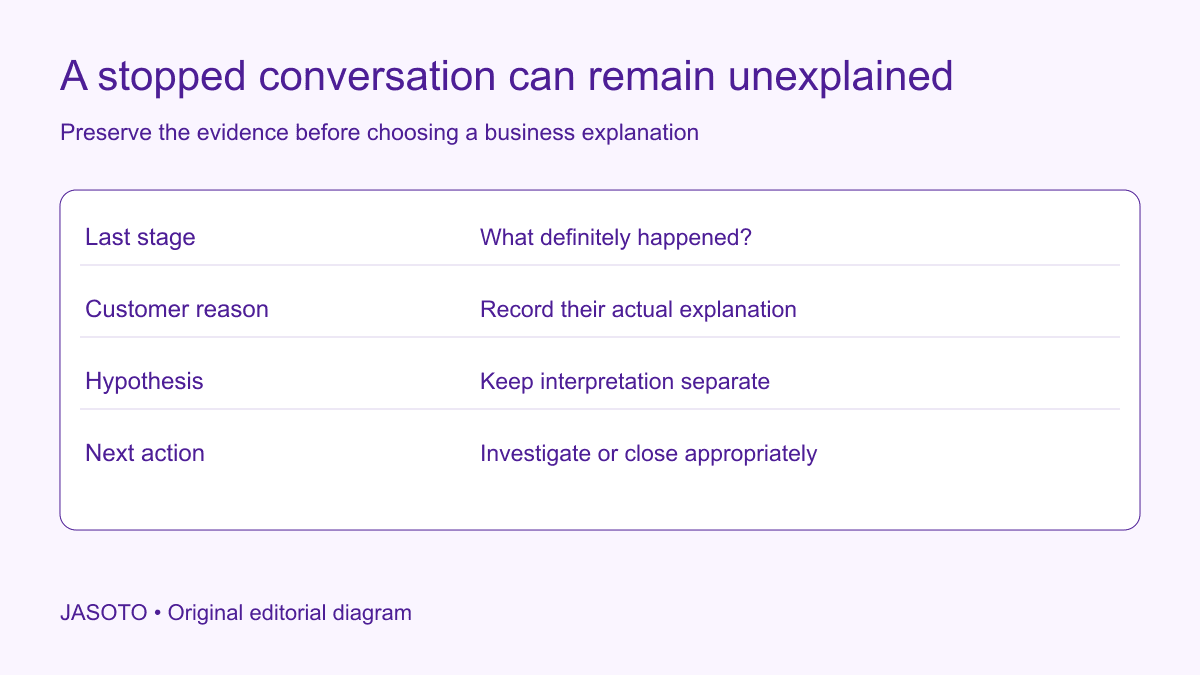
Original JASOTO editorial diagram. Its complete workflow is explained in the article; no actual customer outcome is depicted.
Record why a quotation conversation stops by identifying its last verified stage, preserving any customer-stated reason and keeping staff interpretation separate. Use an explicit unknown category when the evidence does not explain the outcome. Review patterns with the service process and customer context visible. Silence alone cannot establish that price, wording or a competitor caused the conversation to end.
This guide helps a small UK business maintain a proportionate learning log for ordinary quotation discussions. The examples are fictional. Use the organization's appropriate contact, privacy and retention arrangements, and respect customer preferences. The purpose is useful evidence for improvement, rather than pressuring people to explain a decision or inventing a reason to complete a report.
The practical answer
- Define when a conversation is paused, closed or genuinely unresolved.
- Separate customer-stated reasons from staff interpretations.
- Keep unknown outcomes visible instead of inventing an explanation.
- Review patterns by stage and choose proportionate process changes.
Define the conversation and its stages
Agree what counts as one quotation conversation and how related messages connect. Stages might include initial inquiry, scope clarification, assessment, quotation issued and decision pending. Adapt them to the actual service. A customer who is still gathering information should not automatically be classified as abandoning a final offer.
Record the last verified stage and date through controlled references. Keep different tasks separate when one customer has several requests. The unit of analysis should be understandable to another reviewer. Otherwise a long-running customer relationship can appear as several lost opportunities or one completed quote can conceal unresolved work elsewhere.
Distinguish paused, closed and unknown states
Choose practical status definitions with the responsible owner. A customer may explicitly defer the project, decline the offer or stop replying without a known decision. Those situations need different handling and interpretation. Do not use one lost label for every open case the team wants to remove from its active view.
Set review and closure rules suited to the actual process and commitments. Record who decides and what evidence supports the state. Avoid inventing a universal number of days after which every customer has abandoned. Some projects legitimately take longer to assess, while a clear decline can be recorded promptly without waiting for an arbitrary period.
Capture stated reasons accurately
When a customer gives a reason, preserve its meaning and relevant context. Identify whether the record is a quotation or a staff summary. A statement that the project is postponed should not become a price objection because the team expected one. Keep multiple reasons where they genuinely matter rather than forcing every explanation into one convenient category.
Use controlled case references and avoid copying unnecessary personal details into the learning log. The source conversation can remain in its appropriate system. The public or management summary usually needs the task, stage and generalized reason, not the customer's private circumstances. Follow the organization's established information-handling arrangements.
Label staff hypotheses as hypotheses
Record what staff observed and what they think it might mean in separate fields. “Customer asked for a breakdown and then stopped replying” is an observation. “The quote was too expensive” is an interpretation unless the customer or other suitable evidence establishes it. Preserve that difference in summaries and meetings.
Allow unknown reasons to remain unknown. A complete-looking chart built from guesses can drive a harmful business change. A smaller set of confirmed explanations with clearly stated limits is more useful. The log should help the team identify a question worth investigating, not manufacture certainty about every customer's motive.
Choose reason categories with usable boundaries
Possible categories include changed need, timing, service mismatch, scope uncertainty, price feedback, process difficulty, chosen alternative and unknown. Define each using the actual service and evidence. Keep genuine unsuitable requests distinct from a customer declining a suitable quotation. Avoid vague labels such as bad lead that hide what happened.
Write examples and clarify overlap. A customer can mention both timing and budget, while a staff member may only know the project paused. Record enough detail to preserve the distinction. Do not treat a category as a diagnosis. Its value lies in grouping evidence for review while retaining the underlying context and confidence.
Ask permitted follow-up questions neutrally
Where follow-up is appropriate and authorized, ask an open question about the customer's experience or changed plans. Avoid leading wording that invites agreement with the team's preferred explanation. Give people a clear choice about responding and follow the organization's contact rules. The review should not become repeated pressure to resume the sales discussion.
[GOV.UK's interview guidance](https://www.gov.uk/service-manual/user-research/using-in-depth-interviews) supports open questions and exploration of actual experience. Use suitable research practice for deeper investigation. A short customer reply is valuable evidence within its context, while not automatically a representative study of every quotation conversation or proof of a single cause.
Review the business's own process evidence
Check whether the quotation arrived, the scope was understandable and promised follow-up occurred through the actual route. A stopped conversation may coincide with a failed attachment or unclear next step. Verify the relevant facts before attributing the outcome to customer preference. Keep technical and operational issues assigned to appropriate owners.
Consider dependencies such as an assessment, document or site visit. If the business has not completed its own agreed step, the case should not be reported as customer abandonment without context. Record what was pending and who owned it. This preserves accountability and helps the team find improvements it can actually make.
Compare stages and context before counting patterns
Report the stage at which reasons were recorded and the period covered. Feedback after an initial inquiry differs from feedback on an issued quotation. A changed mix of services or traffic sources can alter the reason profile. Keep those factors visible rather than comparing every month as if the same customers considered identical offers.
Show unknown and unresolved cases alongside known reasons where relevant. Do not calculate a precise percentage from a selected handful of respondents and present it as the whole audience's view. Describe the available evidence and its selection limits. The team can still investigate a specific repeated issue without claiming a population-level conclusion.
Work through a fictional quote delay
Imagine a customer asks for clarification of a service boundary and then stops replying. The initial log marks price as the likely reason. Review finds that the business's promised explanation was never sent. The case is corrected to show the pending business action and an unknown final customer reason, with the handling issue assigned.
The team fixes the follow-up process and reviews relevant later cases. This fictional example illustrates why staff interpretation and process evidence need separate fields. It supplies no lost-sales estimate or claim that the correction produces a particular commercial result. The immediate finding is a verified gap in the business's own next action.
Calibrate records without rewarding convenient explanations
Ask appropriate reviewers to classify selected cases independently using controlled access. Discuss differences and improve definitions. A manager should not pressure the team to label unknown cases as price objections or poor fit merely because those explanations match an existing strategy. Keep the record faithful to the evidence.
Review changes to classifications and preserve material history. If new customer feedback arrives, update the reason with its source and date. Do not erase the distinction between what was known earlier and what was learned later. This helps later reviews understand which decisions were based on evidence and which were provisional.
Choose specific improvements and test them
Use findings to identify a practical action, such as clarifying scope, improving delivery confirmation or assigning follow-up ownership. Keep commercial or pricing changes with the responsible owner and appropriate evidence. Research sales-process support with the actual problem rather than commissioning generic persuasion because a set of conversations ended.
Record the expected customer benefit, owner and review trigger. Preserve earlier wording or process references for rollback. If several changes happen together, note that later observations may not isolate their effects. A useful learning decision can be proportionate without claiming the certainty of a controlled experiment.
Examine who is missing from the feedback
Record how many relevant conversations have a customer-stated reason and how many remain unknown, without pressuring people to increase response. People willing to explain a decision may differ from those who stay silent. Their feedback can identify important problems, but it should not silently represent every stopped conversation in the reporting period.
Compare the known cases with basic process context available appropriately, such as stage and service type. Avoid inferring private characteristics or motives to fill gaps. If one group is absent, describe the limitation and decide whether suitable further research is warranted. The review can still support a focused operational fix while remaining honest that the business does not know the full distribution of reasons. This prevents a helpful selected comment from becoming an unsupported general pricing or marketing conclusion.
Maintain a respectful and limited review process
Assign ownership, considering customer coordination roles when recurring work requires capacity. Keep only the records needed for the defined purpose and follow appropriate retention and access arrangements. Review whether the log informs real decisions or merely creates administrative effort.
Use later evidence to revise assumptions and correct inaccurate labels. The practical outcome is a trustworthy record of how quotation conversations progress or stop, with customer explanations, process facts and uncertainty kept distinct. That gives the business a sounder basis for improvement than a confident chart of motives it never actually established.
Put the guide into practice
- Agree the conversation stages and closure rules.
- Use controlled references and minimal reason records.
- Record evidence source and confidence.
- Review permitted follow-up questions neutrally.
- Assign specific changes and later review.
Frequently asked questions
Does no reply mean the customer thought the price was too high?
It establishes only that no reply has been recorded through the observed route and period. The customer may have delayed, changed plans or used another channel. Keep the reason unknown unless suitable evidence supports a more specific explanation. Avoid filling missing feedback with a convenient sales narrative.
Should we ask every customer why they stopped?
Use an appropriate, proportionate contact process that respects preferences and relevant requirements. Decide who may follow up, for what purpose and when to stop. A useful review can combine permitted customer feedback with existing process evidence without pressuring people to justify their decision.
Can staff select a likely reason when the customer says nothing?
If a hypothesis is useful, label it clearly and keep it separate from a customer-stated reason. Record the supporting observation and uncertainty. Reports should not merge guesses into confirmed categories, especially when the result could drive a pricing or service change.
Explore JASOTO tools
Continue with JASOTO
Compare your next step
Discover UK businesses, compare services and request written quotes before making a decision.