
Business Growth · UK Guide 2026
Write an Escalation Note That Helps Someone Act
JASOTO · Updated November 5, 2026 · 1,615 words
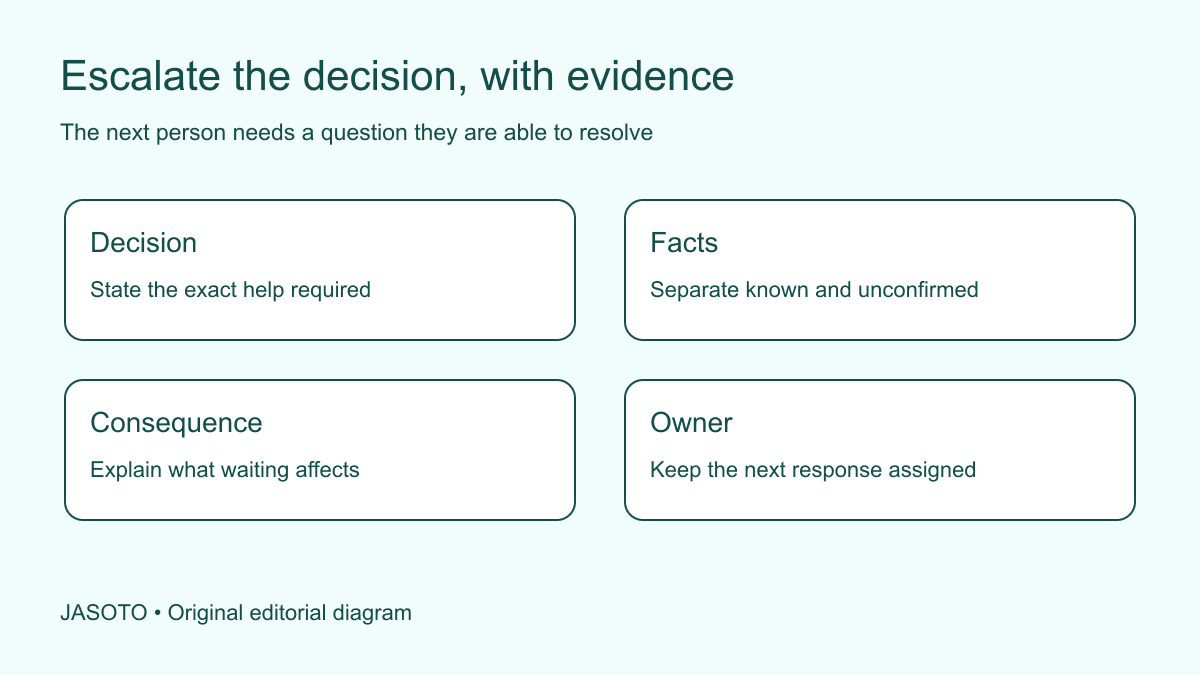
Original JASOTO editorial diagram. Its complete workflow is explained in the article; no actual customer outcome is depicted.
Write an escalation note by stating the exact decision or help needed, the supported current facts and the consequence of waiting. Send it to the person with relevant authority or expertise through the actual process. Keep one owner responsible for the next response. An escalation should make the issue easier to act on, rather than transfer an unexplained email chain to a wider audience.
This guide is an original operational worksheet for small businesses in the United States. The example concerns a retailer whose supplier has not confirmed an expected shipment while customer orders remain open. Use the actual commercial and legal processes for shipment promises, customer communications and remedies. The note organises the decision; it does not determine the rights or obligations of a particular case.
The practical answer
- State the decision needed before retelling the history.
- Separate confirmed facts, customer commitments and unknowns.
- Give realistic options with authority and evidence requirements.
- Keep an owner for the response after the note is sent.
Lead with the decision needed
Start with a clear question such as whether the authorised manager should approve a defined next route or obtain specialist advice before the customer update. Avoid opening with several paragraphs of history while leaving the request implicit. The recipient should know why the issue has reached them and what they are able to decide, investigate or redirect through the appropriate process.
Keep the request within the recipient's actual authority. A supplier contact may confirm availability but cannot necessarily authorise the retailer's customer remedy. A manager may control purchasing while needing legal or technical advice. State the role needed and use the business's normal route. Seniority alone does not guarantee that a person has the relevant information or decision rights.
Identify the case and current owner
Include the order, supplier or project reference and the person coordinating the issue. Use a readable description alongside internal identifiers. If several orders are affected, explain the scope accurately and link the appropriate controlled list. Do not copy unnecessary customer details into a broad message simply because the escalation concerns more than one transaction.
Keep the owner visible after escalation. The person asking for a decision may still need to monitor the response and communicate with customers. Do not assume sending the note transfers every related task automatically. Record who follows up, who decides and who implements the authorised outcome. Those roles may overlap, but the handover should make the actual arrangement clear.
Summarise confirmed facts with sources
Use a short factual sequence: the relevant commitment, what occurred, what was checked and what remains unresolved. Link appropriate source records so the recipient can examine the basis. Preserve the difference between a supplier's forecast and confirmed shipment. An expected dispatch date should not become evidence that goods left the warehouse merely because it appears in an earlier email.
Avoid strengthening the account through emotional labels. Repeatedly saying the supplier is unreliable does not explain the current decision. Record actual missed responses or changed information where relevant. A concise factual summary can be firm without speculation. If the business does not know the cause, say so and identify the question rather than filling the gap with an accusation or convenient theory.
Separate customer commitments from internal hopes
State what customers were actually told and where that information is recorded. An internal target and a public shipment promise can have different consequences. Check the actual wording and applicable process before proposing the response. Do not assume that a delay is harmless because the supplier has not yet confirmed a revised date or because the business would prefer to wait.
The [FTC's merchandise-order guidance](https://www.ftc.gov/business-guidance/resources/business-guide-ftcs-mail-internet-or-telephone-order-merchandise-rule) addresses shipment representations and delay handling for covered orders. Use the actual requirements and suitable advice for the case. This article does not supply a universal deadline or remedy. The escalation should identify the relevant customer commitment and need for appropriate review, rather than substituting a guessed legal answer.
Explain the practical consequence of waiting
Describe which task, commitment or decision is blocked. A pending supplier answer may affect customer information, another purchase or a planned dispatch. Keep the consequence specific and supported. Avoid inventing a revenue loss or reputational outcome to create urgency. The recipient needs enough real context to prioritise the issue without being asked to accept an unsupported worst-case story.
State when the next action is useful and why. If a customer update is due through the actual process, identify that point and its source. Keep a target separate from an external commitment. A precise-looking deadline is not helpful if the owner created it without authority or evidence. Where timing itself is uncertain, make the confirmation task explicit.
Present options at the appropriate level
Offer a small set of realistic routes if they help the recipient decide. Each should identify confirmed facts, unresolved conditions and who can implement it. A route might require a supplier confirmation, customer consent or another appropriate decision. Do not present an unavailable replacement supply as an option ready to approve when its feasibility has not been checked.
Keep recommendation and decision distinct. Explain why the coordinator prefers a route, with its evidence and limits. Avoid giving the recipient a false choice between an obviously unacceptable option and the writer's preferred answer. If only one appropriate route is known, say so and ask for the relevant confirmation or expertise rather than manufacturing alternatives to make the note look analytical.
Include what has already been attempted
List relevant actions and their outcomes, such as a provider enquiry, review of the order record or request for a shipment reference. Keep it concise and sourceable. The recipient should not unknowingly repeat a completed check or assume nobody has contacted the supplier. Avoid a diary of every message if only a few actions affect the current decision.
Explain what the attempt established. Contacted supplier is less useful than supplier acknowledged the enquiry but has not confirmed dispatch. An unanswered message and an explicit refusal provide different information. Preserve the distinction and the next action. The escalation note should reduce ambiguity, not compress every event into an opaque status that needs another call to interpret.
Protect relevant information in the handover
Share the material the recipient needs through suitable business channels. Use access appropriate to customer, supplier and commercial records. A broad email forward can expose unrelated details and make the decision harder to see. Link a controlled case index where that is the actual process, and confirm the authorised recipient can access it before relying on the link.
Do not include passwords, private account credentials or sensitive information merely to make the note self-contained. If special access is needed, use the responsible administrative process. The note can identify the location or owner of relevant evidence without reproducing every document. Useful context and controlled disclosure should support the same decision rather than compete with one another.
Worked example: an unconfirmed supplier dispatch
Imagine a retailer awaiting a supplier shipment linked to open customer orders. The coordinator records the actual promised information, the latest supplier response and the missing dispatch confirmation. The escalation asks the authorised manager for a defined decision and appropriate review of the customer-update route. It distinguishes a possible alternative supply from an offer that has actually been confirmed.
The coordinator remains responsible for tracking the answer and completing the authorised communication. This invented example claims no outcome, legal finding or successful replacement shipment. It shows how an escalation can preserve uncertainty while still giving the next person a specific decision, supported evidence and a clear account of what waiting affects.
Record the response as a new event
If the recipient redirects the issue, confirm who has accepted the decision task. A forwarded message can leave the original owner assuming another person is acting while the new recipient treats it as background information. Keep that handover visible until responsibility is established.
When a decision arrives, preserve who made it, what was authorised and any conditions. Link it to the case and update the actual working instruction. Do not treat a manager's acknowledgement as approval or silently broaden a conditional response. If the note was misunderstood, clarify the decision before acting through the appropriate process.
Tell affected participants the current instruction and assign implementation. An escalation can be resolved administratively while the customer still has no update or a provider still awaits confirmation. Track those actions separately. The note's purpose is fulfilled when the decision supports an appropriate next step, not merely when someone senior has read the message.
Review whether escalation happened at the right point
Afterwards, identify what made the issue hard to resolve. The team may need a clearer authority limit, a better supplier reference or an earlier confirmation trigger. Use actual evidence and avoid assuming every escalation is a failure. Some matters appropriately require a different decision maker or expertise, and a clear early note can be part of a sound process.
Keep a concise template and test it with a colleague unfamiliar with one case. Can they identify the request, evidence, consequence and response owner? Preserve the earlier version so a confusing change can be reversed. Do not claim the template reduces resolution time without appropriate comparison. Its first useful test is whether the recipient can understand and act on the actual issue.
Use JASOTO businesses to discover suitable supplier or operations support and verify capability directly. If coordination becomes continuing work, explore order support roles within a staffing review. For an agreed supplier meeting, research travel after the purpose and appointment are confirmed. A useful escalation note gives the right person a clear decision and preserves ownership of the work that follows.
Put the guide into practice
- Identify the case and decision recipient.
- Summarise the supported current position.
- Explain the consequence and relevant timing.
- Record the decision, communication and remaining action.
Frequently asked questions
Should escalation mean copying more senior people?
Send the issue to the person with relevant authority or expertise through the actual process. A larger recipient list does not establish ownership. State the decision or help needed and keep a clear response owner.
Can the note recommend an option?
Yes, if the recommendation is labelled and its basis and limits are clear. Keep it separate from an authorised decision. Do not present an unconfirmed supplier offer or legal assumption as a fact merely to make the recommendation sound decisive.
What if the decision maker does not respond?
Use the agreed follow-up and escalation route, preserving the actual timing and consequences. Do not treat silence as approval unless the applicable agreement and appropriate process establish that position. Keep the customer-response responsibility visible while the decision remains open.
Explore JASOTO tools
Discuss the actual service or supply issue with suitable providers.
Explore order coordination roles →Consider support where blocked decisions and customer updates become ongoing work.
Research a confirmed supplier meeting →Plan travel after the meeting and decision purpose are agreed.
Continue with JASOTO
Compare your next step
Discover UK businesses, compare services and request written quotes before making a decision.