
Business Operations · UK Guide 2026
Build a Small Experiment Around Appointment Reminders
JASOTO · Updated November 5, 2026 · 1,577 words
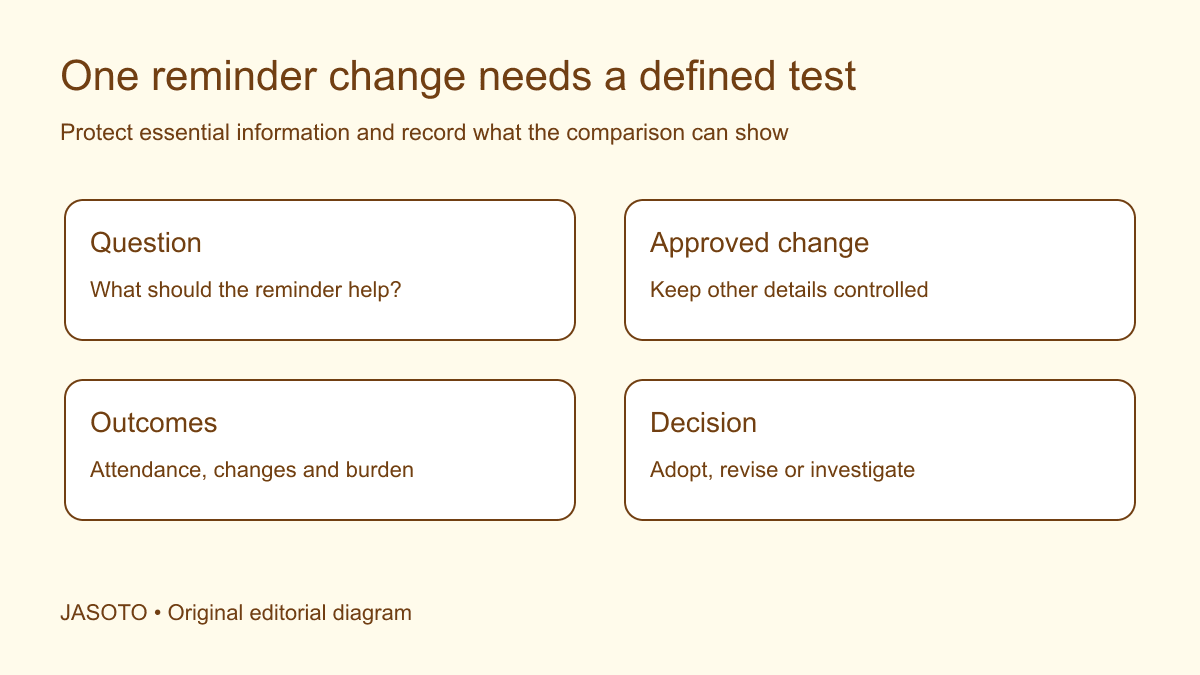
Original JASOTO editorial diagram. Its complete workflow is explained in the article; no actual customer outcome is depicted.
Build a small appointment-reminder experiment by choosing one change, defining the intended benefit and planning how comparable appointments will be observed. Approve the communication and preserve essential information. Record attendance, rescheduling, delivery problems and useful replies separately. Decide in advance what evidence would support keeping, revising or stopping the change, and report the limits of a small comparison honestly.
This guide concerns ordinary business appointments in the United States, using fictional examples. It does not cover clinical reminder design or determine communication-law requirements. The responsible owner should review the actual messaging permissions, commitments and customer needs. A useful experiment fits inside those arrangements rather than treating customers' essential information as an expendable test variable.
The practical answer
- Choose one supported reminder question and define the intended benefit.
- Keep essential customer information and communication requirements intact.
- Plan assignment, outcomes and stopping conditions before reviewing results.
- Inspect small-sample uncertainty and practical burden before adopting a change.
Choose a specific reminder problem
Start with evidence such as customers asking which entrance to use, struggling to change an appointment or overlooking a required confirmation step. Describe the problem and source without assuming reminders cause every missed visit. A clear question helps select a change that can plausibly address the observed issue.
Avoid testing several unrelated improvements together. If timing, wording, channel and booking policy all change, the business may be unable to understand which difference mattered. Choose a manageable question, such as whether a clearer change-request instruction helps customers report a conflict. The objective should support a customer task and a business decision, not merely produce a higher message-open count.
Map the existing reminder process
Record who receives messages, which channel is used, when reminders are generated and what happens after a reply. Identify automated and manual steps. A message can be correctly worded while the reply goes to an unattended address. Testing prose without understanding the operating path may miss the actual cause of confusion.
Verify the essential information and commitments that must remain. Confirm appointment date, local time, location and relevant instructions through the responsible process. If the business has not settled what a message means or how customers change arrangements, resolve that first. The experiment should investigate an approved workflow rather than create policy through a draft template.
Approve a limited change and comparison
Write the proposed variation and the current comparison message. Identify exactly what differs and why. Have the relevant owner check meaning, privacy, permissions and operational consequences. Do not add promotional material to an appointment message casually or assume that every available communication channel is authorized for every customer.
[NIST's experimental-design introduction](https://www.itl.nist.gov/div898/handbook/pri/section1/pri11.htm) describes planned changes and observed responses as part of an experiment. Apply appropriate design expertise to the actual question. The local worksheet here helps make choices explicit; it does not turn any informal before-and-after reminder comparison into a statistically reliable experiment.
Define which appointments are included
Choose eligibility rules before inspecting outcomes. Specify appointment types, periods and exclusions with reasons. Keep essential support intact and consider relevant customer needs through the responsible owner. Do not select only easy cases after seeing that the new wording performs poorly elsewhere.
Record the unit being compared. Several appointments for one customer or one organization may not be independent experiences. A business with low volume may need a cautious pilot focused on feasibility rather than a strong outcome claim. Be honest about that scope and obtain suitable analysis support when the decision requires more reliable inference.
Plan how the comparison is assigned
Discuss an appropriate assignment method with someone competent for the task and the actual operating constraints. Record it before launch. Avoid allowing staff to choose the new message only for customers they expect to attend, because that would confound the comparison. If the design uses periods instead of concurrent groups, note the additional context that may differ.
Keep a stable record of the intended assignment and actual message sent. Exceptions happen, but they need visible reasons. Do not silently move cases between groups after an outcome is known. The report should distinguish planned design from actual implementation and explain how deviations affect what can reasonably be concluded.
Define outcomes with useful boundaries
Record what counts as attendance, a timely change, a cancellation, unresolved status and a message-delivery problem. Use the actual appointment process and avoid inventing a universal acceptable notice window. Keep categories distinct enough to answer the question. A cancellation that allows the business to rearrange work may have a different practical meaning from an unexplained absence.
Include confusion and staff burden where relevant. A message that prompts many avoidable questions may not be the preferred outcome even if another count improves. Define the observation period and handling of unresolved cases. Do not force every appointment into a favorable or unfavorable category when its status is genuinely unknown.
Check delivery separately from customer response
Ask what evidence the system provides for sending and delivery, and what it does not establish. An accepted send request is not necessarily a read message. Use current provider information and appropriate technical verification for the actual tool. Avoid treating an absent reply as proof that the customer ignored the reminder.
Record technical failures and mismatched contact details through the approved information-handling process. Keep personal details controlled and collect only what the test needs. A comparison of wording should not conceal that one group received fewer messages because of an unrelated configuration issue. That is an implementation finding requiring its own action.
Preserve arrival and change information
Check the appointment details and route for questions in both versions. Customers may plan travel using the reminder, so maintain accurate location and confirmation information throughout the experiment. Do not alter essential instructions in ways that create avoidable uncertainty merely to shorten the new message.
Test the reply or change-request path with authorized non-customer cases. Confirm receipt by the responsible team and the next action. A clearer instruction is useful only if someone can handle the resulting contact. If staffing or policy changes during the test, record the effective point and assess the effect on the comparison.
Work through a fictional wording test
Imagine a business notices that customers reply to an unmonitored reminder address when they need to change a visit. The team first corrects the underlying route. It then considers testing a clearer approved change-request sentence, keeping the confirmed appointment details unchanged. The design records which messages were sent and what relevant replies or changes followed.
The review inspects confusion, delivery and staff handling alongside appointment outcomes. This fictional scenario illustrates why operational readiness comes before a wording experiment. It supplies no fabricated attendance improvement and does not recommend a particular timing or channel for another business's reminders.
Set review and stopping conditions
Identify who monitors the test and which problems require prompt correction, such as inaccurate appointment information or a failed help route. Keep those conditions tied to the actual service and responsible process. A desire to finish the observation period should not leave customers exposed to a known misleading message.
Choose a planned review point and avoid repeatedly declaring a winner whenever a small favorable fluctuation appears. Seek appropriate statistical advice where a causal decision matters. If the business lacks enough observations, it can still learn whether the workflow is feasible and understandable while stating that outcome evidence remains limited.
Analyze counts with their context
Show included appointments, actual messages, exceptions and unresolved outcomes. Compare like categories and note service mix, staffing and other changes. Do not convert a small difference into a confident claim about all customers or future performance. Inspect relevant cases to understand plausible mechanisms and alternative explanations.
Keep customer benefit and business effort visible. Research scheduling support if the evidence identifies a tool or process gap. A more complex reminder may create maintenance work or a promise the team cannot support. The final decision should consider the real operating arrangement rather than select a message solely because one convenient measure moved favorably.
Reconcile the case record before drawing a conclusion
At the planned review, compare the appointment list, message log and recorded outcomes. Investigate missing or inconsistent references through the responsible process. A customer may have changed the appointment before a reminder was sent, or a manual message may have replaced the assigned template. Keep those exceptions visible rather than counting the scheduled assignment as proof of what happened.
Have an appropriate colleague check a small set of records against the definitions, especially ambiguous attendance or rescheduling states. Record unresolved cases and explain their effect on interpretation. This practical reconciliation can reveal that the experiment was not implemented as planned, which is itself useful learning. The team should report that limitation instead of selecting whichever data source produces the preferred result or silently excluding awkward cases after seeing their outcomes.
Choose a reversible next step
Record whether to retain the current process, adopt the variation provisionally, revise it or gather more evidence. State the reason and uncertainty. Keep earlier templates and configuration references for rollback. Explore coordination roles if maintaining reminders and exceptions needs dedicated ownership.
Review the arrangement when appointment types, customer needs or systems change. Avoid presenting the pilot as a permanent proof of effectiveness. The practical result is an accountable experiment record: one approved question, a defined comparison, observed outcomes and a proportionate next decision that respects both customer information needs and the limits of the evidence.
Put the guide into practice
- Confirm the actual appointment and messaging process.
- Approve one test change and a comparison approach.
- Define attendance, changes and message-delivery outcomes.
- Record exceptions and concurrent operational changes.
- Review evidence and keep a reversible next step.
Frequently asked questions
Can we test by withholding all reminders from some customers?
Assess the actual commitments, customer needs and relevant requirements with the responsible owner before designing any comparison. A small business can often investigate a less consequential change within an approved reminder process. Do not remove essential information or support simply to create a cleaner experiment.
Does a better result in one week prove the new reminder works?
A short period may contain few appointments or a different customer mix. Record the actual counts, assignment and other changes, and report uncertainty. The result can guide further investigation without supporting a broad causal or financial claim beyond the design and evidence.
What if the new message receives more replies?
Classify what the replies accomplish. Useful corrections, avoidable confusion and unrelated responses have different meanings. More replies can reflect better engagement or a harder-to-understand message. Inspect examples and staff workload alongside attendance and appointment changes before deciding the test succeeded.
Explore JASOTO tools
Continue with JASOTO
Compare your next step
Discover UK businesses, compare services and request written quotes before making a decision.