
Business Growth · UK Guide 2026
Ask for Supplier References Relevant to Your Project
JASOTO · Updated November 5, 2026 · 1,626 words
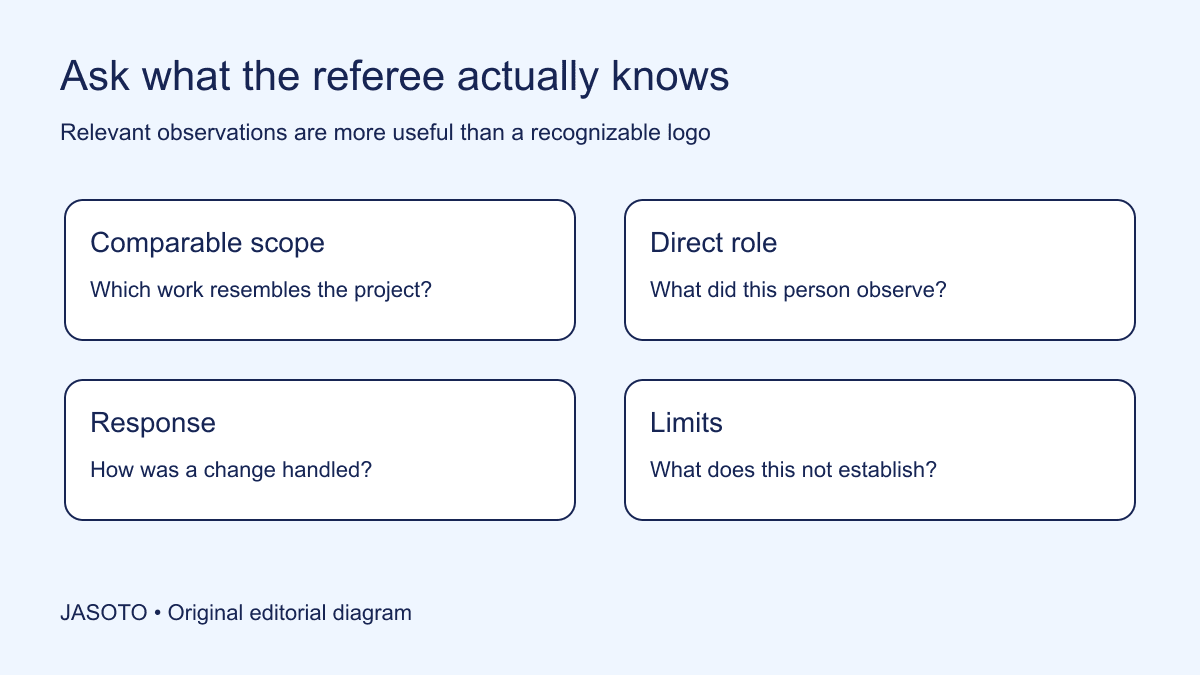
Original JASOTO editorial diagram. Its complete workflow is explained in the article; no actual customer outcome is depicted.
Ask for supplier references by describing the aspects of your project that matter and requesting people with direct knowledge of comparable work. Use the conversation to investigate specific uncertainties, not to collect reassuring adjectives. Record what the referee observed, when it happened and where the comparison stops. A positive reference is useful evidence, but it is not a guarantee about your future project.
For a small business in the United States, this method can support a service purchase involving a new supplier, unfamiliar workflow or important handover. The examples are original editorial scenarios. They do not claim that a named provider has particular customers or results. Keep the process proportionate, respect the referee's time and use references alongside current scope, commercial and capability information.
The practical answer
- Define which project uncertainty a reference might reduce.
- Ask for comparable work rather than famous customer names.
- Keep firsthand observations separate from opinions and supplier claims.
- Use references alongside current scope and capacity checks.
Identify the question a reference can help answer
Write the uncertainty before asking for names. You may want to know how the supplier handled a short implementation window, coordinated with an occupied business or explained an incomplete brief. A reference can describe relevant experience with those conditions. It usually cannot establish the supplier's current financial position, technical compliance or availability for a date that has not yet been agreed.
Avoid asking one reference to validate everything. Separate questions that need current documents, specialist assessment or contractual confirmation. This prevents an enthusiastic conversation from becoming a substitute for evidence it cannot provide. If the main uncertainty is whether your exact task works, a task-based demonstration may be more informative than a general conversation about another customer's satisfaction.
Define comparability in practical terms
Describe the service, scale, environment, responsibilities and constraints of your planned work. Look for meaningful similarities rather than an identical company. A supplier's work for a smaller customer may be highly relevant if the same team delivered the same type of handover. A larger customer may be less comparable if it supplied extensive internal resources your business does not have.
Ask the supplier which proposed references match which characteristics. Do not demand disclosure of confidential customer details as a routine condition of the enquiry. A provider may need consent before introducing someone. Give enough information for it to seek an appropriate introduction and ask what alternative evidence can be offered where a direct reference conversation is unavailable.
Keep the supplier's claims separate from the reference
Save the supplier's description of the earlier project and the specific claim you want to explore. During the conversation, ask the referee about their own involvement rather than reading the claim back as an established fact. A project may have several suppliers, and a person may know only one stage. Give them room to explain that boundary without treating it as evasiveness.
For example, a referee might confirm that the delivery arrived on time but have no knowledge of the later installation. Record those as separate findings. Do not summarize the conversation as complete project success when the person observed only receipt. Narrow evidence can still be useful when it is accurately matched to a narrow question.
Arrange a focused conversation with permission
Explain who you are, why you are asking and how much time you expect to need. Use an appropriate business contact route and confirm that the person is willing to speak. Send the broad topics beforehand if helpful. A reference process should not become an unannounced interview that pressures someone to discuss confidential project information or act as the supplier's salesperson.
Keep the information request relevant. Ask about the service and directly observed interactions, not private employee matters or unrelated commercial details. If the referee cannot answer, accept the limit and identify another evidence route. Do not treat hesitation about confidential information as proof of poor performance. The quality of the purchasing record depends on distinguishing missing evidence from adverse evidence.
Use questions that invite facts
Ask what the supplier was engaged to do, what the referee's role was and which outcomes they personally reviewed. Then explore the particular issue you identified: “What information did the handover contain?” is more concrete than “Were they professional?” Ask for an example where appropriate, without requesting confidential documents. Keep the wording neutral enough to allow a mixed or qualified answer.
The [federal past-performance procedure in FAR 42.1503](https://www.acquisition.gov/far/42.1503) provides one specific public-sector example of evaluations grounded in relevant facts. It does not govern an ordinary private-business reference call. The practical lesson for this original method is modest: record the observed event supporting a conclusion, rather than borrowing formal ratings or implying that a casual conversation is an official assessment.
Ask about a change, not just the original plan
A useful reference may describe what happened when something changed. Ask whether the scope, schedule or information available differed from the initial plan, and how the parties communicated. The answer can reveal whether expectations were clarified or left ambiguous. Avoid assuming that every change is a failure; some projects appropriately evolve when new information becomes available.
Keep causes and responses distinct. A delay may have originated with the customer, a third party, the supplier or several interacting events. Ask the referee what they know rather than assigning blame from a short account. If the reference raises a concern, give the supplier an appropriate opportunity to explain the relevant point, without disclosing information you were not entitled to share.
Check who delivered the earlier work
Ask whether the same service team, subcontracting arrangement or operating location is relevant to your project. A reference for work completed long ago by a different team may still indicate experience, but it does not answer every question about current delivery. Record the date and known team context so the evidence is not treated as timeless proof of present capacity.
Ask the supplier separately about the people and resources proposed for your work. Do not expect the referee to know the provider's current workload or commitments. A good earlier relationship and an unavailable current team can coexist. Keep current scheduling and staffing confirmation in the purchasing process instead of allowing the reference conversation to close questions that were never put to the right person.
Worked example: a service handover for a small office
Imagine a business choosing a provider to organize a new office booking process. It wants evidence about handover because its staff will maintain the process themselves. The supplier offers two references. One used a different service with ongoing management; the other received a comparable handover. The buyer chooses the second conversation and asks what the staff received and what questions remained afterwards.
The referee describes their own role and a particular clarification that helped the team use the materials. The buyer records that observation and asks the supplier how its proposed handover would address the buyer's different staffing arrangement. This invented example claims no endorsement or result. It shows how comparability can guide a useful follow-up rather than becoming a binary label of good supplier or bad supplier.
Record a fair summary while the conversation is fresh
Use a short note with date, referee role, relevant project context, observations, opinions and limitations. Distinguish a direct quotation from your own paraphrase if quotations are necessary and appropriately permitted. Do not improve the wording into a stronger endorsement. A statement that the supplier answered questions promptly should not become a guarantee of immediate support under a contract the referee has never seen.
Let a colleague review the summary for unsupported conclusions. Can they identify the evidence behind the recommendation and the unanswered questions? If the note contains only adjectives, ask whether the conversation really addressed the intended uncertainty. Do not manufacture detail later to make the record look stronger. An honest limited note is more useful than a confident narrative unsupported by the conversation.
Combine the evidence before choosing
Keep a small comparison table with the uncertainty, relevant observation, limitation and next question. For the office handover example, an entry might say that the referee personally used the written instructions, that their team had a dedicated administrator and that your own team has no equivalent role. The next question is then concrete: what additional handover support would your proposed arrangement need? The table should preserve context rather than stripping every conversation down to a satisfaction score.
Record when a reference changes no part of the decision. A pleasant conversation may simply confirm that the provider has completed work of a general kind. That is different from resolving your particular implementation concern. Do not invent a stronger relevance claim to justify the time spent on the call. If the key uncertainty remains, choose another proportionate evidence route or keep the purchasing decision open. Reference checking earns its place by improving understanding, not by filling a mandatory box with any available name.
Compare the reference information with the current proposal, demonstration, scope and practical requirements. Resolve contradictions through focused questions. A reference may reveal that an important service was included for the earlier customer but excluded from your quote. That is a purchasing difference to clarify, not necessarily evidence that either account is wrong. Keep the final decision tied to the actual offer you can accept.
Use JASOTO businesses to discover suppliers and discuss relevant experience directly. If evaluation becomes recurring work, explore procurement support roles within a staffing review. For a mutually agreed reference or supplier visit, research travel after the appointment is confirmed. The useful outcome is a more informed decision with visible limits, rather than a collection of names presented as certainty about work that has not happened yet.
Put the guide into practice
- Describe the relevant project characteristics.
- Ask permission for a focused reference conversation.
- Use consistent factual questions.
- Record limitations and follow up unresolved issues.
Frequently asked questions
Does a well-known customer make a reference stronger?
Only if the reference provides relevant evidence. A recognizable name may have purchased a different service, used another team or worked under different constraints. Ask what the person directly observed and how that work compares with your own project.
Should we reject a newer provider without references?
Do not let one missing evidence type substitute for the whole evaluation. Record the gap and ask what other appropriate evidence is available, such as a relevant demonstration or documented work sample. Consider the project requirements and consequences, and seek suitable advice for consequential purchases.
Can we publish comments from a reference call?
Do not assume permission to publish or use the person's words as an endorsement. Explain the purpose of the conversation and handle the information appropriately. A purchasing note and a public testimonial are different uses that require separate consideration.
Explore JASOTO tools
Continue with JASOTO
Compare your next step
Discover UK businesses, compare services and request written quotes before making a decision.