
Language Learning · UK Guide 2026
Bilingual Appointment Confirmations: A Practical Checklist
JASOTO · Updated November 5, 2026 · 1,532 words
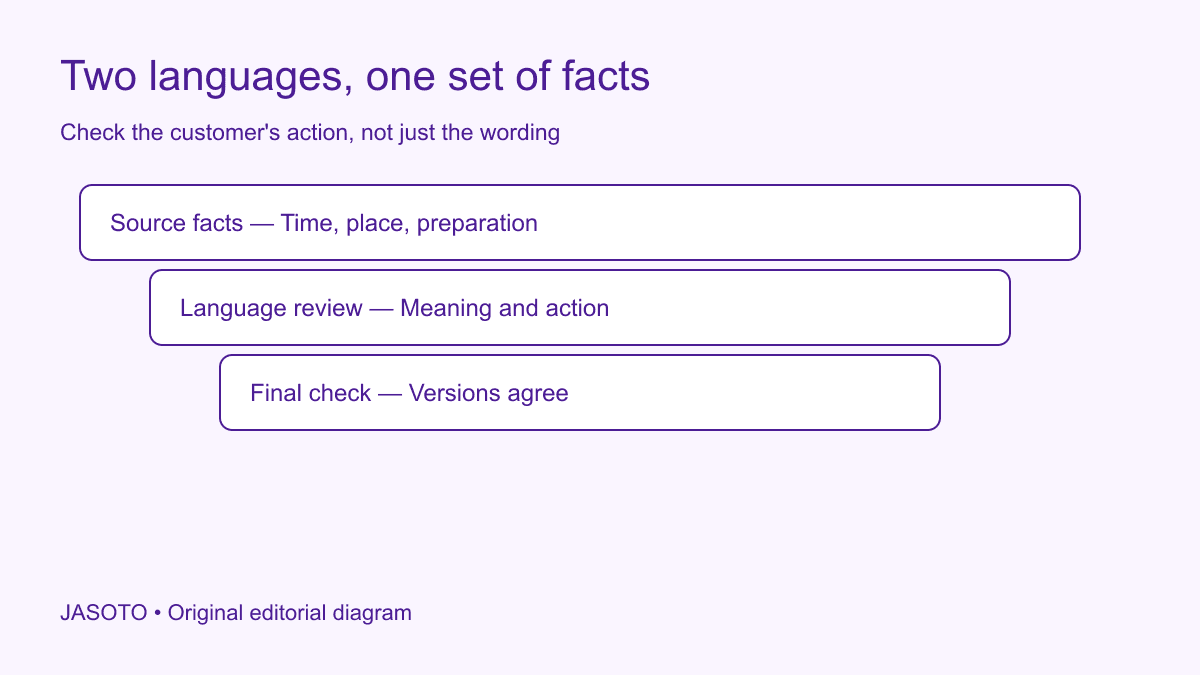
Original JASOTO editorial diagram. Its complete workflow is explained in the article; no actual customer outcome is depicted.
A bilingual appointment confirmation should give the same practical instructions in both languages: what is booked, when and where it happens, what preparation is required and how to ask a question or report a change. Approve those facts first, translate them for the intended reader and check the two versions together. Fluent wording is not enough if one message points to a different entrance or leaves out an important instruction.
This guide uses US English and focuses on ordinary service appointments. The workflow is an editorial recommendation, not a substitute for specialist translation in legal, medical or safety-sensitive situations. It does not provide a ready-made translation into a language that has not been specified. Instead, it shows how a business can prepare and review a useful bilingual message without multiplying inconsistent copies.
The practical answer
- Agree the appointment facts before translating the message.
- Keep names, addresses and booking references consistent.
- Check meaning and customer actions in both versions.
- Update all language versions when arrangements change.
Begin with a single appointment fact record
Create a short source record containing the service, date, start time, expected duration, location or joining method, booking reference and contact route. Include preparation instructions only when the provider has confirmed them. Mark anything unresolved before it reaches a translator. A reviewer cannot fix an uncertain appointment by choosing more elegant language, and a translation can make an unverified fact appear more authoritative than it deserves.
Name the person who can approve changes to the appointment. Keep a distinction between editable explanatory text and facts that must match a booking system. If the service name has an official version, record that too. When a source record changes, identify the changed field and who confirmed it. This prevents separate language drafts from drifting apart while several colleagues try to help with the wording in different email threads.
Ask what language the customer actually needs
Use the customer's stated preference where appropriate rather than inferring it from a name, address or nationality. A language can have regional conventions and vocabulary that matter for a particular audience. Tell the reviewer who will read the message and what the recipient must be able to do afterwards. “Help the customer find reception and confirm the time” is a more useful brief than simply “translate this”.
Be clear about the business's actual service capability. A translated reminder does not mean every staff member can conduct the appointment in that language. If an interpreter or bilingual colleague is arranged, confirm the details. If support is limited, explain the available route honestly. JASOTO languages offers a relevant place to explore language resources, while JASOTO businesses can help identify providers to discuss appropriate translation or interpreting support directly.
Make dates, times and references unambiguous
Avoid leaving a customer to guess the order of numbers in a date. W3C's date-format guidance discusses the ambiguity that can arise across locales. Use a readable date format suitable for each language while preserving the same actual date. If people may be in different time zones, identify the zone relevant to the appointment and check that calendar information agrees with the message.
Keep the booking reference unchanged unless the booking system explicitly requires another format. A translator should know which codes, product names and proper nouns are not ordinary prose. Check punctuation around references so an extra character is not copied into a lookup field. If a message contains a phone number, verify it through the business's actual contact record. Do not automatically convert or shorten it based on an assumption about where the recipient is located.
Keep the destination identifiable
Record the official address, venue name and useful arrival instructions. A landmark description can be translated, but the actual destination must remain recognisable to the customer, a driver and a map search. If a building has a separate visitor entrance, ask the provider for a clear description before translating it. Translating a vague instruction faithfully will still leave the reader unsure which door to use.
Where the appointment is online, check the link, platform name and joining instructions. Preserve the actual destination of a link rather than replacing it with a guessed localized URL. Explain any account or software requirement that has been verified. For an in-person appointment, customers can research travel on JASOTO, but the business should first provide the correct destination and time. A translation review is a good opportunity to discover that the original arrival instructions were incomplete for everyone.
Check preparation instructions as actions
Ask the reviewer to identify what the customer must bring or do, not merely whether sentences sound natural. “Bring a copy” can leave open whether a digital version is acceptable, while “arrive early” is unclear if no practical arrival time has been agreed. Resolve those questions with the service owner before finalizing either language. Do not invent extra preparation to make the message look more complete.
For higher-consequence instructions, use the appropriate subject specialist and review process. The method here does not establish that a general-language reviewer is qualified to approve technical content. Record the limits of the message: an appointment confirmation may point to separately approved instructions rather than restating them inaccurately. Keep the link and version correct. A short clear confirmation that refers to the right information can be more useful than a long message assembled from unreviewed fragments.
Review meaning with a second perspective
Give the reviewer the source facts, intended audience and purpose. Ask them to flag uncertainty instead of silently choosing between plausible meanings. A useful review can reveal that “consultation”, “assessment” or “service” has been used inconsistently in the original. Fix the source and then align both language versions. Otherwise the translation process merely preserves a confusion that the business already had.
Read the finished messages as practical tasks. Can the recipient identify the appointment, arrive or connect, prepare appropriately and ask a question? Do both versions describe the same conditions? Keep a simple record of who reviewed the language and who approved the facts. Those can be different people. Avoid treating a back-translation as automatic proof of correctness; it can help discussion, but an understandable final message still needs appropriate review in its own context.
Present both versions so people can use them
Label language sections clearly and keep their structure comparable. Avoid placing one language inside an image that cannot be selected or adjusted. On a web page, declare the appropriate language in the markup; W3C's language-declaration guidance explains how language information is expressed in HTML. That technical step does not replace reviewing the translation, but it is relevant to how tools interpret and present the content.
Check the actual channel: email, text message, booking portal or printed card. Long text may be cut off, links may be hard to recognise and a narrow layout may separate a condition from the instruction it qualifies. Test the complete message, not just a document that looks correct on the reviewer's screen. If a service uses separate messages by language, keep them connected to the same appointment facts rather than manually maintaining unrelated copies indefinitely.
Worked example: a changed entrance instruction
Imagine a training provider sending a confirmation in English and another language chosen by the customer. The appointment record initially says to use the main door. The venue later confirms that visitors must use a side reception entrance on the appointment day. This is an invented example. The organiser updates the source field and sends the changed instruction to the language reviewer, identifying exactly what needs revision.
The final checks compare the address, date, time, entrance and contact route in both versions. The organiser labels the new message as an update rather than assuming the recipient will notice a changed sentence. The staff member handling arrivals receives the same information. Nothing in this workflow guarantees that the customer will read the update, but it avoids the preventable problem of knowingly sending two contradictory sets of instructions under the same booking reference.
Maintain the message after it is approved
Keep an approved template for stable wording, but recheck appointment-specific details every time. Record which language versions need updating when the service, address, preparation or contact changes. Archive replaced versions so they are not accidentally reused. If a customer asks a recurring clarification question, review the source message and the relevant translation instead of blaming the reader for misunderstanding.
Maintain a short list of approved service terms and proper names with the template. Give it to future reviewers so routine wording stays consistent, while leaving room to flag a term that does not fit a new context. Consistency should support accurate meaning rather than prevent a necessary correction.
When multilingual communication becomes continuing work, explore relevant roles on JASOTO or discuss a suitable support arrangement with a provider. Use observed needs to decide the scope, rather than promising every language in advance. A good bilingual confirmation gives a customer an accurate next action and tells them how to get help. Its quality comes from factual agreement, appropriate language review and maintenance after changes, not from simply placing two blocks of text beside each other.
Put the guide into practice
- Create one approved appointment fact record.
- Identify the customer's required language and variant.
- Have an appropriate reviewer check the complete message.
- Test the date, address, preparation and reply route in each version.
Frequently asked questions
Can machine translation help with an appointment message?
It may assist drafting, but the business still needs to check the final message, especially dates, names, instructions and important conditions. Use an appropriate qualified reviewer where the subject demands one, and follow your information-handling policy.
Should I translate a street address?
Keep the official destination identifiable and check how the recipient should use it for travel or a map search. Explain an entrance in the reader's language where helpful, without silently changing the address or proper name.
Does a translated confirmation mean support is available in that language?
Only promise the support the business can provide. Say how the customer can ask a question and what language arrangements exist. A fluent message should not create an unsupported expectation about the appointment itself.
Explore JASOTO tools
Explore language resources while planning communication needs.
Find language service providers →Discuss appropriate translation or interpreting support directly.
Explore language and customer support roles →Consider staffing when multilingual communication is a continuing responsibility.
Research appointment travel →Check the confirmed destination before arranging a journey.
Continue with JASOTO
Compare your next step
Discover UK businesses, compare services and request written quotes before making a decision.