
Business Operations · UK Guide 2026
Create a Bilingual Handover for a Visiting Contractor
JASOTO · Updated 5 November 2026 · 1,611 words
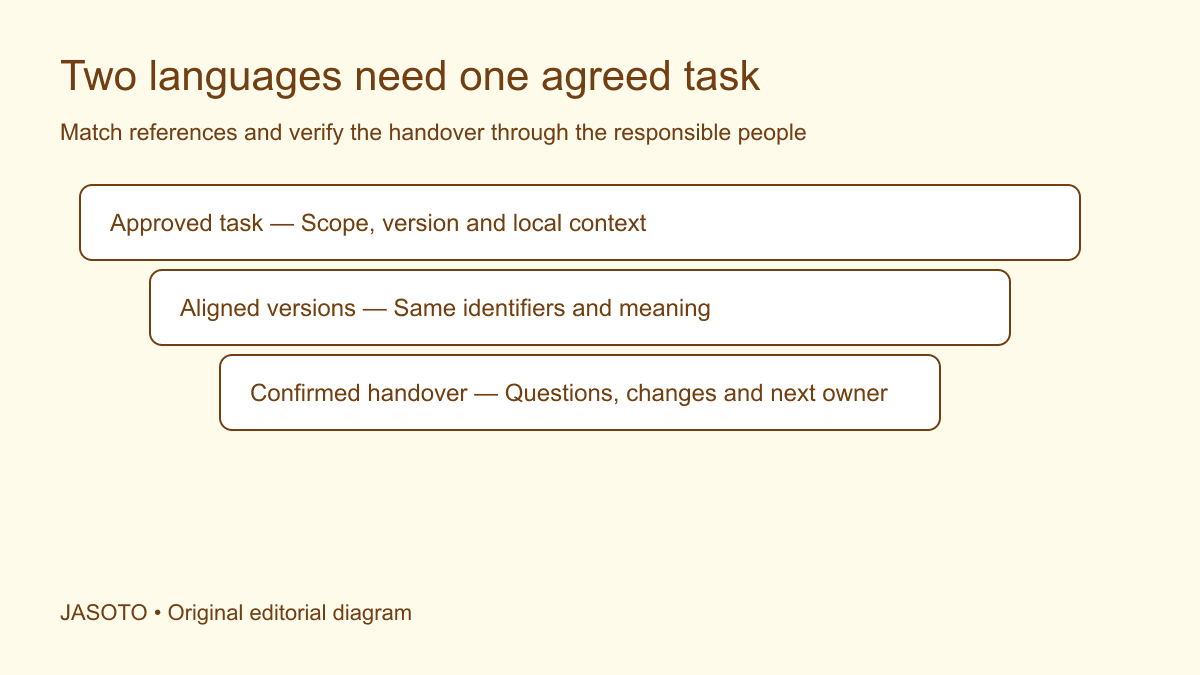
Original JASOTO editorial diagram. Its complete workflow is explained in the article; no actual customer outcome is depicted.
Create a bilingual contractor handover by starting with the approved task and local arrangements, linking both language versions through stable references and confirming how questions or changes reach the responsible person. Check understanding of the actual work context before treating the handover as complete. Two columns of translated text are useful only when they preserve the same current meaning and connect to a workable briefing process.
The focus here is information handover for a visiting contractor at a UK business. Specialist instructions, risk assessment, training and authorization belong with competent responsible people and the actual site arrangements. The fictional example uses administrative task references rather than technical operating steps, so the format can be discussed without inventing instructions for hazardous work.
The practical answer
- Use the approved job scope and local arrangements as the source.
- Align both languages with stable task and document references.
- Identify who answers questions and authorizes changes.
- Check understanding of the actual task before the handover is treated as complete.
Establish the job and authority boundaries
Confirm the agreed task, relevant location, date and person responsible for the handover. Identify who may authorize changes and where technical or safety questions go. A visiting contractor should not have to infer authority from whoever happens to meet them at reception. Record role names as well as individuals where that helps cover absences.
Separate the scope agreement from the handover sheet. The sheet should point to the approved documents and communicate the information needed at that stage. It should not quietly introduce extra work or altered terms. If the task itself is unclear, settle it with the responsible owner before translation, rather than hoping two versions will make an unresolved instruction more definite.
Identify the language support actually needed
Discuss the relevant language and communication requirements with the people involved through an appropriate process. Distinguish written reference material from a live briefing and the ability to ask questions. A contractor may read one language comfortably while needing different support for a technical discussion. Avoid assumptions based on nationality, name or an agency's general description.
Explore language assistance where suitable expertise is required. Assess the subject and consequences with the responsible owner, particularly for specialist or safety-sensitive content. The organizer should know what the provider is being asked to translate or interpret and who verifies the technical meaning. A general bilingual label does not establish that every necessary conversation is supported.
Gather the current approved source material
Collect the task brief, site information and relevant document references. Record versions and applicability. Include diagrams or location labels needed to understand the handover, using the site's actual approved information. Avoid supplying a folder of old and new instructions without identifying which documents govern the current task.
[HSE's contractor guide](https://www.hse.gov.uk/pubns/indg368.htm) addresses information, cooperation and management when businesses use contractors. Use the actual guidance and competent advice for the work. The bilingual handover is one communication aid within those arrangements; its preparation should preserve the responsible team's approved content and make unresolved questions visible.
Align the versions through task identifiers
Give each handover topic or action a stable identifier. Both versions can reference T03 for a particular administrative task even if the translated wording uses a different order. Link relevant documents and diagrams with the same identifiers. This helps people discuss a question without relying on matching page positions or pointing vaguely at a paragraph.
Choose a layout suited to the length and language pair. Parallel columns may be useful for a short sheet, while longer material may need separate clearly linked versions. Test readability and keep important relationships intact. Do not shrink one language until it is difficult to use merely to preserve an attractive symmetrical design.
Preserve local names and recognizable references
Check business, entrance, room and equipment identifiers against the approved local source. Explain labels in a way the contractor can match to signs or documents onsite. A translated room name that never appears in the building may create confusion even when it is linguistically correct. Keep the recognizable reference and helpful explanation connected.
For arrival planning, research journeys separately from authorized site access. The handover should communicate the actual entrance and check-in arrangement approved by the site team. Do not invent a route from a consumer map or send a contractor through guest instructions when the relevant requirements differ. Give arrival uncertainty a maintained contact.
Separate information from specialist instruction
Mark which parts describe administration, task scope, local arrangements and specialist material requiring particular competence. Have the appropriate reviewers check their domains. A language reviewer should flag an unclear technical meaning rather than select a plausible interpretation. The technical owner should settle that meaning and update the source where necessary.
Do not paraphrase approved safety-sensitive instructions casually to fit the handover. Use the responsible process and relevant qualified support. If material cannot be communicated adequately, raise that as an unresolved issue before the task proceeds under its actual authorization arrangements. The sheet should not disguise a missing briefing or required training with a completed translation tick.
Give questions and changes distinct routes
Explain whom to ask for clarification and who can authorize a change. These may be different people. A coordinator can locate information while another owner approves scope or technical decisions. Keep that distinction visible so a helpful answer is not mistaken for permission to vary the work.
Use a short query record when the issue affects the agreed task or documentation. Capture the reference, question, decision, authority and affected versions. Avoid resolving material differences through an unrecorded side conversation known to only one language group. Once settled, communicate the outcome to everyone who needs it through the established process.
Check understanding through a realistic scenario
Ask the receiving person to identify the task reference, current scope, relevant contact and next action using the handover. Use an ordinary question or change request rather than asking them to repeat a scripted sentence. The exercise should test the information and support route, not embarrass someone for an unfamiliar word.
Keep any practical competence assessment with the appropriate responsible people. Understanding the sheet's administrative route does not establish ability to perform specialist work. Record what was actually checked and what remains subject to other requirements. This keeps the acknowledgement accurate and gives the team a useful basis for resolving gaps before treating the information transfer as finished.
Work through a fictional document-delivery handover
Imagine a contractor visiting to deliver and position approved display materials. The bilingual handover identifies the current task, destination and local coordinator using stable references. During the briefing, the contractor asks whether an additional room is included. The coordinator checks the scope owner instead of treating the question as an automatic addition to the task.
The owner confirms the approved scope and the record is updated in both versions. The receiving person can find the decision and explain the next step. This fictional example illustrates authority and information alignment. It provides no handling method, installation instruction or safety approval for real display work, which remains with the actual competent team.
Record receipt and open issues accurately
Define what the handover acknowledgement means. It may record that specified information was received and particular questions discussed. Avoid vague declarations that appear to certify every aspect of the work. Record unresolved matters with owners and the relevant consequence through the actual site process.
If the receiving contractor team changes, identify whether another handover is required. A company contact receiving a document does not establish that the people arriving have it. Confirm the operational recipient and current version where appropriate. Keep sensitive personal or site information controlled rather than circulating every working note to every participant.
Control updates between arrival and the next shift
Decide how a revised task reference or local contact reaches people already working from printed copies. A corrected master file may leave an earlier version in the contractor's folder or at the receiving desk. Use the site's actual change process to withdraw or mark obsolete material and confirm that affected people know which instruction is current.
Keep the update's authority and effective point visible in both languages. If the person who gave the original briefing leaves, the next coordinator needs enough context to continue without reconstructing an informal conversation. Record the changed reference, approved meaning and open questions, and make the incoming owner accept the handover through the agreed workflow. This is particularly useful when a language provider is no longer onsite: the team should know how to obtain appropriate clarification rather than improvising an unverified translation under time pressure.
Check completion language does not overstate acceptance
Review labels such as done, checked and accepted with the people using them. They may describe different stages: a task performed, information reviewed or a deliverable approved by an authorized owner. Keep the distinction in both versions. A translated completion tick should not imply approval of scope, quality or payment when the actual record only confirms that a document was received.
Close the task and maintain the reusable structure
At completion, transfer relevant status, outstanding questions and agreed next actions to the appropriate owner. Record returned documents or equipment where that forms part of the task. Keep the factual outcome distinct from assumptions about quality or performance. A completed handover sheet does not itself establish that every deliverable was accepted.
Review which labels, references or questions were difficult to use. Research contractor or language providers against the actual need, and consider site coordination roles when continuing responsibility requires capacity. Preserve earlier versions and a correction path. The reusable result is a clear structure that links two languages to one approved task and keeps questions, authority and follow-through visible.
Put the guide into practice
- Confirm the task, source version and responsible people.
- Separate general handover information from specialist instructions.
- Arrange appropriate translation and factual review.
- Rehearse a question and a change request.
- Record acceptance, open issues and the next owner.
Frequently asked questions
Does a signed bilingual sheet prove the contractor understood everything?
A signature records a particular acknowledgement, whose meaning should be clear. It does not automatically demonstrate comprehension or competence for every task. Use the appropriate briefing, training and practical checks required by the actual work, with questions and unresolved issues directed to responsible people.
Can a bilingual colleague translate technical instructions informally?
Assess the actual task and required competence with the responsible owner. Conversational ability does not establish suitability for safety-sensitive or specialist material. Arrange appropriate qualified support, preserve approved technical meaning and do not leave important uncertainty to an unrecorded informal explanation.
Which language should take priority if the versions conflict?
Set the document and contractual arrangement through the appropriate owner and advice before use. Operationally, a material conflict should be raised and resolved rather than asking the contractor to guess. Record the correction, update affected versions and confirm the revised meaning through the agreed process.
Explore JASOTO tools
Find suitable services for a clearly defined handover or language task.
Explore site coordination roles →Assign responsibility for briefing, questions and handover records.
Coordinate contractor visits →Keep arrival planning aligned with the approved site arrangement.
Explore language assistance →Consider appropriate expertise for bilingual briefing material.
Continue with JASOTO
Compare your next step
Discover UK businesses, compare services and request written quotes before making a decision.