
Jobs & Careers · UK Guide 2026
Turn a Broad Job Ad Into Useful Research Questions
JASOTO · Updated November 5, 2026 · 1,697 words
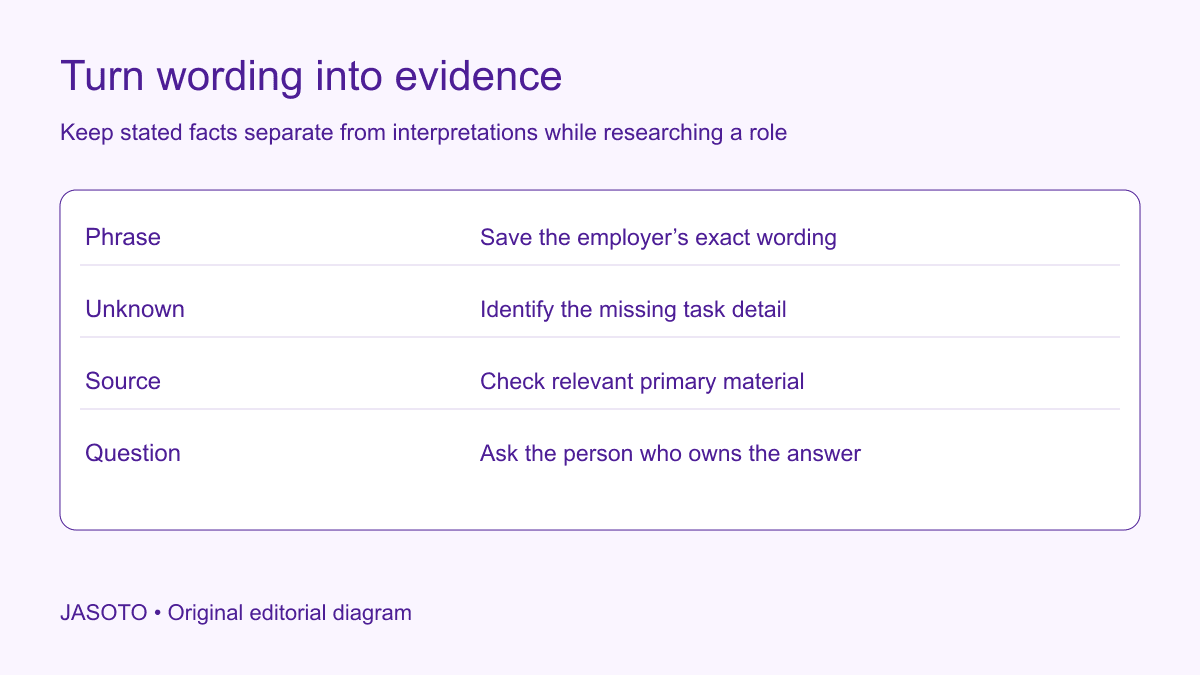
Original JASOTO editorial diagram. Its complete workflow is explained in the article; no actual customer outcome is depicted.
Turn a broad job ad into useful research questions by separating its stated facts from the responsibilities you still need to understand. Translate phrases such as “support growth” into questions about the work, decisions and evidence the employer expects. Research what can be verified publicly, then reserve role-specific uncertainty for the recruiter or hiring manager. Do not write an application around an imagined job simply because the advertisement uses a familiar title.
This original guide is for US applicants researching a vaguely described role. For relevant public companies, the SEC's EDGAR search provides access to company filings; those records can add business context, but they do not define a particular vacancy's day-to-day responsibilities. The question-building framework below is editorial advice. Confirm the current job details with the employer and avoid treating public research as a guarantee about team conditions or future employment.
The practical answer
- Save the actual employer posting.
- Separate facts from plausible interpretations.
- Ask about tasks and authority behind broad phrases.
- Use business research as context, not proof.
Preserve the actual advertisement first
Save the job description or an appropriate reference, publication date and application deadline where available. Identify which version you are using, especially when a role appears on several sites. The employer's current application instructions should guide the submission. A short third-party summary can omit responsibilities or conditions that appear in the full posting, so locate the original employer version where possible before deciding what is unknown.
Highlight exact statements rather than paraphrasing them into stronger claims. “May travel” does not establish a travel frequency. “Assist with budgets” does not establish budget ownership. Keep the original phrase beside your question so you can see where the ambiguity began. This prevents your notes from gradually turning a possibility into a requirement or a support task into a management responsibility as you prepare the application.
Sort facts, implications and unknowns
Create three small groups. Facts are details the posting explicitly states. Implications are plausible interpretations you should not yet rely on. Unknowns are details needed to understand the work or assess practical fit. For example, an ad may state that the role supports several stores. It may imply contact with local managers, but it does not establish which stores, how often visits occur or who controls the schedule.
Keep the distinction visible as research progresses. A company page showing a national network adds context, but it does not prove that this vacancy covers the entire network. A recruiter can confirm the actual territory or say it is still being determined. Record either answer accurately. The value of the exercise is to reduce guessing before you invest in a tailored application or interview, rather than assemble enough notes to create an illusion of certainty.
Translate vague outcomes into task questions
Take one broad phrase at a time and ask what activity would produce it. “Improve customer experience” might involve reviewing feedback, writing support material, resolving complaints or redesigning a process. These require different evidence. Ask which activities occupy the role and what a typical output looks like. A question grounded in the phrase is more useful than asking the interviewer to explain the whole job from scratch.
For an invented operations analyst ad, “drive efficiency” becomes “Which recurring process would this person examine first, and what information would they use?” A second question asks who decides whether the proposed change proceeds. This separates analysis from implementation authority. You can prepare evidence of a comparable skill while remaining explicit that the employer's actual process is not yet known. Avoid claiming experience with a task merely because your interpretation of the ad made it seem likely.
Research the employer's business context
Read the employer's own description of its products, services, customers and operating locations. Note the date and scope of the material. A corporate page can explain what the organization does without revealing how a particular team is structured. Use that context to make your questions specific: “Does this position support the service business, the product business or both?” is more informative than a general request for company background already available online.
For an appropriate public-company employer, EDGAR may provide filings relevant to understanding its business. Search by the correct company identity and read only the sections needed for your research. Do not confuse a similarly named business or a parent entity with the hiring team. A filing's risk discussion is not evidence that a particular employee will face the described event, and financial research should not become an unsupported prediction about the vacancy's security or future.
Identify decision authority and handoffs
Look for verbs such as approve, recommend, coordinate, own and support. Ask what decisions sit with the position and which require someone else's approval. Titles can conceal different levels of authority across employers. A “manager” may manage a process without supervising employees, while an “associate” may carry substantial independent responsibility. The specific boundary matters more than a generic hierarchy inferred from the title alone.
Map the likely handoffs described in the posting and ask where the role receives work and where it passes work onward. If an ad mentions partnership with sales, clarify whether the person prepares information, joins client discussions or owns a service commitment. Do not assume the most senior interpretation simply because it would make your application sound stronger. Accurate task boundaries help you choose relevant evidence and evaluate whether the role matches your interests.
Turn practical uncertainty into neutral questions
List the working arrangements that materially affect your decision: location, schedule, travel, equipment, reporting relationships and any stated onsite requirements. Ask for the current arrangement rather than making an accusation about vague wording. “Which locations would this role attend during an ordinary month?” invites a factual answer. “Why are you hiding the travel?” introduces a conclusion that the available evidence may not support.
Where a requirement affects your ability to proceed, clarify it early through the appropriate contact. You do not need to postpone every practical question until a final interview. Equally, avoid sending an unprioritized list of every conceivable uncertainty before reading the information already supplied. Choose the details that change your decision and explain why you need the answer where that helps. Handle individual support or accommodation questions through the employer's appropriate process rather than putting private circumstances into a public discussion.
Choose questions for the right person
A recruiter may be able to confirm process, location and published conditions, while the hiring manager can explain priorities, decisions and examples of work. Use the contact route given in the posting. If the first contact cannot answer a specialist question, ask who owns it rather than repeatedly pressing them for a guess. A clearly routed question is more useful than collecting inconsistent informal answers from several employees.
Prepare a short prioritized list for each stage. Early questions can establish whether the role is workable; later questions can explore the difficult parts of the task. Combine related questions without creating a long multi-part speech. For example, ask about the first project before asking how success will be reviewed. Give the interviewer space to answer, then clarify the specific gap that remains. Research should support a conversation, rather than become a test of whether the employer can recite your entire checklist.
Connect verified requirements to your evidence
Once a responsibility is clear, select a factual example from your work, study or other appropriate experience. State what you did and which capability it demonstrates. Keep the example proportionate to the requirement. If the employer needs someone to prepare a report, evidence of producing a clear accurate summary may be relevant even if your previous industry differed. Do not claim to have owned the employer's exact process unless that is true.
For unresolved responsibilities, prepare a transferable example and a question rather than pretending the match is complete. An applicant could say, “I have coordinated handoffs between teams; I would like to understand which handoffs this position owns.” This keeps the evidence useful while respecting uncertainty. A broad advertisement does not require a generic application. It requires carefully chosen facts, with the remaining assumptions made visible rather than quietly built into your claims.
Review answers for remaining ambiguity
After a conversation, record the answer, who supplied it and which question remains open. Distinguish a current working arrangement from a possibility under discussion. “The team may add another office” does not establish that travel to it will be required. If two answers conflict, raise the discrepancy neutrally through the established contact and ask which information should guide your decision.
Use job listings to compare opportunities, but keep employer-specific conclusions tied to each actual posting and contact. A business directory can help identify relevant organizations or services; it does not verify the conditions of a vacancy. If an interview or site visit is proposed, confirm the location and purpose before researching travel. Keep the application decision connected to confirmed facts instead of allowing enthusiasm about a recognizable employer to override unresolved practical questions.
Decide what the research has and has not established
Summarize the role in a few factual sentences: its main tasks, decision boundary, working arrangements and next application stage. Then list the remaining uncertainties that matter. You may decide to continue, ask another question or stop investing in the application. None of those choices requires proving that the employer is good or bad. The purpose is an informed next step based on evidence relevant to your circumstances.
If your original interpretation proves wrong, revise the evidence and questions rather than forcing the application to fit. Keep the saved posting and restore the factual baseline when notes become speculative. That is the rollback for an overcomplicated research exercise: return to the actual words, remove unsupported assumptions and ask the smallest useful unanswered question. A broad ad becomes more manageable when each vague phrase leads to a verifiable fact or a specific conversation, instead of a larger pile of guesses.
Put the guide into practice
- List decision-critical unknowns.
- Research the correct employer entity.
- Route questions to the right contact.
- Match verified requirements to factual examples.
Frequently asked questions
How much employer research is enough?
Research enough to understand the business context and identify the questions that affect your application. Focus on relevant current primary material. More pages do not necessarily improve understanding, especially when they concern another entity, an older strategy or a different team from the one hiring.
Can public company filings explain what the role will be like?
They can provide business context for an appropriate employer, but they do not establish a team’s daily tasks, manager behavior or future conditions. Use the information to ask better questions. Confirm the actual vacancy responsibilities and working arrangements with the recruiting contact or hiring manager.
Should I apply if some responsibilities remain unclear?
Decide based on how important the uncertainty is to your next step. You can ask a targeted question, continue with clearly relevant evidence or choose not to invest further. Avoid filling the gap with invented assumptions merely to produce a more confident-looking application.
Explore JASOTO tools
Discover providers and check support for your specific task.
Explore roles and responsibilities →Consider the practical responsibilities involved when recruiting or joining a team.
Plan work-related travel →Research a journey when joining, training or meeting colleagues in person.
Continue with JASOTO
Compare your next step
Discover UK businesses, compare services and request written quotes before making a decision.