
Property & Moving · UK Guide 2026
Building Survey Cost UK: Level 2 & Level 3 Prices
JASOTO · Updated October 6, 2026 · 1,309 words
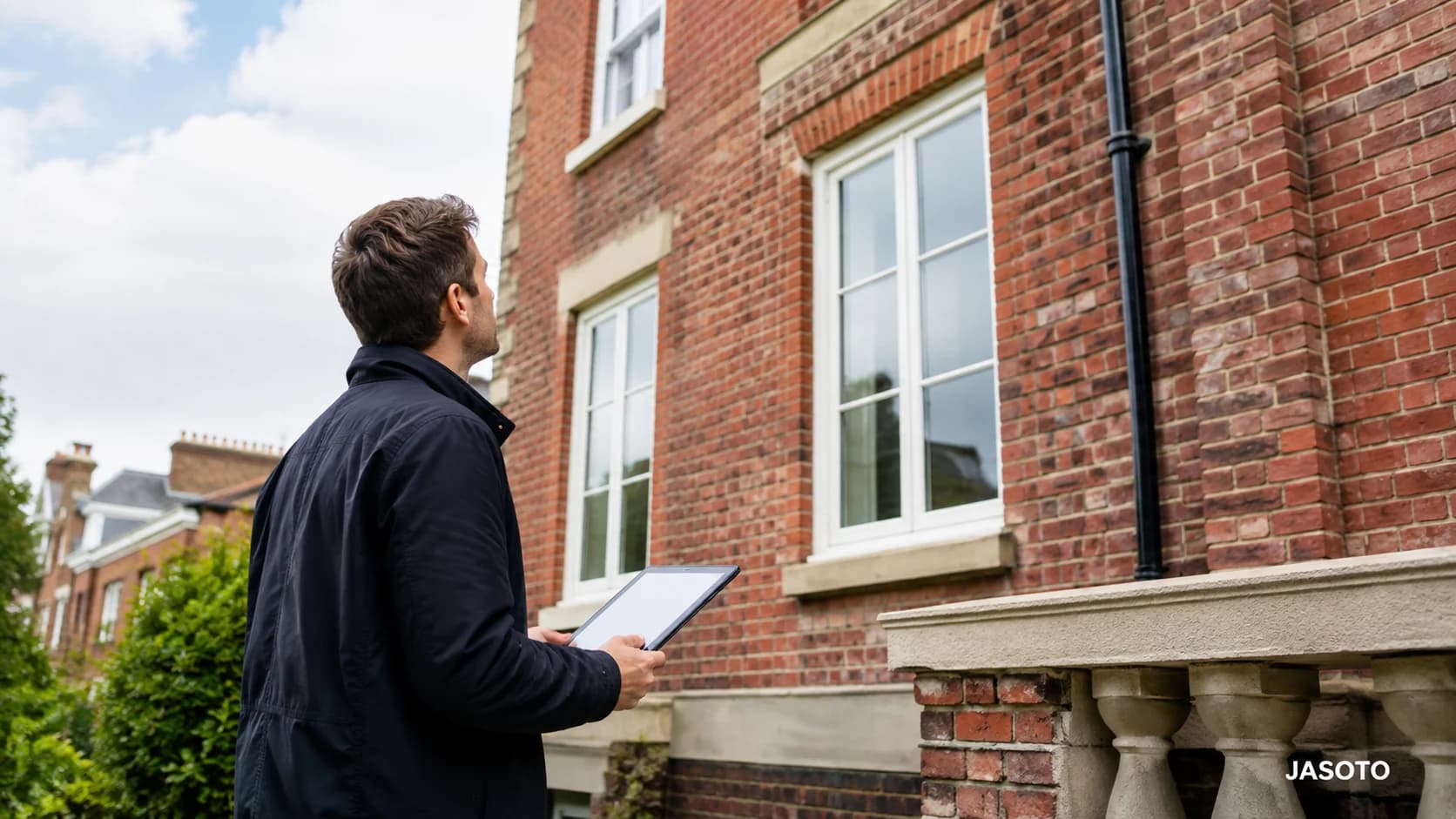
AI-generated illustration; it does not show a customer project or a tested product.
A building survey budget starts with the service the property needs. Ask a surveyor to recommend the level for the building, then compare written quotes for the same inspection and report scope.
This guide gives named provider price examples, explains important limits and extras, and helps you prepare a quote brief. The figures are reference points rather than a national average or a quote for your home.
Building survey fees at a glance
- CJ Bloor publishes £595–£845 for Level 2 and £845–£1,195 for Level 3, including VAT, for its stated regional market.
- Max Dixon Surveying advertises Level 3 from £700 including VAT; a starting price is not a fixed fee for every property.
- Confirm inspection scope, valuation, follow-up discussion and separately priced investigations before booking.
How much do Level 2 and Level 3 surveys cost?
CJ Bloor’s published guide gives £595–£845 including VAT for a Level 2 survey and £845–£1,195 including VAT for a Level 3 building survey. It describes these as its guide ranges across the North West, Yorkshire and West Midlands, with an individual fee depending on the property. These are provider figures, not a UK-wide average or JASOTO prices.
Ask each provider for a final payable amount for the address and agreed service. Record whether the fee includes VAT, what is included and any conditions that could change it. A different region or property can produce a different quote.
Source: CJ Bloor: published regional survey fee guide. Check the source for current guidance and terms.
A second provider example: what a starting price includes
Max Dixon Surveying’s Level 3 page advertises prices from £700 including VAT. It says its home surveys include a 30-minute call to discuss the report, and that a valuation can be added for an extra charge.
Treat “from” as a starting price, not a promise that your property will cost that amount. Use this example to ask about service inclusions rather than treating two providers’ headline prices as equivalent offers. Confirm availability, coverage and your property-specific fee directly.
Source: Max Dixon Surveying: Level 3 price and inclusions. Check the source for current guidance and terms.
Which survey level should you ask for?
RICS describes Level 1 as a basic condition report for conventional homes in good condition, Level 2 as more detailed advice for conventional properties in reasonable condition, and Level 3 as the most comprehensive option for older, altered, unusual or run-down buildings and planned major works.
Level 2 is available as survey-only or survey-and-valuation. Discuss the building and your concerns with the surveyor; the cheapest level is not automatically the right service. Request the reason for the recommended level before comparing fees.
Source: RICS: home survey levels and choices. Check the source for current guidance and terms.
What does a Level 3 survey leave outside its scope?
RICS’s Level 3 scope guidance describes a detailed assessment with access and safety limits. It says service installations and appliances are not tested, although their normal operation is observed where appropriate. A survey should not be treated as a comprehensive electrical, heating or other specialist test.
The guidance says the report gives general recommendations on priorities and timescales for work; an indication of repair costs can be agreed as an additional service. Ask whether cost advice is included in your engagement rather than assuming every report comes with a priced repair schedule.
Before booking, ask how the surveyor will record inaccessible areas and what happens if access is unavailable on the day. Identify any specialist investigation you already need and ask whether it is a separate instruction.
Source: RICS: Level 3 inspection and report scope. Check the source for current guidance and terms.
Give every surveyor the same property information
Send the address and a property listing or floor plan if available. Describe the approximate age, construction, size, extensions, alterations and any visible concerns. Include the work you are considering so the provider can decide whether the requested service is suitable.
State your preferred inspection and report dates, together with any transaction deadline. Ask when those dates can be confirmed and who will arrange access with the seller or agent. Avoid relying on a general turnaround promise when you need a specific appointment.
- Name any areas you particularly want discussed in the report.
- Describe known restrictions on access and occupied or furnished areas.
- Identify outbuildings or other features you expect to be considered.
- Ask who will inspect the property and who will answer your report questions.
Compare the written service, not just the headline fee
Make a simple comparison for each quote: recommended level, inspection, written report, optional valuation, cost advice, follow-up discussion, delivery date and total payable amount. Record exclusions beside the price so they remain visible when you choose.
Ask for the terms of engagement and a sample report. Check the provider’s stated professional credentials and complaints process using the relevant professional register rather than relying only on badges in an advertisement. Ask about experience with the construction and concerns you have described.
If a report recommends further investigation, ask what question that investigation should answer and whether the surveyor offers it under a separate engagement. Obtain written prices and scope before commissioning additional work; a recommendation is not an included appointment.
An editable building survey quote brief
Use this brief with your property details: “Please recommend an appropriate home survey for [address/property description], considering [known concerns] and [planned work]. Please explain the proposed level, inspection limits, report contents and delivery date. Confirm whether valuation, repair-cost advice and a follow-up discussion are included, and give the final payable fee with VAT treatment, extras and booking terms.”
Keep replies with the provider’s proposed terms. If two quotes differ, ask each provider to explain the difference in deliverables. Decide on the suitable service before reducing the comparison to price alone.
Illustrative arithmetic only: quote A is £800 with a separately agreed £150 valuation, while quote B is £900 including that same valuation. If the rest of the service and tax basis match, the comparable totals are £950 and £900. These invented figures show how to compare scope; they are not predicted survey fees.
Build your survey budget from confirmed quotes
Use one booking for one complete survey package in the calculator below. Enter the final payable quoted fee and add only separately quoted extras excluded from it. Do not enter a whole-package price and add its included report or discussion again.
The calculator adds the figures you provide; it does not generate a market estimate. Keep separately commissioned investigations and future repair work visible in your wider property budget, and confirm their prices independently.
- Use the same VAT basis when comparing fees.
- Separate included services from optional additions.
- Check cancellation, rebooking and payment terms.
- Keep the survey fee distinct from repair costs identified later.
Calculate your quoted budget
Use one booking per complete survey. Enter the final payable package price and only excluded extras; this calculator does not generate a market estimate.
Enter figures from your quote. Use amounts including VAT consistently. Leave extras blank if none apply. These fields stay in your browser.
Calculated total
Enter valid quoted figures
This is arithmetic using your figures, not a market estimate. Include separately charged work once and check provisional costs with the provider.
Before instructing a surveyor
- Confirm the recommended level and why it suits the property.
- Read the inspection scope, access limits and terms of engagement.
- Check valuation, repair-cost advice and follow-up discussion inclusions.
- Agree the final payable fee, report date and access arrangements.
- Verify professional credentials and how questions or complaints are handled.
Frequently asked questions
How much does a Level 3 building survey cost?
CJ Bloor publishes a regional guide of £845–£1,195 including VAT, while Max Dixon Surveying advertises Level 3 from £700 including VAT. They are provider examples with different pricing formats, not a UK average. Request a fee for your property and agreed scope.
Is Level 3 always necessary?
RICS describes it as suitable for older, unusual, altered or run-down properties and major planned works. Discuss your building with a surveyor to select the appropriate level.
Does a building survey include a valuation?
Confirm it in the engagement. RICS distinguishes survey-only and survey-and-valuation Level 2 services; Max Dixon advertises valuation as an additional-cost option with its Level 3 service.
Does Level 3 test all the services?
No. RICS’s Level 3 scope says services and appliances are not tested. Ask the surveyor which separate specialist checks your concerns may require.
Does the budget calculator estimate a UK survey price?
No. It totals the quoted package and separately priced extras you enter. Use one booking per complete survey, a consistent tax basis and no duplicated inclusions.
Continue with JASOTO
Compare your next step
Discover UK businesses, compare services and request written quotes before making a decision.