
Travel · UK Guide 2026
Separate Business Bookings From Optional Leisure Plans
JASOTO · Updated 5 November 2026 · 1,610 words
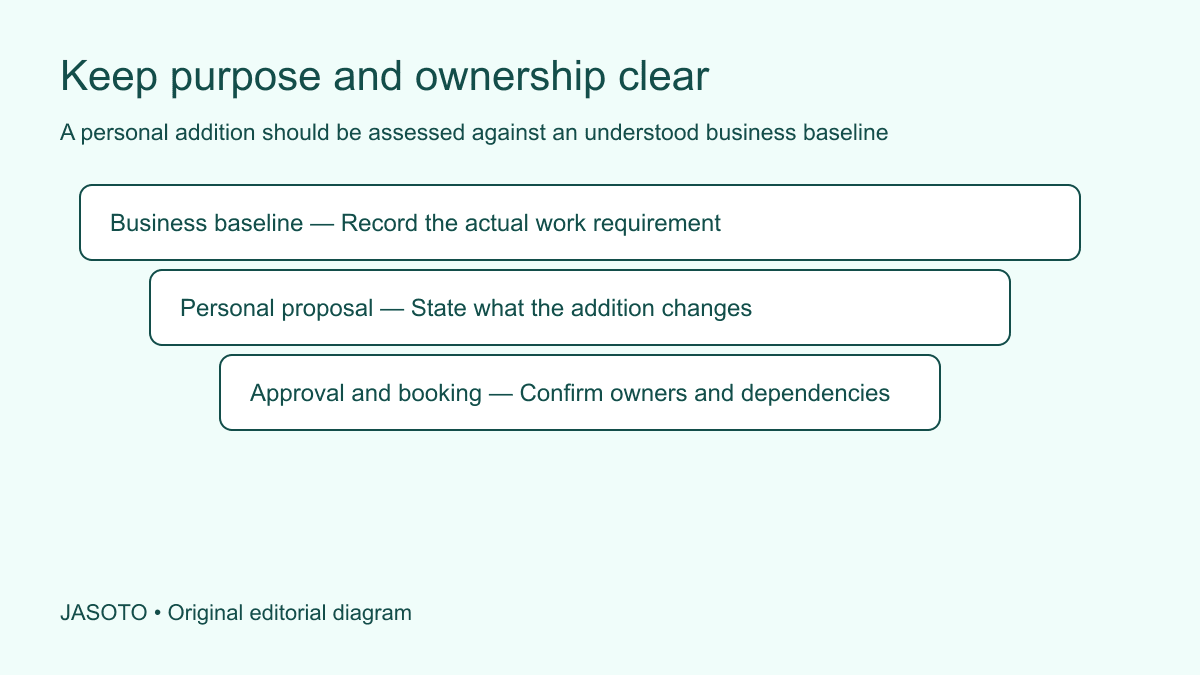
Original JASOTO editorial diagram. Its complete workflow is explained in the article; no actual customer outcome is depicted.
Separate a business booking from optional leisure plans by recording the required work itinerary first, then identifying the personal addition, who arranges it and what it changes. Confirm the organization's approval process before altering a work booking. Keep the business appointment, provider references and responsibility for changes clear enough that the work trip remains understandable if the leisure plan is cancelled or revised.
This guide provides an original coordination method for UK work trips. HMRC guidance treats business and private travel through different rules, so obtain the appropriate finance or professional advice for a specific arrangement. The planning method below helps collect accurate facts for that decision. It does not decide tax treatment, reimbursement, insurance coverage or employment obligations from the simple label attached to a journey.
The practical answer
- Define the business itinerary before the addition.
- Describe the proposed change factually.
- Separate business approval from provider permission.
- Keep ownership and cross-boundary dependencies clear.
Establish the required business itinerary first
Write the work purpose, confirmed appointment, necessary travel and intended return without the optional extension. Identify the decision owner and current booking status. This gives the discussion a factual starting point. A personal plan should not become part of the assumed business requirement merely because it appears in the same travel calendar or uses the same destination.
Keep the business facts specific. The requirement may be attending a meeting at a particular venue and time, while another proposed activity is optional. Ask the responsible owner to clarify uncertainty before comparing travel arrangements. A work trip that has not yet been defined is difficult to separate from leisure because nobody knows which dates or routes are necessary. Establish the baseline so later questions concern actual differences rather than a vague idea of what the employer probably needs.
Describe the personal addition accurately
State the proposed change in dates, route, companions or accommodation, using only the details relevant to the approval process. A weekend extension differs from adding an evening activity within an otherwise unchanged itinerary. A companion's travel creates different booking and responsibility questions from a solo traveler returning a day later. Avoid treating every personal addition as though it has the same practical effect.
Keep private detail proportionate. The business decision owner may need to understand which part of the itinerary changes and who will arrange it, without receiving a complete personal holiday plan. Use the appropriate process and ask what information is actually required. The objective is transparent coordination, not unnecessary disclosure. Where the proposal remains only an idea, label it accordingly so accommodation or transport researchers do not accidentally treat it as an instruction to book.
Ask what approval is needed before changing bookings
Consult the organization's actual travel and expense arrangements and identify the responsible approver. Ask how a proposed personal addition should be considered and what supporting facts are needed. Do not assume a manager's general encouragement to enjoy the destination authorizes a changed business booking. A clear decision should identify the arrangement being approved and any relevant conditions.
Keep provider permission separate from business permission. A travel company may allow a change while the organization has not authorized the cost or itinerary. Conversely, business approval does not establish availability or change rights under the provider's terms. Both questions may need an answer before the plan is actionable. Record the actual approvals and open conditions rather than combining them into a single “extension agreed” note that leaves ownership uncertain.
Compare the requested change on matching facts
Where the process requires a comparison, use the same traveler, dates and relevant service assumptions for the business baseline and proposed option. Verify current provider information directly and label the point at which it was checked. A quote is time-specific research, not a guaranteed future price or a booking. Keep complete relevant cost categories visible through the organization's requested format.
Avoid deciding an allocation or tax method yourself if that belongs to finance or a professional adviser. Provide the factual comparison and the question to be resolved. For an invented conference trip, the employee proposes returning after a personal weekend rather than immediately after the event. The record identifies the actual travel change and current quotations as required by the process. It does not claim that matching headline fares automatically settle every approval, tax, coverage or duty question.
Make booking ownership explicit
Identify who books the required travel and who books the optional activity or extension. Keep each arrangement's actual provider reference and current status. If one booking contains both elements, ask the responsible owner and provider how the arrangement should be documented and changed. Do not create a false impression of separation by giving one reservation two labels without understanding its real conditions.
Clarify who contacts the provider when a detail changes. A traveler, business coordinator and personal companion making independent amendments can produce conflicting instructions. Use an agreed route and update the maintained record. Keep sensitive confirmation information through the appropriate channel. The business itinerary can identify that a personal segment exists without distributing private booking details to colleagues who only need the work arrival and departure requirements.
Check the handoff between work and personal time
Describe the point where the required business activity ends and the optional arrangement begins, according to the actual agreed plan. Include any equipment, documents or access responsibility that continues beyond the meeting. A traveler carrying business materials may need an appropriate handling arrangement during an extension. Ask the responsible owner rather than assuming personal storage or use is automatically approved.
Keep the discussion factual and avoid making legal or insurance conclusions from a calendar boundary. The relevant obligations and coverage depend on the actual arrangements and professional or policy advice. The planning record should state what the traveler will do, which items remain in their care and what question needs an answer. This supplies useful information to the decision owner without pretending a simple heading marked “leisure” resolves every consequence of a combined trip.
Keep companions and shared services clear
If another person joins a personal segment, distinguish their bookings from the business traveler's requirements. Confirm actual passenger numbers for any shared service and follow the organization's process for a change. A transfer or room confirmed for one traveler should not be assumed to cover another person. Ask the provider about the relevant conditions and route the business approval separately.
Handle personal contact and identity information through appropriate channels. The business coordinator should receive what is needed for their task, rather than a full set of companion documents by default. If a service must be shared, make the practical arrangement explicit and record who owns it. This prevents a personal addition from creating an unnoticed capacity or responsibility issue in a work booking while preserving the relevant distinction between the two purposes.
Plan for changes to either part
Ask what happens if the work appointment moves, the personal activity is cancelled or the traveler needs to return differently. Check the actual provider terms and approval route. Do not assume cancelling one segment leaves every other booking unaffected. The dependency can run in either direction, especially when arrangements share a transport reservation or accommodation period.
Agree who is informed when a personal change affects work arrival, equipment or an approved return. Keep the message focused on the practical consequence. A personal activity that changes without affecting the work plan may require a different level of information from a revised arrival that threatens the appointment. Follow the actual organization and provider arrangements rather than inventing a universal notification rule. The important point is that material dependencies have owners and a clear way to be reviewed.
Maintain two understandable views
Keep a concise business itinerary showing the required appointments, approved arrangements, contacts and current status. Maintain personal planning details separately where appropriate. If an essential dependency crosses the boundary, show it accurately without obscuring it. The business record should remain usable for the host or coordinator even if they have no reason to know the details of optional leisure activities.
Use travel research to explore possibilities while checking actual terms with the providers. A service discovered through business listings remains an option until suitability and booking are confirmed. If combined-trip coordination is a recurring task, describe the responsibility accurately in relevant roles, including when finance or another approver owns the decision. A helpful coordinator organizes facts and questions; they should not quietly become the authority for every personal, financial and contractual consequence of the arrangement.
Review the facts before committing
Check that the business baseline, proposed addition, booking ownership and approval are aligned. Ask the appropriate finance, insurance or other responsible contact to resolve material questions before treating the combined itinerary as ready. Keep a proposal distinct from confirmation. The traveler should know which parts can proceed and which remain dependent on a decision or provider response. Record the actual answer in the maintained plan, including any condition that changes who can authorize the next booking step.
If the optional plan becomes too entangled with the work requirement, return to the agreed business baseline and reconsider the addition through the proper process. Preserve accurate bookings and avoid an unapproved change merely because planning effort has already been invested. After travel, keep the records needed through the organization's arrangements and close unresolved questions with the responsible owner. A useful separation leaves the work purpose, personal choice and actual commitments traceable, without assuming that one label or a convenient calendar view settles the decisions that belong elsewhere.
Put the guide into practice
- Check the actual travel and expense process.
- Collect matching current facts if requested.
- Resolve professional or policy questions appropriately.
- Review changes before committing to the combined plan.
Frequently asked questions
Does paying personally for an extension settle every issue?
It establishes an important fact, but approval, provider conditions, coverage and tax or employment questions may still need the appropriate review. Describe the actual arrangement and follow the organization’s process. Do not assume a payment label resolves every consequence of a combined trip.
Should the business itinerary include my whole leisure plan?
Keep the information proportionate to the work requirements and actual approval process. Show any dependency that affects business arrival, departure, equipment or responsibility, while maintaining unrelated personal detail separately through appropriate arrangements.
What if the business appointment changes after personal plans are booked?
Review the dependency with the responsible business owner and relevant providers using the actual terms. Do not assume either part can be changed without affecting the other. Update confirmed arrangements and keep proposals visibly separate until the necessary decisions are made.
Explore JASOTO tools
Discover providers and check support for your specific task.
Explore roles and responsibilities →Consider the practical responsibilities involved when recruiting or joining a team.
Plan work-related travel →Research a journey when joining, training or meeting colleagues in person.
Continue with JASOTO
Compare your next step
Discover UK businesses, compare services and request written quotes before making a decision.