
Global Business · UK Guide 2026
Prepare an Interpreter Brief for a Business Meeting
JASOTO · Updated 5 November 2026 · 1,602 words
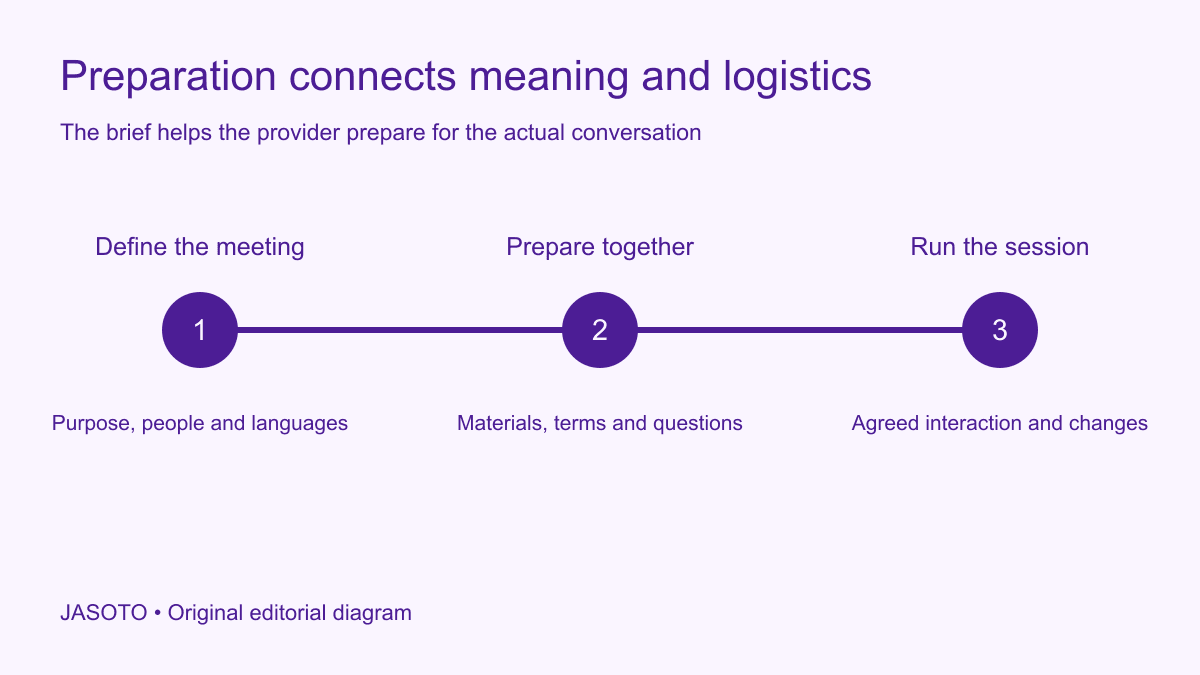
Original JASOTO editorial diagram. Its complete workflow is explained in the article; no actual customer outcome is depicted.
Prepare an interpreter brief by explaining the meeting's purpose, who will participate, the language needs and how the conversation will work. Share relevant materials and terminology through an appropriate process, then confirm logistics and interaction with the provider. A booking that gives only a language, date and video link leaves important preparation to chance, particularly when the discussion involves technical terms or decisions.
This guide helps a UK business organize an ordinary interpreted meeting. It uses a fictional supplier discussion to illustrate the brief. Specialist legal, medical or other consequential settings need appropriately qualified support and relevant professional guidance. Confirm the actual provider's requirements and scope rather than treating a general checklist as proof that any particular arrangement is suitable.
The practical answer
- Confirm language needs and interpreting arrangements with the provider.
- Share the meeting purpose, participants and relevant materials appropriately.
- Explain technical terms and document versions before the session.
- Plan turn-taking, questions and changes with the interpreter and chair.
Define the meeting outcome in plain language
State why the meeting is happening and what participants hope to decide or understand. Distinguish a presentation, discovery conversation, negotiation and technical review. Identify any documents or decisions central to that purpose. The interpreter needs context for how the discussion may develop, while the chair needs a realistic agenda that supports the intended interaction.
Keep the brief factual. Do not ask the interpreter to secure a commercial outcome or advocate for one party as part of interpreting. Clarify roles with the provider where needed. A useful purpose statement explains the conversation without instructing someone to soften, omit or reshape a participant's meaning to make the meeting more persuasive.
Confirm the participant language requirements
Ask what languages and relevant varieties participants use, and whether any communication requirements need discussion with the provider. Avoid assuming language from nationality or a colleague's informal description. Identify who will speak and listen through interpretation, including remote participants and any late additions. This helps the provider assess the actual assignment.
Use language support resources when exploring options, then verify suitability directly. A broad language label does not settle every dialect, specialist or access question. Record who confirms the requirement and how a change will be handled. If a new participant adds a language close to the meeting, raise it promptly rather than assuming the existing arrangement can absorb it.
Agree the interpreting mode and practical scope
Discuss the type of interaction with the provider and ask what arrangement is appropriate. Mode, equipment, staffing and timing can depend on the meeting. Do not choose solely from an assumption that one approach is cheaper or requires less planning. Confirm what is included, what the organizer supplies and which dependencies remain unresolved.
[NAATI's meeting-preparation guidance](https://directory.naati.com.au/resource/preparing-for-an-interpreter-appointment-or-meeting/) highlights essential logistics, briefing and advance materials. It is an Australian professional resource used here for general preparation principles. Confirm credentials, requirements and the appropriate service for your actual UK meeting separately. Avoid turning a general scheduling example into a universal duration or staffing rule.
Give the agenda enough operational detail
Provide the current agenda, session order, planned speakers and the kind of discussion expected in each section. Note technical demonstrations, video clips, audience questions or document review. An agenda that says only “discussion” may conceal several different communication tasks. Explain where decisions may be made and which material participants will refer to.
Ask the provider and chair how the schedule should accommodate interpretation and breaks for the actual assignment. Record the agreed arrangement. Do not squeeze the original agenda into an unchanged slot and expect everyone to speak faster. The organizer should revise priorities or timing through an explicit decision, rather than leaving the interpreter to reconcile an unworkable schedule during the meeting.
Supply relevant documents with version control
Share approved slides, agenda, subject background and relevant extracts in the agreed format. Identify the current version and planned changes. Avoid dumping a large unstructured archive on the provider without explaining what matters. A short index can identify each file, its role in the meeting and the contact who can answer questions.
Check whether documents exist in the participants' languages and what support is actually required. A live meeting does not automatically include a completed written translation of every attachment. Discuss that requirement separately with suitable providers. Keep document preparation, interpretation and publication deliverables clear so the organizer does not discover during the session that a participant lacks material needed to follow a decision.
Explain terminology and names accurately
Prepare a small glossary of product names, acronyms, technical terms and internal labels likely to arise. Give definitions and context, not merely a list of words. Identify approved existing translations where available and distinguish them from suggestions requiring review. Include names and roles that help the interpreter follow who is speaking or being discussed.
Invite questions before the meeting and nominate someone who can answer them. If a term is disputed internally, resolve the underlying meaning with the responsible specialist. Do not ask the interpreter to invent a technical definition because the business has not agreed one. Keep the glossary linked to the current materials so a later slide update does not introduce unexplained terminology after preparation is complete.
Confirm confidentiality and sharing arrangements
Discuss sensitive material, access controls and any relevant agreements with the provider through the organization's approved process. Share only what is necessary and authorized. Do not assume that a general statement about professional confidentiality settles every issue involving recordings, third-party systems or restricted documents. The responsible owner should approve the actual handling arrangement.
Explain whether a recording or transcript is proposed and obtain the appropriate decisions and permissions. Interpretation, recording and later reuse are separate questions. Keep the provider and participants informed about the agreed process. Avoid promising an automatically accurate permanent record of a meeting simply because live interpretation is being arranged.
Plan the room or remote setup with the provider
Give the confirmed location, entrance and briefing point for an onsite meeting, or the platform and connection information for a remote session. Ask the provider what equipment, visibility and audio arrangements are needed. Assign technical responsibilities and a test opportunity. A working meeting link does not establish that interpreted audio or participant access is configured correctly.
For onsite participation, research journeys alongside the agreed arrival and preparation needs. Keep venue-specific access information verified by the responsible team. For remote participation, confirm how technical help is reached if someone loses access. The brief should connect practical logistics to named owners rather than leave the interpreter managing every equipment problem while the discussion continues.
Brief the chair on interaction and questions
Agree how speakers take turns, signal questions and allow interpretation to finish. Ask the provider for appropriate guidance for the chosen arrangement. The chair should explain the process to participants and intervene when overlapping discussion makes it difficult to follow. Preparation is more effective when the group understands how it will communicate.
Include demonstrations, side discussions and shared-screen documents in this plan. A speaker pointing at an unlabeled chart while several people interrupt can create avoidable uncertainty. Keep the relevant material available through the agreed route and identify it clearly. The organizer's responsibility is to support a usable interaction, not to rely on the interpreter to reconstruct a conversation nobody has structured.
Work through a fictional supplier discussion
Imagine a business reviewing an equipment proposal with a supplier using an interpreter. The brief identifies the participants, the decision needed and the current proposal version. A glossary explains the internal product codes, while the technical owner answers questions about a term used inconsistently in two documents. The chair and provider agree how the demonstration and questions will be handled.
A revised specification arrives before the meeting. The coordinator identifies the changed sections and confirms the provider has the new material, rather than replacing the file silently. This fictional example shows how a brief remains useful through change. It does not promise a particular negotiation outcome or establish that the chosen interpreting arrangement is appropriate for every technical meeting.
Agree how unclear terms are checked during the meeting
Ask the provider and chair how a clarification request should be raised if a speaker uses an unexpected term or refers to an unidentified document. Make the process understandable to participants before substantive discussion. A short clarification can protect shared understanding; treating every pause as an interruption may discourage people from resolving an important ambiguity.
Nominate the subject owner who can explain the underlying technical meaning when needed. The interpreter should not be expected to decide a disputed specification or commercial fact. If the group agrees a corrected term or document reference, record it through the meeting's normal note process and update relevant preparation material for later sessions. Keep the distinction between a clarified expression and a changed business decision visible, since the latter may require its own approval and follow-through.
Close preparation with a read-back and update owner
Confirm the purpose, participants, languages, schedule, materials and practical responsibilities with the provider. Keep open questions visible with owners and review points. Research language providers against this clear brief, and consider international coordination roles if recurring meetings need dedicated preparation capacity. A named coordinator reduces fragmented updates without replacing professional advice.
After the session, collect specific feedback about preparation, terminology and logistics through the appropriate process. Keep the reusable brief structure while protecting sensitive meeting content. Record what changed and what needs improvement before the next booking. The practical result is a shared preparation record that connects the interpreter, chair, technical support and participants to the actual conversation they are arranging.
Put the guide into practice
- Define the meeting outcome and participant language needs.
- Agree mode, schedule, location and technical arrangements.
- Send relevant approved materials and terminology.
- Confirm confidentiality and information-sharing requirements.
- Rehearse the communication process and record changes.
Frequently asked questions
Can we book an interpreter using only a language name and date?
Provide more context and ask the provider what else is needed. Language variety, meeting purpose, participants, subject, location or platform, expected duration and the planned interaction can affect preparation. The provider should help confirm the appropriate arrangement rather than leaving the organizer to guess the mode or staffing.
Should the interpreter receive slides in advance?
Share relevant approved materials through an appropriate process, with enough context to identify the current versions. Explain what may change and who answers questions. Confirm confidentiality and sharing requirements with the provider; do not assume a general briefing instruction authorizes unrestricted circulation of sensitive documents.
Can an interpreter also provide final written translations of meeting documents?
Discuss that as a separate requirement. Live interpreting and written translation involve different tasks and deliverables. Confirm scope, suitability, review and timing with the provider rather than assuming document translation is included in a meeting booking.
Explore JASOTO tools
Compare providers using the actual meeting requirements.
Explore international coordination roles →Define ownership for meeting materials and participant communication.
Plan meeting journeys →Coordinate arrival and briefing needs with confirmed meeting arrangements.
Explore language support →Consider appropriate services for the meeting and related documents.
Continue with JASOTO
Compare your next step
Discover UK businesses, compare services and request written quotes before making a decision.