
Business Growth · UK Guide 2026
Business Subscription Review: What to Check Before Renewal
JASOTO · Updated 5 November 2026 · 1,571 words
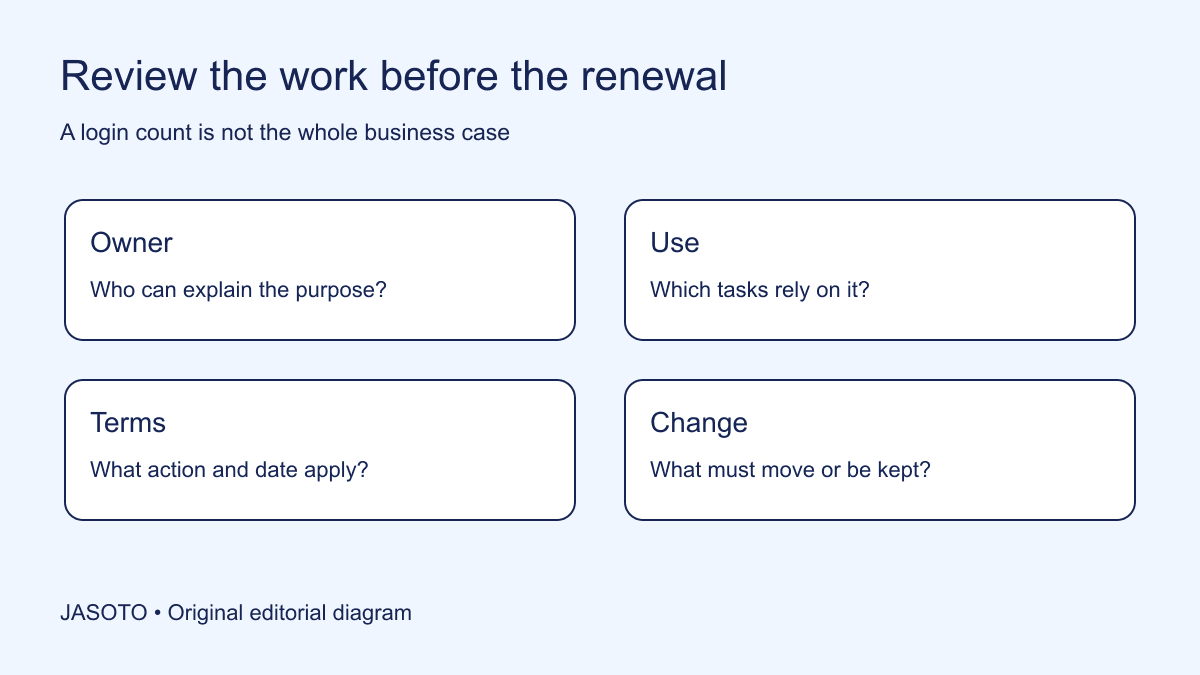
Original JASOTO editorial diagram. Its complete workflow is explained in the article; no actual customer outcome is depicted.
Before a business subscription renews, identify its owner, the work it supports, the actual renewal conditions and what would happen if it changed or ended. Review usage in context rather than cancelling solely because a dashboard looks quiet. If you choose to leave, plan the data, access and connected processes before relying on a cancellation confirmation.
This guide proposes an operational review for a UK small business, not a universal cancellation rule or a guaranteed cost-saving method. Provider terms and contractual arrangements vary. The NCSC account guidance is referenced for the importance of protecting business accounts; the review template and worked example are original editorial recommendations. Keep the business decision separate from technical steps that need an appropriate administrator.
The practical answer
- Identify the service and its business owner before judging its value.
- Separate unused seats from an unused service.
- Check renewal conditions directly rather than assuming cancellation terms.
- Plan data, access and dependencies before changing or ending the subscription.
Identify exactly what is renewing
Record the provider, service name, current plan, billing account and business owner. A card statement may show a payment processor or reseller rather than the name staff recognise. Resolve that identity before judging whether two charges are duplicates. Ask who arranged the service and where the original agreement or confirmation is stored. Do not make a purchasing decision from an unexplained transaction label alone.
Distinguish the person who receives invoices from the person who understands the work. Finance may know when a charge arrives without knowing why a service matters. A technical administrator may manage access without owning the budget. The review needs those perspectives to meet. Assign one person to coordinate the decision and identify who can authorise it, so a renewal reminder does not circulate among several colleagues while everyone assumes someone else will act.
Describe the business task it supports
Write the tasks the subscription makes possible, including occasional and background work. A system may send scheduled messages, retain an archive or support a periodic report without frequent interactive logins. Ask the actual users what would stop or become harder if the service were unavailable. Where the answer is uncertain, investigate rather than treating uncertainty as evidence of no value.
Keep the description specific enough to test. “We need it for marketing” is broad; “it sends the confirmed event follow-up list through the approved process” identifies a dependency. If the service is travel-related, review an actual booking or reporting task alongside the options available through JASOTO travel, without assuming that different products offer identical functions. The objective is to understand the required work before comparing packages or deciding that a simpler alternative is adequate.
Review seats and features separately
Check who has access and which roles still need it. Unused seats may be a different issue from an unused service. A plan might include features the business no longer needs while one core feature remains essential. Ask the provider about the actual options and conditions before assuming that a smaller plan preserves everything important. Document differences that affect the task, not just the headline price.
Use available usage reports carefully and explain their limits. A report might show logins but not background activity or work done through an integration. Former colleagues may still appear because access has not been reviewed. Resolve that through the appropriate account process; do not simply delete unfamiliar users without establishing ownership and dependencies. An operational review should improve the record and control of the service, not create disruption because a dashboard was interpreted without context.
Verify the renewal conditions directly
Locate the current agreement, provider account information and relevant renewal message. Check the date, billing period, proposed charge, notice requirements and method for making changes. Record the currency and treatment shown in the actual documents. This article does not establish a universal cooling-off period, right to refund or notice deadline for business subscriptions; those questions depend on the particular arrangement and applicable rules.
Set an internal decision date that gives the responsible people time to assess the options, while keeping it distinct from any contractual deadline. If documents disagree, ask the provider to clarify through a trustworthy channel. Save the answer. An old reminder copied into a spreadsheet may no longer describe the current plan. Do not assume that removing a payment method, uninstalling software or leaving an account unused completes the provider's required cancellation process.
Map the connected work before changing the plan
List integrations, shared links, scheduled actions and other services that rely on the subscription. Ask the relevant administrators to identify what can be checked safely. Avoid experimenting with a live business-critical configuration merely to see what breaks. The review record can name the dependency and its owner without containing credentials or detailed sensitive configuration.
Distinguish a replacement in principle from a working migration. Another tool may appear to offer the same feature while using different permissions, formats or limits. Test the actual task through the approved process before committing to a switch. Keep the existing arrangement available where appropriate until the decision owner has evidence that the replacement supports the required work. The useful comparison is between complete workable arrangements, not two lists of marketing features.
Plan what must be retained or exported
Identify records, files, templates or reports that the business needs after a change. Check the provider's supported export method, available formats and access conditions. Have the appropriate person verify that an export can actually be opened and used. A downloaded archive is not automatically a usable replacement for the workflow that created it. Keep data-handling and retention requirements within the organisation's applicable policies.
Decide who performs the work and where approved material will be stored. Do not copy every customer record into a broadly shared folder simply because the subscription might end. Avoid promising that data can be recovered later unless the provider confirms the actual arrangement. The review should expose any uncertainty before cancellation. If specialist migration support is needed, give the provider a defined brief instead of asking for an unbounded instruction to move everything somewhere else.
Keep account security part of the handover
The NCSC guidance on important online accounts is relevant when responsibility changes. Identify the appropriate administrator, supported access controls and recovery arrangements without placing secrets in the review document. If the original account owner has left, resolve access through the provider's legitimate process. Do not assume a colleague's personal inbox or device will remain available for future recovery or billing questions.
When a plan changes or a service ends, confirm which access and connected credentials need attention through the approved process. An operational reviewer can identify the task while a qualified administrator handles implementation. JASOTO businesses can help you discover support providers, but confirm suitability and scope directly. The renewal decision and the technical handover should have explicit owners so neither is accidentally treated as complete when only the other has been addressed.
Worked example: a reporting tool with quiet usage
Imagine a small business reviewing a reporting subscription that shows few recent logins. This is an invented scenario, not a claimed saving. The owner explains that the tool produces a periodic report and provides an archive used during a recurring customer review. Several paid seats are no longer needed, but ending the service immediately would leave an unresolved reporting dependency.
The coordinator checks the current plan options, export format and renewal conditions with the provider. The business may decide to reduce seats, retain the plan or test an alternative before the next decision point. The example deliberately gives no made-up price or outcome. The useful lesson is that the login count raised a question, while the task, conditions and dependency review supplied the information needed to make an informed decision.
Record the decision and verify the action
Write the chosen action, authority, reason and remaining tasks. If the decision is to renew, record why the service is still needed and when it should next be reviewed. If the decision is to change or cancel, save the provider's confirmation and verify the actual account or plan status. A sent request is not necessarily a completed change, particularly if more information or approval is required.
Keep financial claims tied to confirmed outcomes. A proposed reduction is not a realised saving, and a lower subscription charge may come with migration or support work. Report those distinctions honestly. If ownership and renewal reviews become sustained work, explore operations roles on JASOTO. A useful review process should make it easier for the next colleague to understand both the business reason and the completed actions, rather than leave an unexplained tick beside a renewal date.
Keep the register small and current
A practical subscription register can contain the provider, plan, owner, purpose, renewal details, dependency link, decision and next review. Link to controlled records instead of duplicating confidential information. Review it when staff leave, business processes change or a provider changes its offer. Do not let a yearly renewal reminder become the only time anyone thinks about a service that supports daily work.
Use the first review to identify missing facts, then improve the record for the next one. Avoid building a reporting exercise larger than the decision warrants. The goal is not to cancel the greatest number of subscriptions or claim an impressive percentage reduction. It is to keep services the business genuinely needs, make deliberate changes when appropriate and complete those changes without losing the work or information that still matters.
Put the guide into practice
- Record the actual provider, plan and responsible owner.
- Review real tasks and dependencies with the people using the service.
- Verify the renewal route, dates and conditions.
- Assign and test any export, migration or access work before ending use.
Frequently asked questions
Should I cancel a service because nobody opened it recently?
Not without checking its purpose. Some services work in the background or are used infrequently for important tasks. Review the actual dependency and ask the owner before treating a login count as a complete measure of value.
Does deleting an app cancel the subscription?
Do not assume so. Check the provider's actual billing and cancellation process, including any marketplace or reseller involved. Save confirmation of the action you requested and verify the resulting account status.
Can a review guarantee a saving?
No. It can identify unused capacity, unclear ownership or better-fitting arrangements, but the decision may be to retain the service. Report savings only when the change and its actual financial effect have been verified.
Explore JASOTO tools
Continue with JASOTO
Compare your next step
Discover UK businesses, compare services and request written quotes before making a decision.