
Business Growth · UK Guide 2026
Choose Case Study Evidence Without Inventing Outcomes
JASOTO · Updated 5 November 2026 · 1,575 words
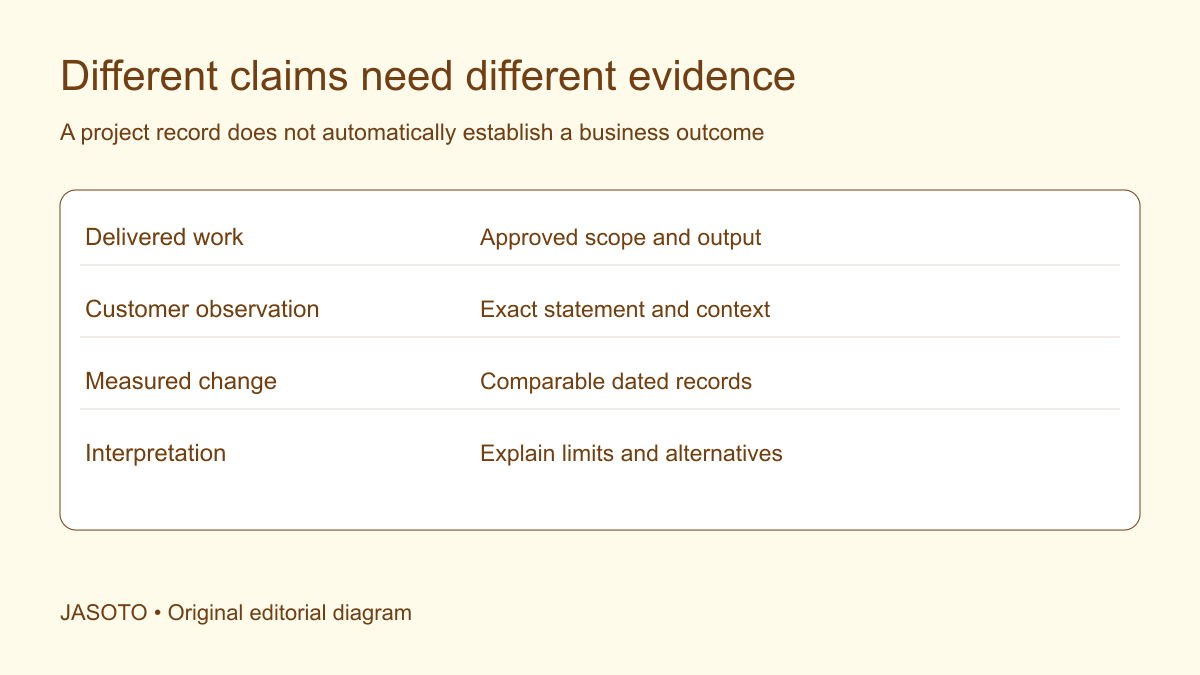
Original JASOTO editorial diagram. Its complete workflow is explained in the article; no actual customer outcome is depicted.
Choose case study evidence before writing the success story. Separate what the business delivered, what the customer said and what was actually measured afterwards. Then match every factual claim to a record that supports it. If the records show a completed installation but no measured productivity change, write about the installation and decisions rather than inventing a productivity improvement to finish the narrative.
This guide offers an editorial evidence workflow for a UK small business. It is not legal advice or a substitute for specialist review of regulated claims. The worked example is fictional. A real case study should describe real work with appropriate permissions; an illustrative scenario should be clearly labelled and should never be presented as an actual customer project.
The practical answer
- Choose the evidence before writing a success headline.
- Separate what was delivered from what changed afterwards.
- Match every objective claim to an appropriate record.
- Keep uncertainty and permissions visible through editing and approval.
Begin with the project record, not the desired headline
Collect the agreed scope, relevant changes, delivery records and final output. Identify the dates and who can explain the work. Record which material is original and which has been reconstructed from memory. A project may have several phases, so avoid implying that the output from one phase represents the entire customer's operation or a later result that nobody observed.
Write a short evidence inventory before drafting: what exists, where it is held, what it shows and its limitations. This prevents the story from becoming anchored to an attractive claim that the team later struggles to justify. The inventory can also reveal a strong practical angle, such as resolving an awkward scheduling constraint, that is more credible than a generic claim of transformation.
Separate four kinds of statement
Distinguish delivered work, customer observations, measured changes and interpretations. Delivered work might be a documented handover pack. A customer observation might be an approved statement about using it. A measured change might compare relevant records before and after. An interpretation explains what the writer believes those observations mean, with limitations and alternative explanations kept visible.
These categories can coexist, but one should not silently stand in for another. “The team received a revised process” is not the same as “the process saved time.” “The customer liked the layout” does not establish that it increased inquiries. Clear distinctions allow a case study to be informative with modest evidence. They also make it easier for the customer and internal reviewer to identify exactly what they are approving.
Build a claim-to-evidence register
For each proposed objective claim, record the wording, supporting source, date range, relevant calculation and reviewer. Add the limitation and publication status. Include headlines, captions, callout statistics and comparison labels. A body paragraph may be careful while a large graphic makes a much stronger assertion. Review the entire page as the reader will encounter it.
[CAP's substantiation advice](https://www.asa.org.uk/advice-online/substantiation.html) explains the need for documentary support for objective advertising claims before publication. Use the current rules and appropriate advice for the actual communication. The register here is an editorial control: it helps the team find the basis for a statement and remove wording that the available evidence does not support.
Check what a number actually measures
Identify the numerator, denominator, period and inclusion rules behind a figure. A count of submitted forms differs from qualified inquiries, and a count of scheduled visits differs from completed visits. Keep the definition in the working record and explain what matters to the reader. Avoid a precise percentage when the underlying categories changed or the original count cannot be verified.
Check units and rounding. A difference in hours should not become a financial saving unless the required assumptions and evidence support that separate claim. If a figure is an estimate, label it and explain the relevant basis. Do not add invented benchmark comparisons to make a modest result appear impressive. The useful question is what the number helps a reader understand about this specific project.
Use comparisons only when the periods are meaningfully comparable
Before describing a before-and-after change, ask whether the periods represent similar activity and whether other important conditions changed. A service page revised during a seasonal surge cannot be credited with the whole increase in demand merely because the dates line up. Record promotions, staffing changes or altered measurement that could affect the interpretation.
You can describe an observed change without claiming the project caused it. State what was measured and keep causal language proportionate to the evidence. If no suitable baseline exists, say so. A case study can explain that the business established a new way to collect future evidence, but it should not claim the improvement that the later measurement has not yet shown.
Verify quotations without enlarging their meaning
Keep the customer's original statement and context, and confirm the version approved for publication through the appropriate process. Identify any edits or omissions that matter to meaning. A short quotation should not combine unrelated remarks into a stronger endorsement or make an individual appear to speak for an organization without the relevant authority.
Distinguish personal satisfaction from an objective outcome. If a customer says a handover was easier to follow, present that observation accurately rather than converting it into a measured reduction in support time. Avoid fictional names, roles or quotations that appear to be real endorsements. If permission or verification is incomplete, leave the statement out until the issue is resolved instead of using a plausible placeholder in published material.
Use photographs as evidence of what they show
A photograph can document visible work or provide useful context, but it does not automatically establish performance, durability or customer satisfaction. Record what it depicts, when it was taken where relevant, and how it relates to the project. Distinguish actual project images from stock, staged examples, renders and diagrams. Give each an accurate caption.
Check publication rights and relevant privacy considerations through the business's process. Removing a name from the text does not necessarily make a distinctive site or visible document anonymous. Where a visit is needed to gather permitted material, research project travel and coordinate with the responsible contact. Do not encourage staff to collect extra personal information merely to make the story feel more detailed.
Work through a case with no measured commercial result
Imagine a fictional office supplier that reorganized a customer's equipment handover documents. Available evidence includes the agreed scope, approved templates, a dated handover record and the customer's permission to describe the project. No comparable records show whether support requests or staff time changed. The case study can explain the original documentation problem, the decisions made and the delivered pack.
It should not claim that the project reduced support by a percentage, increased productivity or paid for itself. A useful conclusion might state that the customer received a consistent reference pack and that future review will examine how it is used. This is an editorial scenario, not a real customer outcome. It demonstrates that a clear account of work can be valuable without a manufactured result.
Keep constraints and limitations in the narrative
Explain material limits that affect how a reader should understand the example. The project may cover one location, a selected sample or a short period. Do not bury those limits in a distant footnote while the headline implies a universal result. A reader considering similar work benefits from knowing where the approach was tested and where it remains uncertain.
Keep the language specific. “The revised document was approved for this team's workflow” is more useful than “a proven solution for every business” when only one workflow was reviewed. Avoid compensating for limited evidence with broad adjectives about expertise, authority or excellence. Explain the actual choices and trade-offs. That gives prospective customers something concrete to discuss when they compare business providers.
Review the finished page as a new reader
Ask a reviewer to identify what the case claims happened, what caused it and whether the result is typical. Compare their interpretation with the claim register. If they infer more than the evidence supports, revise the headline, image, sequence or wording. Meaning comes from the whole presentation, not only from individually defensible sentences.
Run the review on the final layout, including previews and social snippets where available. A cropped caption or shortened title can remove an important qualification. Confirm that the approved customer version matches what will actually publish. When content work requires additional capacity, define the checking responsibilities clearly before exploring research or content roles; drafting and independent verification are different tasks even when one person performs both.
Preserve the evidence and correct unsupported claims
Keep the approved draft, claim register and relevant source references according to the business's document arrangements. Set a review point for facts that can change, such as the service still being offered or a continuing customer statement. If a claim is challenged or found unsupported, investigate the specific evidence and correct or remove the statement promptly through the publishing process.
Retain earlier wording and a rollback path. If later measurement becomes available, treat it as new evidence and review the revised claim rather than quietly inserting a stronger outcome into an old story. A trustworthy case study makes its support easy to understand: real work, accurate context, appropriate permission and claims that stop where the evidence stops.
Put the guide into practice
- Collect the original project records and define their limits.
- Build a claim-to-evidence register.
- Verify figures, dates, comparisons and quotations.
- Confirm publication permissions through the appropriate process.
- Review the final headline and images as well as the body.
Frequently asked questions
Can we write a case study without outcome metrics?
Yes. Explain the customer's task, constraints, decisions and delivered work using supported records. You can show how a process was carried out without claiming a financial or performance improvement. Label the limits honestly and avoid replacing missing measurement with a confident but unsupported success statement.
Does a customer saying they were pleased prove the project improved sales?
No. The statement can describe the customer's expressed opinion when quoted accurately and used appropriately, but it does not independently establish a sales change or its cause. A different claim needs suitable evidence. Keep the customer's observation separate from measured outcomes and your own interpretation.
Can we estimate missing results to complete the story?
Do not present an estimate as an observed result. If an estimate is useful and appropriate, identify it clearly, explain its assumptions and keep it distinct from actual outcomes. Often the stronger editorial choice is to omit the unsupported result and explain the work and evidence you genuinely have.
Explore JASOTO tools
Continue with JASOTO
Compare your next step
Discover UK businesses, compare services and request written quotes before making a decision.