
Business Growth · UK Guide 2026
Keep Catering Counts Separate From Invitation Numbers
JASOTO · Updated 5 November 2026 · 1,606 words
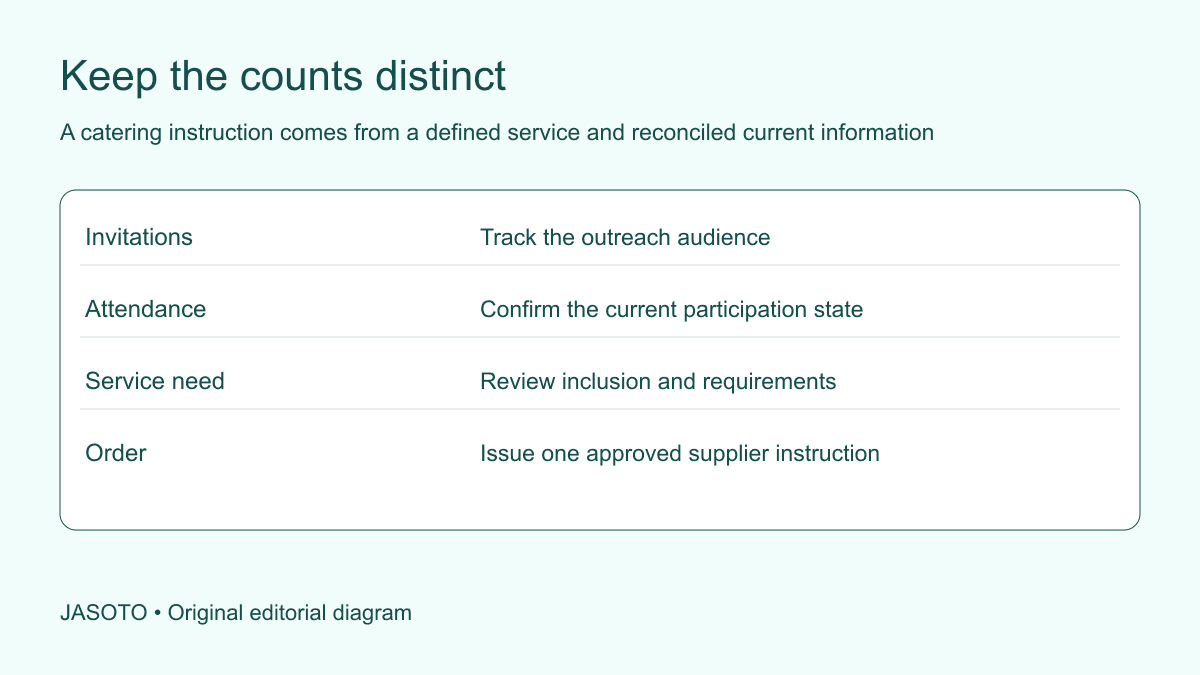
Original JASOTO editorial diagram. Its complete workflow is explained in the article; no actual customer outcome is depicted.
Keep the invitation list, expected attendance and catering order as separate records connected by a clear review. An invitation is an offer to attend, while a catering count should describe the actual service requested from the provider at a stated point. Record who is included, which response is still missing and who can authorize a change after the agreed cutoff.
This original guide is for UK event organizers coordinating numbers. Food Standards Agency guidance addresses providing food at community and charity events in its stated jurisdictions; use the appropriate authority and competent food provider for actual safety and allergen arrangements. The counting method below organizes facts and supplier instructions. It does not determine food suitability or turn a dietary response into a safety assurance the caterer has not confirmed.
The practical answer
- Define the actual food service first.
- Keep invitations and attendance separate.
- Route individual requirements to the competent provider.
- Make the approved order and changes traceable.
Define the service before counting people
Confirm what is being ordered, when it is served and who is intended to receive it. Refreshments for a short break, individual meals and an exhibitor lunch create different counting questions. Record the actual provider's required information and ordering process. A generic field marked “catering total” can hide whether the team is counting cups, portions, meals or people expected somewhere in the venue.
Identify the responsible organizer and supplier contact. Ask who approves the order, who maintains the response record and who receives a changed count. These may be different people. A volunteer can collect replies without authority to alter an order, and a supplier may need a particular contact to confirm a change. Keep that route visible so a revised spreadsheet does not silently become an instruction the caterer has never received.
Separate the main attendance states
Use a practical set of labels for invited, responded, confirmed and cancelled where those states match the event process. Keep waiting or provisional attendance distinct if relevant. Explain what each means and avoid assuming that no reply means either acceptance or refusal. The invitation number is useful for outreach, but it is not a reliable substitute for the current attendance view.
Record the source and time of the current count. A list exported yesterday can differ from a live registration view, and neither should be described as final if changes are still being accepted. Preserve the distinction between the latest fact and an organizer's planning assumption. This lets the decision owner choose how to handle uncertainty explicitly, rather than present an estimate as though every person has confirmed the same requirement.
Identify who is eligible for the particular service
Not everyone attending every part of an event necessarily uses the same food service. A speaker may arrive after lunch, an exhibitor may bring a separate arrangement or a volunteer may work a shift that includes the break. Confirm the actual event plan before adding or excluding these groups. Avoid using job titles alone to decide who should receive a meal.
Keep the service entitlement or planned inclusion clear in the working record, with the appropriate communication to those affected. For an invented afternoon workshop, the organizer orders a refreshment service for confirmed participants and a separately agreed volunteer group. A morning-only visitor is not automatically included in an afternoon count. The point is a factual service definition, not an arbitrary attempt to minimize numbers. People should know what is actually being provided and how to raise a practical question.
Collect relevant requirements through an appropriate route
Ask the provider what information is needed to plan the actual service and how questions should be handled. Give attendees a clear response route and explain its practical purpose. Keep individual information accessible only to the appropriate people. Do not circulate detailed personal responses to every event volunteer merely because they appear in the registration export.
Use precise status for unresolved questions. A participant reporting a requirement does not establish that the provider can safely meet it. Route the question to the competent food provider and obtain the actual response. Food Standards Agency guidance is a relevant starting resource within its scope, while other UK jurisdictions have their own appropriate information. This counting guide does not supply a substitute safety or allergen decision. The organizer's task is to ensure the right question reaches the right owner and the answer is communicated appropriately.
Build the order count from confirmed categories
Create a view that connects the relevant attendee group with the service requested. Use the provider's actual categories and avoid inventing a grouping that changes their meaning. Check that a person is counted once for the relevant service, while preserving separate services where the event genuinely provides them. A duplicate registration should be resolved through the event process rather than automatically becoming another meal.
Distinguish confirmed requirements from estimates or contingency chosen by the decision owner. If an additional allowance is approved, identify it as such. Do not claim a universal percentage is appropriate for every event or hide it inside the attendee total. The provider and business owner should understand what the number represents. That clarity makes a later adjustment easier and prevents the team from arguing about whether an order included guests who never responded.
Set the cutoff with the actual provider
Confirm when the supplier needs the count and what can change afterwards. Use the real terms for the booking rather than a date copied from another event. Work backwards to a suitable attendee response point that lets the organizer review missing information. A cutoff is useful only if someone owns the reconciliation and communicates the final instruction through the agreed route.
Tell attendees what the deadline means factually. If a late request may not be accommodated, explain the relevant process without promising an outcome. Keep an individual late requirement visibly pending until the provider responds. Avoid assuming that a small change is always easy because the overall event is small. The provider's capacity, preparation and safety arrangements determine what it can accept, and the organizer should obtain the actual answer before updating the person's expectation.
Reconcile before issuing the order
Compare the attendance view, service inclusion and requirement responses. Check duplicates, cancellations, staff or speaker additions and unresolved questions. Record the count date and the approver. Keep the source response list available through the appropriate permission so a later discrepancy can be traced to the original state. A total that matches the number of invitations may still be wrong if several invited people have declined or if confirmed volunteers were never on the invitation list.
For the invented workshop, the organizer finds that two registrations belong to the same attendee and one facilitator has an agreed meal inclusion outside the public form. The corrected service count reflects those facts, while an unanswered individual requirement remains assigned to the provider contact. This is a practical reconciliation, not a claim that the resulting number predicts exact consumption. The team can explain the order and the uncertainty without manufacturing precision from incomplete responses.
Send one traceable supplier instruction
Use the agreed channel and specify the event, service date and time, count, relevant confirmed categories and current version. Ask for the appropriate acknowledgement or confirmation through the provider's process. A spreadsheet being saved does not establish that the caterer received or accepted the instruction. Keep the response with the working record so another organizer can locate the actual agreement.
If a change is requested, identify which earlier instruction it replaces and whether the provider has confirmed it. Do not send independent amendments through several volunteers. Name who owns the supplier conversation and make the current status visible to the team. A late message saying the count “should be one higher” is still a request until the actual provider response and required approval are established.
Give the service team the information it needs
Prepare the appropriate current service view for the people who will receive or distribute the order. Keep unnecessary personal information out of that view and follow the provider's actual arrangements. Clarify who can answer a mismatch or an unexpected request on the day. General volunteers should not improvise a food-suitability assurance when the question belongs to the competent provider.
Discover potential catering or event support through business listings, then verify suitability directly for the actual service. Confirm the venue and receiving window before planning delivery or staff travel. If catering coordination is a continuing responsibility, describe it accurately in relevant roles, distinguishing response collection, order approval and food-safety decisions. Those boundaries help a small team act efficiently without treating everyone who can read the count as equally authorized to change or interpret it.
Review the record after service
Compare the ordered, received and used information only to the extent it is actually recorded and useful. Attendance and consumption are different measures. Avoid claiming that every unused item proves the ordering method failed, or that an empty tray establishes everyone received an appropriate service. Ask the responsible provider and event team what specific information would improve another order.
Apply the organization's appropriate arrangements to retaining or removing individual responses. Keep the reusable counting lesson without preserving unnecessary personal detail. If the process becomes confusing, return to the service definition, current attendance states and last confirmed supplier instruction. Correct the actual discrepancy through the named owner. A reliable catering count is a traceable decision based on defined service needs, with uncertainty and provider confirmation visible instead of hidden inside the invitation total.
Put the guide into practice
- Confirm supplier categories and cutoff.
- Reconcile duplicates and separate event roles.
- Record estimates distinctly.
- Obtain the appropriate provider confirmation.
Frequently asked questions
Can the invitation total be used as the catering order?
Use it as outreach context, then reconcile the actual attendance states and service needs. Invitations, confirmed attendance and the provider order describe different things. If an estimate or additional allowance is approved, label it explicitly rather than presenting it as confirmed responses.
Does recording a dietary requirement confirm it can be met?
No. Route the requirement to the competent food provider through the appropriate process and obtain the actual response. Keep individual information handled appropriately and avoid volunteers making an assurance that the provider has not confirmed.
What happens after the supplier cutoff?
Follow the actual booking conditions and named change route. Record a late change as a request until the provider and relevant approver confirm it. Communicate the current status to the attendee or service team without promising that every addition can be accommodated.
Explore JASOTO tools
Discover providers and check support for your specific task.
Explore roles and responsibilities →Consider the practical responsibilities involved when recruiting or joining a team.
Plan work-related travel →Research a journey when joining, training or meeting colleagues in person.
Continue with JASOTO
Compare your next step
Discover UK businesses, compare services and request written quotes before making a decision.