
Business Growth · UK Guide 2026
Check Whether a New Workflow Actually Saves Effort
JASOTO · Updated November 5, 2026 · 1,611 words
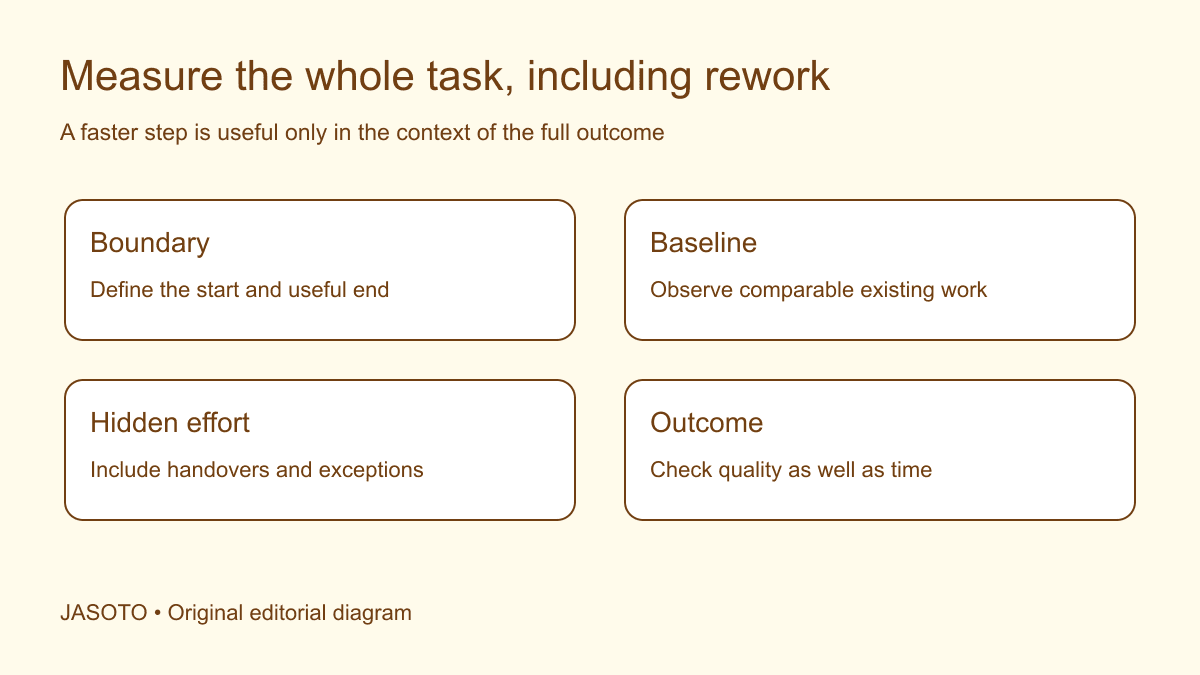
Original JASOTO editorial diagram. Its complete workflow is explained in the article; no actual customer outcome is depicted.
Check whether a new workflow saves effort by defining the complete task, observing comparable work before and after the change and including effort across everyone affected. Count checking, exceptions and rework as well as the step that looks faster. Keep the result honest: a simpler interface or preferred routine can be useful without proving a business-wide time saving.
This guide is an original evaluation worksheet for small businesses in the United States. The example concerns an invented service company replacing an emailed job brief with a shared intake form. It does not promise a statistical result or prescribe a universal measurement sample. Use suitable specialist advice where the work's complexity or consequences require a more rigorous assessment.
The practical answer
- Define the complete task and the result it must preserve.
- Measure comparable work before and after the change.
- Include effort transferred to another person or stage.
- Keep uncertainty and rollback criteria visible.
Define the task and useful endpoint
State where the workflow begins and what usable outcome marks completion. For the job-brief example, receiving a form may not be the endpoint if an administrator still needs to verify it and prepare the actual work record. Choose a boundary that reflects the business purpose. A narrow boundary can make a change appear efficient by excluding the work it creates immediately afterwards.
Identify relevant roles and systems. The customer, intake employee and delivery colleague may each contribute effort. Keep customer burden visible where it matters rather than measuring only staff activity. A business can reduce internal typing by asking customers to do more, but that is a transfer to examine, not automatically proof that the whole service requires less effort.
Map what happens now
Describe the current sequence, including ordinary handovers and common exceptions. Ask people doing the work to explain it rather than relying only on the procedure document. The actual routine may contain an extra check or correction that the written version omits. Record meaningful variation and identify which parts the proposed change is intended to affect.
[NIST MEP's value-stream mapping information](https://www.nist.gov/mep/value-stream-mapping) describes mapping current and future processes within its improvement approach. The original small-business method here uses a limited practical principle: understand the sequence before comparing it. It does not claim a complete formal mapping exercise or reproduce a methodology as a guarantee of savings.
State the expected benefit as a testable claim
Write what the change is expected to improve and why. A shared form might reduce repeated transcription of the same reference or make a required detail easier to find. Keep the claim specific. A statement such as modernises the process is too broad to tell the team what evidence would support keeping the change or what would count as a regression.
Identify outcomes that must remain acceptable. Faster intake is not necessarily useful if the resulting brief contains more errors or creates unsupported customer expectations. Record the relevant quality, access, privacy and operational requirements through the appropriate process. The evaluation should preserve the actual service outcome rather than treating elapsed time as the only thing that matters.
Collect a useful baseline
Observe the existing workflow before relying on memory or enthusiasm for the new method. Define what is being timed or otherwise recorded and use a consistent approach. Label estimates and interruptions. A task performed during a quiet period may differ from the same task amid normal customer interruptions, so preserve context rather than presenting every observation as directly equivalent.
Choose cases that represent meaningful task types and exceptions. Do not select only the easiest examples because they are convenient to observe. State the actual scope of the baseline and its limitations. If the workflow varies widely, obtain appropriate measurement support before making a precise savings claim. A limited baseline can still support a cautious practical decision when described accurately.
Separate active effort from waiting
Record the distinction between a person working on a task and a task waiting for an input or decision. A new form may reduce active entry while leaving the same approval delay. That can still be useful, but the claim should match the evidence. Do not combine the two into one unexplained turnaround figure and attribute every difference to the interface change.
Identify the reason for relevant waiting where it is known. A missing customer detail and an unavailable approver create different improvement opportunities. Preserve uncertainty if the cause cannot be established. The purpose is to understand the actual pathway, not assign an artificial cause to every interval so a spreadsheet produces a complete-looking breakdown.
Include work that moves elsewhere
Ask each affected role what the new method adds, removes or changes. The intake employee may type less while the delivery colleague spends longer interpreting inconsistent free-text answers. A customer may need to find information they did not previously supply. Keep those observations connected to the same task cases where appropriate, so a local saving is not reported without its downstream cost.
Avoid assuming that every transferred task is unacceptable. It may be sensible for the right person to enter information once rather than several people copy it. Explain the trade-off and test whether the new arrangement actually works. The decision should distinguish deliberate useful redistribution from hidden effort that appears only because the evaluation stopped too early.
Observe exceptions and rework
List the common cases that need correction, clarification or another route. Check whether the new workflow handles them appropriately or merely rejects them. A form that prevents submission without a guessed answer may look complete while creating later clarification work. Record the actual exception and response rather than treating all successful submissions as equally usable outputs.
Count meaningful rework through a suitable method. A short correction can occur repeatedly, while one unusual complex case may dominate a small observation set. Keep both visible and explain their context. Do not hide difficult cases to improve an average, or let one anecdote prove the whole change failed. The review needs a fair account of the work actually observed.
Pilot the change with a rollback path
Define the scope of the pilot and who authorises it. Preserve the previous process and relevant records so the team can revert appropriately if the change creates a material problem. Keep customer and staff expectations accurate during the transition. A trial should not silently introduce a new commercial promise or bypass the business's privacy and security requirements.
Avoid changing several unrelated steps at once if the goal is to understand one effect. Where other changes are unavoidable, record them and limit the conclusion. The team may decide the combined process is better without being able to isolate which component caused the difference. Report that honestly rather than crediting the preferred tool for every observed improvement.
Worked example: a shared job-intake form
Imagine a service company replacing emailed job briefs with a shared form. The team expects less repeated transcription. Its baseline follows the task from receipt through preparation of a usable delivery record. In the pilot, staff observe that one entry step is shorter but a field creates additional clarification questions. They revise that field and check the relevant task again.
The team preserves the distinction between observed typing effort, waiting and output quality. This invented example claims no quantified saving or successful software outcome. It shows how a workflow can improve in one place while still needing correction elsewhere, and why the business should compare the complete task rather than celebrate a faster first screen.
Review the result with its limits
Keep a simple evidence table with task type, roles observed, active effort, waiting, rework and usable outcome. Empty cells should mean information was not measured, rather than silently being treated as zero. If a customer performs work outside the observation, record that limitation. Do not calculate a complete process saving from only the staff step that was easiest to time.
Also record the learning stage. New users may need appropriate familiarisation, while experienced users can rely on shortcuts a replacement method changes. Decide how that affects the comparison and report it openly. A promising early result can justify further observation without becoming a permanent savings claim based on conditions that ordinary future users may not share.
Compare like with like as far as the evidence allows. State which task types, roles and periods were observed, and identify relevant differences in demand or experience. Avoid presenting a small informal review as a controlled experiment. A cautious finding such as fewer repeated reference entries in the observed cases may be more accurate than a broad percentage saving.
Include staff and customer observations where appropriate, distinguishing preference from measured effort. Ask whether the new method makes the work easier to understand, not only whether it is familiar or fashionable. The final decision can weigh usability, quality and effort explicitly. It should not claim evidence for an outcome the evaluation never examined.
Decide, maintain and revisit
Record whether the business will keep, revise, expand or revert the change and who owns the next step. Preserve the rationale, relevant evidence and remaining questions. If the process is kept, assign maintenance so a later product or service change does not leave the workflow collecting irrelevant information or relying on an obsolete handover.
Use JASOTO businesses to discover suitable process-improvement support and verify capability directly. If evidence maintenance becomes continuing work, explore operations analysis roles within a staffing review. For an agreed observation visit, research travel after the arrangements are confirmed. A useful evaluation supports a proportionate decision and keeps the distinction between a promising change and a demonstrated effort saving clear.
Put the guide into practice
- Choose a defined workflow and relevant outcomes.
- Record a baseline with comparable task types.
- Observe role effort, exceptions and output quality.
- Review evidence before expanding or reverting the change.
Frequently asked questions
Does a faster screen mean the process is faster?
Check the complete task. A quicker entry step may create later checking, correction or transfer work. Measure the relevant roles and output rather than assuming a local improvement produces the same business-wide saving.
How many cases should be measured?
Choose a proportionate approach suited to the variation and consequence of the work, with specialist help where needed. Do not invent a universal sample size or claim certainty from a few convenient examples. State the cases observed and the limits of the comparison.
Should the new workflow be kept if people prefer it?
Preference is useful evidence, alongside effort, quality and actual task outcomes. Identify what people prefer and what trade-offs remain. A decision can acknowledge a usability benefit without claiming a measured time saving that the evidence does not establish.
Explore JASOTO tools
Discuss the actual workflow, evidence and measurement needs with suitable providers.
Explore operations analysis roles →Consider support where maintaining workflow evidence becomes ongoing work.
Research a confirmed workflow observation visit →Plan travel after the task and authorised observation arrangements are agreed.
Continue with JASOTO
Compare your next step
Discover UK businesses, compare services and request written quotes before making a decision.