
Jobs & Careers · UK Guide 2026
Check the Practical Commute Before Accepting a Location
JASOTO · Updated 5 November 2026 · 1,660 words
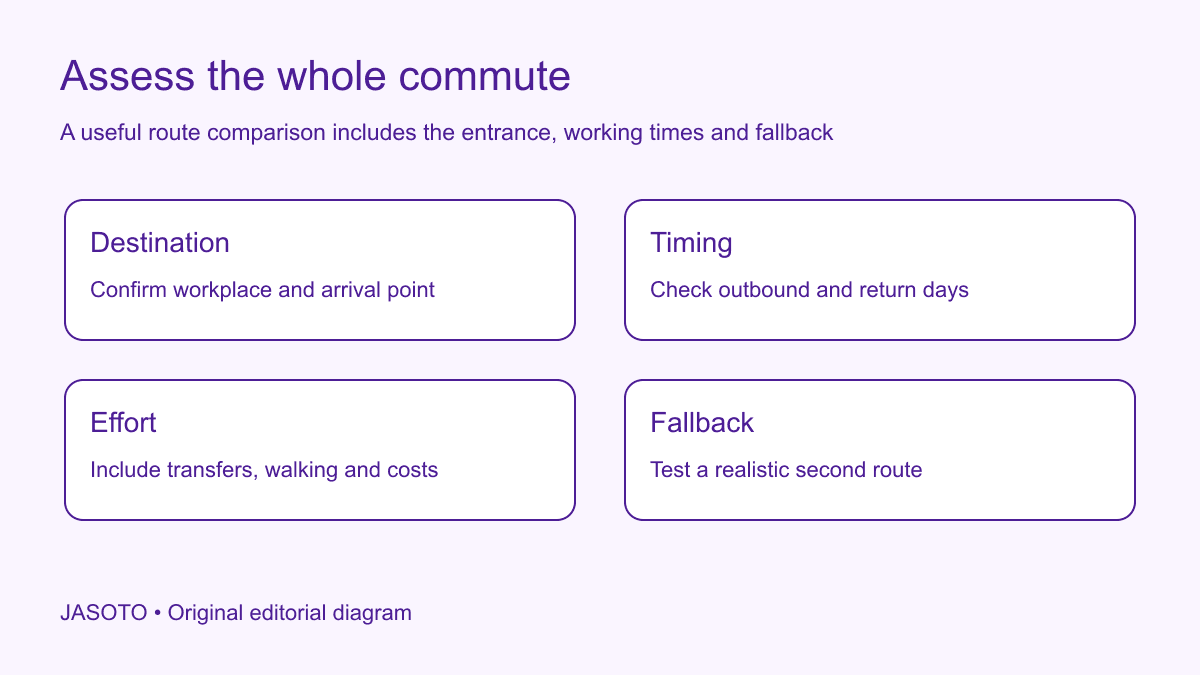
Original JASOTO editorial diagram. Its complete workflow is explained in the article; no actual customer outcome is depicted.
Check a proposed commute using the confirmed workplace entrance and the actual times you would need to arrive and leave. Include the journey to the first stop, transfers, the final walk and the return. Then test the route where practical and identify what happens when one ordinary link fails. A map's headline duration is a starting point for research, while your decision needs the whole recurring journey.
This original guide is for UK applicants assessing a workplace location. Transport for London's planner illustrates useful checks such as arriving or leaving at a chosen time and selecting access preferences. Use the relevant operator's current information for your area. The comparison sheet and examples below help organize the evidence; they do not guarantee services, establish ticket prices or decide whether a commute is suitable for your circumstances.
The practical answer
- Confirm the actual workplace and entrance.
- Check both directions at working times.
- Include every stage and relevant cost.
- Evaluate a real fallback and unresolved constraints.
Confirm the workplace before researching the route
Ask the employer which location applies to the role, including the building and entrance. Separate the interview venue, training site and regular workplace. If the role moves between sites, establish the ordinary pattern before treating one address as the whole commute. An application decision based on head office may be misleading when the work starts at a distribution facility elsewhere.
Confirm the practical arrival requirement. A stated shift start may mean being ready at a work area after entry procedures, rather than arriving at the property boundary. Ask what information the employer can provide about reception, access and the start point. Avoid assuming every site uses the same arrangements. Record what is confirmed and which detail remains uncertain, so the route plan does not hide a guess behind a precise arrival time.
Build a door-to-door journey
Write each stage from home to the required workplace point. Include walking, waiting, changing services, parking or other relevant steps. The list helps reveal where a short main journey depends on a less reliable local leg. Use actual route information rather than assuming the straight line on a map is a usable pedestrian path, particularly around large roads, industrial sites or separate entrances.
For an invented office role, the train journey may look straightforward, but the workplace is reached through a gate on the opposite side of the site. That affects the final walking leg and arrival plan. Ask the employer about the appropriate route where necessary. Keep the research specific to your own needs; a route that suits a fast walker with no equipment may not suit someone carrying a required bag or using a different access arrangement.
Check the actual working times and days
Search the journey for the date, day and arrival time relevant to the role. A route available in the middle of the day may not operate before an early shift or after a late finish. Review weekend or other working patterns where they apply. Use current operator information and relevant service notices rather than relying entirely on a route saved during a different part of the week.
Check the return separately. A usable morning journey does not prove that you can get home after the ordinary finish. If the end time can vary, identify the practical effect of that variation and ask the employer about the actual work pattern. Avoid designing a commute around leaving at the earliest imaginable moment every day. Equally, do not assume every shift will run late without evidence. Make the ordinary plan and the uncertain part visible as separate questions.
Compare transfers and waiting, not just speed
Inspect the interchange steps in the proposed route. A journey with a fast main service can still involve a difficult transfer, a long walk between stops or a narrow connection. Note how often the next service runs and what the next option would be if you miss it. The purpose is to understand the consequence of a routine delay, rather than predict that the fastest published journey will always happen.
Compare a plausible alternative with fewer changes where one exists. For a London journey, TfL offers options including fastest routes, fewer changes and less walking; other operators provide different tools. Test the actual choices available rather than assuming a longer route is automatically more reliable. Your comparison should describe the tradeoff: extra journey time, a simpler transfer or a different final walk. Keep conclusions tied to the information you checked and your own practical requirements.
Include the cost categories you will actually face
List the relevant recurring costs, then verify current amounts and ticket conditions with the providers. Depending on the route, categories might include public transport, parking or a final local transfer. Keep occasional fallback costs separate from the ordinary plan. Do not copy an old fare from a discussion forum or assume the cheapest headline ticket supports the working pattern you need.
Review the frequency of attendance before comparing purchase options. An arrangement involving different sites or changing days can alter which ticket is useful. Ask the provider about the actual conditions and avoid treating this guide as financial advice. The practical goal is a complete cost picture for your decision. A route that appears cheap because the final leg is omitted is not a useful comparison with another route whose full costs have been included.
Rehearse the difficult part when practical
If feasible, try the route at a representative time or inspect the unfamiliar final section. Record observations such as the station exit used, the crossing or the building entrance. Distinguish a real trial from a map review. One successful journey gives useful context but does not establish that every future service will run the same way. Keep the current operator information alongside your observations.
You do not need to make an unnecessary costly trip solely to complete a checklist. A targeted check of the uncertain segment may be enough to answer the practical question. If a site cannot be visited without an appointment, ask the employer before arriving. Avoid treating a candidate's curiosity as permission to enter a workplace or restricted area. The rehearsal should improve the evidence without creating new access or safety problems.
Check access and carrying requirements
Use the relevant access preferences and confirm uncertain facilities through appropriate sources. A route described as step-free to a platform may differ from a route usable through the entire journey. Check the specific meaning of the operator's information and the entrance required at the destination. If an individual arrangement affects attendance, discuss it through the employer's appropriate contact route rather than assuming a general map icon answers the whole question.
Consider what the role requires you to carry between home, transport and the site. A route that works with a small bag may need reconsideration if bulky equipment is involved. Ask what the employer supplies onsite and what movement is actually expected before buying a different bag or planning a workaround. Keep equipment suitability and any specialist handling question with the responsible people. Commute research should reflect the real task without inventing a transport requirement the role does not have.
Choose a realistic fallback
Identify one plausible response to a failure of the main route. It might be a different service, another station or contacting the manager under the employer's absence or delay arrangements. Check whether the alternative actually operates at the necessary time and whether its cost and availability are practical. “Take a taxi” is not a complete fallback if no suitable service has been identified or if the expense is outside what you can sustain.
Record the point at which the fallback no longer solves the arrival problem. Then identify the contact route for explaining the situation. You cannot eliminate disruption through planning, but you can avoid depending on an imaginary alternative. Keep the difference between an occasional emergency option and a viable daily route. If the ordinary commute only works through repeated expensive rescue journeys, that is material evidence for your decision about the location.
Summarize the recurring effort honestly
Create a concise comparison with normal door-to-door time, required departure, expected return, transfer complexity, cost categories and unresolved points. Add any observations from a trial. Review the whole week or working cycle rather than judging the route only from one attractive morning option. Include the practical effect on rest and other responsibilities without assuming that everybody should accept the same travel burden.
Use travel research to explore relevant options and verify services with operators. If you need a local provider discovered through business listings, confirm availability and the exact journey directly. Compare job opportunities using confirmed workplace details rather than an employer's general office map. The comparison should support your decision, not produce a score that hides the particular constraint most important to you.
Resolve the remaining question before committing
If the commute depends on an unconfirmed work pattern or entrance arrangement, ask the employer for clarification through the recruitment process. Explain the specific fact you need, such as whether the ordinary finish is later than the last usable connection. Distinguish your own travel limitation from the employer's stated requirement. That creates a concrete conversation about whether the role and location are workable.
If new information changes the route, return to the relevant stage and revise the plan rather than defending an earlier assumption. You can shorten the research by preserving the confirmed facts and replacing only the affected part. The practical outcome is a commute you understand well enough to assess: where it starts and ends, what it requires on the actual working days and what happens when a link fails. Acceptance remains your decision, informed by current evidence instead of a headline journey time.
Put the guide into practice
- Record the required arrival point.
- Inspect transfers and final-mile access.
- Verify current services and ticket conditions.
- Clarify decision-critical work-pattern details.
Frequently asked questions
Should I test the commute at the exact start time?
A representative trial can be useful when practical, especially for an unfamiliar final leg. Also check current dated operator information. One successful journey does not prove future reliability, and a targeted check may answer the uncertainty without requiring an unnecessary full trip.
What if the role has several work sites?
Confirm which locations apply, how often you would attend and who sets the pattern. Assess the relevant journeys separately. A workable commute to one office does not establish feasibility for a role whose ordinary work begins at another site or changes locations during the week.
How much extra time should I allow?
Choose an allowance based on the route, interchange, entry arrangements and your circumstances. There is no universal number that makes every commute workable. Inspect what happens after a missed connection and confirm the actual arrival requirement before deciding whether the plan is realistic.
Explore JASOTO tools
Discover providers and check support for your specific task.
Explore roles and responsibilities →Consider the practical responsibilities involved when recruiting or joining a team.
Plan work-related travel →Research a journey when joining, training or meeting colleagues in person.
Continue with JASOTO
Compare your next step
Discover UK businesses, compare services and request written quotes before making a decision.