
Business Growth · UK Guide 2026
Choose What Belongs in a Small-Team Operations Manual
JASOTO · Updated 5 November 2026 · 1,620 words
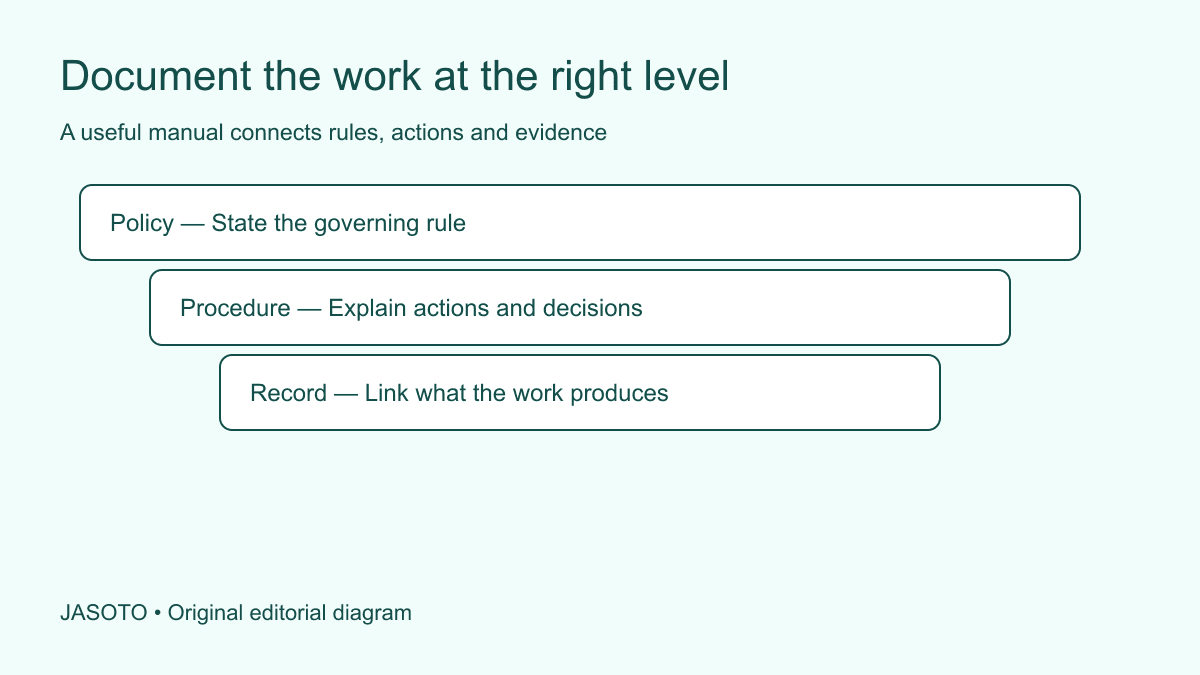
Original JASOTO editorial diagram. Its complete workflow is explained in the article; no actual customer outcome is depicted.
Choose operations-manual content by asking what a colleague needs to complete a recurring task, make an authorised decision or hand work over reliably. Include the practical instruction and route to authoritative information. Keep documents that serve other purposes in their proper locations, with suitable links and access. A manual should help someone act, rather than become a storage folder presented as a finished process.
This guide is an original method for small UK teams documenting ordinary administrative work. The example uses an invented print studio with repeat customer orders. Specialist tasks still need appropriate expertise, training and controlled instructions. Start with observed questions or handover problems so the first procedures address real work, and give each one an owner who can maintain it.
The practical answer
- Include information that helps someone complete a recurring task or decision.
- Separate policy, practical procedure and the records produced by work.
- Link specialist instructions instead of rewriting them casually.
- Give every procedure an owner, scope and review trigger.
Start with recurring work and observed gaps
List tasks that recur across people or shifts: receiving an enquiry, preparing an order, requesting approval or handing over an unfinished job. Ask staff where information is repeatedly missing or interpreted differently. A useful candidate might be the step where a customer approves artwork, because several colleagues need to distinguish a draft from an approved production file.
Avoid choosing content only because it is easy to write. A lengthy description of the company's history may be valuable elsewhere, while a short explanation of who can approve a change may remove a daily uncertainty. Record the problem the procedure is intended to solve. That gives the team a way to judge whether the document helps after it is introduced.
Separate policy from practical procedure
A policy states the governing rule or principle. A procedure explains the appropriate steps and decisions for a defined task. A record shows what happened in a particular case. Keeping these roles clear helps the writer avoid mixing a general rule, a customer-specific exception and a completed form into one confusing document.
For the print-studio example, a rule about authorised production approval differs from the steps staff follow to obtain it. The customer's actual approval belongs with the order record. The manual can connect all three through references. It should not copy an individual customer's message into the general procedure or make an exceptional arrangement look like the rule for every future order.
Define the procedure's beginning and end
State the trigger that starts the task and the result that marks its appropriate completion. For an artwork handover, the trigger might be receipt of a revision request and the end might be a clearly recorded current file status. Use the actual business process. Avoid broad procedures called manage orders that try to cover every activity from first enquiry to final accounts.
Identify who the procedure is for and what knowledge it assumes. A guide for trained production staff may differ from a receptionist's routing instruction. Do not imply that anyone reading the manual is now competent or authorised to perform every step. Clear scope allows the document to provide the right detail while preserving the role boundaries the business actually needs.
Give decisions and exceptions enough attention
Routine steps are often easy to describe, while the real uncertainty occurs when something differs. Identify the likely decision points: missing information, conflicting instructions, unavailable approver or a changed customer request. State what the reader may decide and when they must contact someone else. Keep the escalation route current and suitable for the actual working hours.
Avoid turning every possible exception into a complicated branching diagram. Start with the cases staff genuinely encounter and a clear route for the rest. The procedure should help a colleague recognise the limit of their authority. A short instruction to pause and obtain a named approval can be more useful than several pages that pretend to anticipate every situation without an accountable decision maker.
Link specialist guidance rather than improvising it
Identify the authoritative source for technical, safety, legal or product-specific instructions. Link it through an appropriate controlled process and explain when the reader needs it. Do not rewrite specialist material casually to make the manual shorter. A summary can remove an important qualification or become outdated while the official source changes.
[HSE's work-equipment guidance](https://www.hse.gov.uk/work-equipment-machinery/training-competence.htm) describes training and competence in its particular context. A general operations manual is not a substitute for those arrangements. The administrative guide can identify the relevant source and responsible person, while the business determines the suitable training, supervision and authority for the actual task through the proper process.
Keep sensitive and case-specific material controlled
The manual may need to explain where customer records or access procedures are held without exposing their contents to every reader. Use appropriate permissions and business systems. Do not embed passwords, personal account details or private customer information in a broadly shared procedure because the author wants every necessary fact on one page.
Distinguish the route to a record from the record itself. An order procedure can say how authorised staff find the current approval, while the approval remains in its proper case location. This reduces uncontrolled duplication and helps updates happen in one authoritative place. Ask the responsible privacy or security person where a process requires particular handling rather than inventing a convenient shared folder.
Use a procedure structure people can scan
A practical entry can include purpose, scope, trigger, responsible role, steps, decisions, output and source references. Use only fields that support the work. Put the current version and owner where they are easy to find. Avoid decorative sections that make each entry look complete while leaving the actual next action buried in narrative text.
Write steps in the order someone performs them and explain the consequence of a decision where necessary. Use the language employees actually recognise, with precise system labels where helpful. Do not make screenshots the only instruction if a small interface change would make the procedure unusable. Keep the action understandable and provide enough context for a trained reader to locate the relevant control appropriately.
Choose detail according to the user's task
Ask what the reader needs at the moment of work. A cover colleague may need a concise routing guide, while the process owner needs deeper maintenance information. Separate those views where appropriate rather than giving every user the longest document. Keep them linked and consistent so a short quick-reference sheet does not become an independent outdated policy.
Avoid both unexplained shorthand and unnecessary transcription of every click. A procedure should preserve meaningful actions and decisions. If the task is simple and familiar, a short checklist may be sufficient. If the task is consequential or specialist, obtain appropriate expertise and validation. Document length should follow the actual need rather than an arbitrary template target for every procedure.
Worked example: a print studio's artwork approval
Imagine a print studio where customer revision requests sometimes arrive after a file has been marked ready. The team documents the trigger, the person who records the request and the route to the authorised production decision. The procedure links the current file location and approval record, while keeping customer-specific messages in the order system. It explains how to identify a pending change without treating it as approved automatically.
A colleague covering the inbox can now route the request and preserve its status without deciding technical production matters. This invented example claims no reduction in waste or guaranteed outcome. It shows how a focused procedure can resolve an observed handover problem while leaving authority and specialist work with the appropriate people.
Test the document through a realistic task
Ask an authorised colleague who did not write the procedure to work through a suitable fictional case or controlled review. Watch where they need an explanation. Can they identify the trigger, current source, next action and escalation point? Do not help immediately from memory, because the gap they encounter is the evidence needed to improve the document.
Record the specific confusion and change the relevant section. A missing permission or unavailable source may require a system fix rather than more prose. Keep the earlier version and repeat only the meaningful check after revision. Avoid declaring the manual effective because everyone attended a presentation; the useful question is whether the intended reader can follow the appropriate process in context.
Maintain ownership and retire obsolete content
Give users a simple correction route. A colleague who finds an obsolete screen label should know how to report it without editing a controlled procedure independently. The owner can distinguish a wording correction from a process change that needs approval, then update the relevant working references consistently.
Give each procedure an owner and relevant review triggers. A changed system, supplier, role or recurring exception may require an update before a calendar review date. Keep substantive changes traceable and notify affected users through the business's normal process. Do not leave several current-looking copies with conflicting instructions in separate folders.
Remove or clearly retire obsolete working versions while preserving records appropriately where needed. Check linked quick guides and templates when the main procedure changes. If the team cannot maintain a large manual, prioritise the procedures that support actual recurring decisions. A smaller current manual is more useful when it gives staff a reliable route to the work they are responsible for.
Use JASOTO businesses to discover appropriate operations support and verify relevant capability directly. If procedure ownership becomes ongoing work, explore operations coordination roles within a staffing review. For an agreed observation visit, research travel after confirming its purpose. A useful manual connects a real task to clear authority, current sources and an appropriate next action.
Put the guide into practice
- List recurring work and observed information gaps.
- Choose a usable procedure structure.
- Identify authoritative sources and appropriate access.
- Test one task with a colleague and maintain the result.
Frequently asked questions
Should the manual contain every business document?
Use it as a practical route to the information needed for work. Link appropriate authoritative records instead of duplicating everything. Contracts, personal records and specialist instructions may need separate controlled locations and access rather than broad inclusion in a general manual.
Can written instructions replace training?
Do not assume so. The training and competence needed depend on the task and applicable requirements. A manual can support appropriate learning and provide references, while the business still needs suitable instruction, supervision and specialist arrangements where relevant.
How often should procedures be reviewed?
Assign review triggers appropriate to the work, such as a system change, altered responsibility or repeated exception. An occasional scheduled review can help, but a fixed calendar date alone may miss an important change. Keep the current owner and version clear.
Explore JASOTO tools
Discuss the actual process and documentation gaps with suitable providers.
Explore operations coordination roles →Consider staffing where procedure ownership and handovers become ongoing work.
Research a confirmed process review visit →Plan travel after agreeing why in-person observation is useful.
Continue with JASOTO
Compare your next step
Discover UK businesses, compare services and request written quotes before making a decision.