
Business Growth · UK Guide 2026
Write a Delivery Note Customers Can Understand
JASOTO · Updated 5 November 2026 · 1,621 words
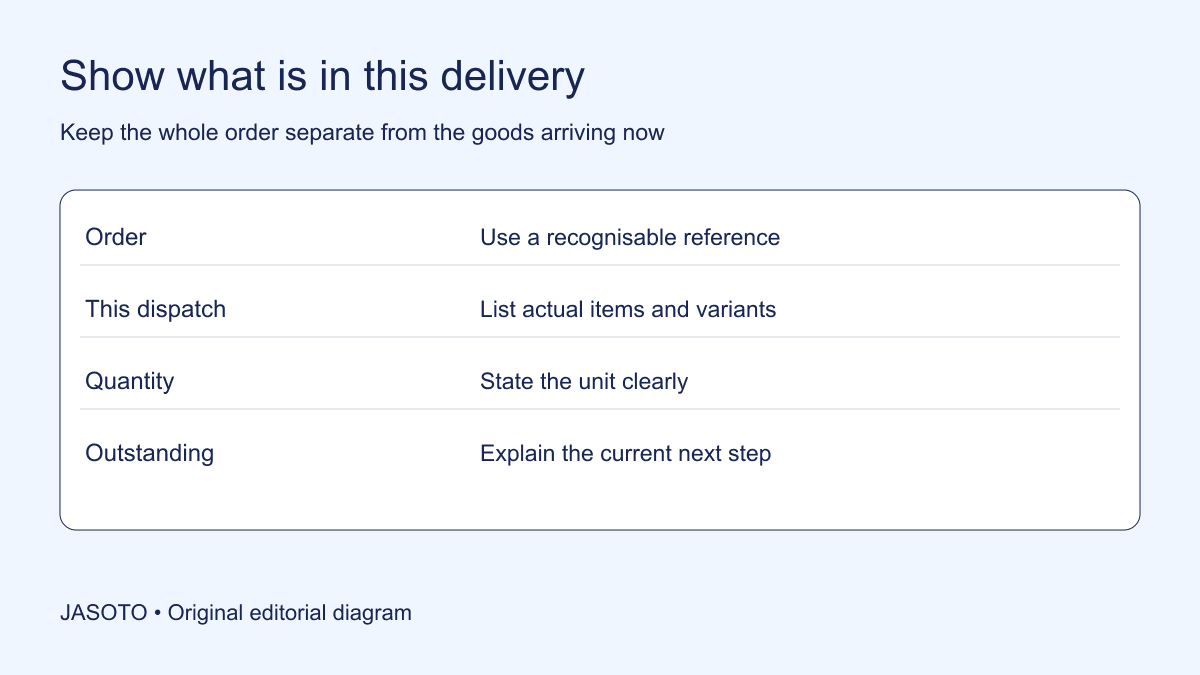
Original JASOTO editorial diagram. Its complete workflow is explained in the article; no actual customer outcome is depicted.
A clear delivery note identifies the order, lists the goods in this delivery and explains anything still outstanding. Use recognisable product names, exact variants and understandable quantities. Give the customer a contact route connected to the reference on the page. Someone opening the packages should be able to compare the document with what arrived without reconstructing the original sales conversation.
For a small UK retailer or supplier, the note is a practical handover between dispatch, the recipient and customer service. This original guide focuses on ordinary goods documentation. Invoice rules, contractual acceptance and specialist traceability requirements need their own appropriate process. The worked example uses an invented order of office stationery arriving in two dispatches.
The practical answer
- Identify the order and the items in this delivery.
- Make quantities and units understandable.
- Separate supplied goods from items still outstanding.
- Explain the document's purpose and the next contact route.
State what the document records
Use a clear title and explain its role where ambiguity is likely. A delivery note can record the contents of a dispatch while a separate invoice records charges. [GOV.UK's invoice guidance](https://www.gov.uk/invoicing-and-taking-payment-from-customers/invoices-what-they-must-include) sets out invoice information requirements; do not assume a delivery document automatically satisfies them. Keep each document understandable for the task it actually performs.
If the business combines functions in one document, have the responsible person check the actual commercial and record requirements. Avoid a heading that says delivery note while the body unexpectedly asks for payment or implies a balance has been settled. The customer should understand whether they are checking goods, reviewing charges or doing both through a properly prepared combined record.
Use references the customer can recognise
Include the order reference and a distinct dispatch reference where the business uses one. A customer may know the order number from a confirmation email but never have seen the warehouse's internal batch number. Show the relationship clearly. If the recipient uses a purchase-order reference and it has been appropriately supplied, preserve it accurately rather than abbreviating it beyond recognition.
Check the delivery address and relevant business or recipient details through the actual order process. Do not copy unnecessary private information into paperwork that may be visible during transit. Keep the note linked to the correct dispatch, especially when several orders go to the same building. Similar addresses and familiar customer names are not enough to establish which package belongs with which record.
Write product lines people can interpret
Use the actual item description and relevant variant alongside the internal stock code. A code supports traceability, while the readable name helps a recipient identify what they are checking. Include the distinction that matters: colour, size, pack type or configuration. Avoid assuming that a generic family name explains which version the customer ordered.
Keep supplier jargon out of the main description where a plain equivalent is available. If a technical identifier is necessary, retain it accurately and provide context rather than removing it. The aim is not to replace precise information with vague prose. It is to make the line useful to both the operational system and the person looking at the actual goods.
Make the quantity unit explicit
Write whether the quantity means individual units, packs, cartons or another agreed measure. A line showing six beside a product sold in packs can be interpreted several ways. Check how the order, picking process and delivery note represent the unit. Resolve any mismatch before dispatch rather than leaving customer service to explain why the arithmetic appears wrong.
If a carton contains several product types, distinguish package count from item quantity. Two packages can contain many items; the note should not make those counts look interchangeable. Use a simple layout with labels that match the business's actual process. Ask a colleague to explain the expected contents from the note alone as a practical check of whether the units are clear.
Describe this dispatch separately from the whole order
For a split order, show which goods are included now. Identify outstanding items in a clearly separate part of the record or through an appropriate linked status. Do not print the original full order list without explaining that only part is arriving. A recipient may otherwise spend time searching for a carton that was never dispatched.
Use confirmed information about the remaining items. If timing is still being checked, say that and give the next contact or update point. Avoid entering a hoped-for arrival date as though it were a provider commitment. The delivery note should preserve the real status at dispatch, while the business's current order system handles later changes and customer-service follow-up.
Explain substitutions through the actual approval process
If the business has agreed a different item with the customer, reflect that accurately and retain the relevant approval record. Do not quietly replace the original description with the supplied item and erase the change history. The customer may need to understand why the delivery differs from their original confirmation, and the support team needs a traceable explanation.
Where a difference has not been agreed, follow the appropriate order exception process. A delivery note is not a mechanism for making an unapproved substitution acceptable after dispatch. Keep facts, decisions and commercial consequences clear. Seek appropriate advice for a consequential disagreement rather than assuming a sentence on the paperwork settles the customer's rights.
Give the recipient a useful discrepancy route
Explain how to report a missing or unexpected item and which reference to quote. Use a contact channel the business actually monitors for that purpose. A general website address may be insufficient if the customer cannot find the relevant service route. Keep the instruction short enough to read while checking the delivery.
Ask for relevant information rather than an excessive evidence pack for every enquiry. The order and dispatch references, affected line and factual observation may support the first response. Specific claims or specialist processes can require additional evidence, which should be explained appropriately. Avoid invented universal reporting deadlines or wording that suggests legitimate concerns disappear simply because a generic form was not completed immediately.
Keep signature wording aligned with the process
If a signature or electronic acknowledgement is used, have the responsible person confirm what it records. The employee receiving cartons may be able to acknowledge arrival without examining every item or accepting technical performance. Use accurate labels and the actual agreement. Do not assume that every recipient has authority to accept all commercial and technical matters for the buyer.
Give the delivery team appropriate instructions for discrepancies and unavailable recipients. They should not improvise a declaration that conflicts with the business's process. Preserve what actually happened: delivered, partly handed over, awaiting clarification or another appropriate status. Pre-completing a record to make the dispatch appear finished can create a misleading history when the physical handover differs.
Worked example: stationery in two dispatches
Imagine a customer ordering notebook packs, folders and desk trays. The first dispatch contains notebooks and folders in two cartons; the trays remain outstanding. The note identifies the original order, lists only the supplied quantities in the main dispatch section and separately explains the tray status. Pack quantities and carton count have different labels, so the recipient can compare them without guessing.
The note gives the relevant support route and reference for questions. It does not claim that the remaining trays will arrive on a date the supplier has not confirmed. This invented example makes no assertion about a particular platform or customer's outcome. It shows how a readable dispatch record can distinguish physical contents from the broader order and preserve uncertainty honestly.
Test the layout with a fresh reader
A simple wording check can use a fictional dispatch: Order A contains twelve notebook packs in total; this delivery supplies eight packs in two cartons; four packs remain outstanding with timing awaiting confirmation. Ask the reader to explain each number. If they say the customer receives twelve packs now, the layout is obscuring the distinction. If they say two notebooks arrive, the carton and item units are unclear. Adjust the relevant headings and line structure rather than adding a general warning that leaves the same numbers ambiguous. Repeat the check on the actual generated document.
Ask someone outside dispatch to identify the customer reference, goods arriving, quantities, outstanding items and next contact. Watch where they hesitate. A familiar internal abbreviation may be obvious to the author and meaningless to the recipient. Revise the label or arrangement that caused confusion. Keep the test focused on practical interpretation rather than asking only whether the document looks professional.
Check the actual output format, including a printed copy if that is what travels with the goods. Important information can become unreadable through a small font, a page break or a clipped description. Use the actual system's preview and appropriate verification. A correct template in an editor does not prove that a long real product description survives the final document generation.
Maintain the note as products and processes change
Name the person who updates descriptions and template wording. Review recurring questions from customers and receiving staff. If people repeatedly confuse ordered and delivered quantities, clarify those fields rather than adding an unrelated paragraph of instructions. Preserve the earlier template so a confusing change can be corrected, and avoid claiming a reduction in errors without suitable evidence.
Use JASOTO businesses to discover dispatch or document support and verify relevant capability directly. If maintaining order records becomes continuing work, explore order administration roles within a staffing review. For an agreed collection or depot appointment, research travel after confirmation. A useful delivery note gives the recipient an accurate picture of this handover and a clear route for whatever remains unresolved.
Put the guide into practice
- Match the note to the actual dispatch.
- Check item names, variants and quantities.
- Explain split deliveries without inventing dates.
- Review the note with someone outside dispatch.
Frequently asked questions
Is a delivery note the same as an invoice?
They can serve different purposes. State what your document records and keep any invoice accurate for its own requirements. Do not let a customer infer that a delivery note requests payment unless that is the intended and properly prepared commercial document.
What if only part of the order is delivered?
Identify what is in this delivery and what remains outstanding. Use the actual order references and confirmed next information. Avoid entering an unconfirmed future delivery date merely to fill the form, and give the customer a clear contact for questions.
Does a signature confirm everything is correct?
Use wording and processes appropriate to the actual agreement. Physical receipt, quantity checks and technical acceptance can be different events. Do not present a generic signature field as a universal legal conclusion about the customer's rights or the goods' condition.
Explore JASOTO tools
Discuss the actual packing and document handover requirements with suitable providers.
Explore order administration roles →Consider support where dispatch records and customer queries are ongoing work.
Research a confirmed delivery-related journey →Plan travel for an agreed collection or depot visit after confirming the arrangement.
Continue with JASOTO
Compare your next step
Discover UK businesses, compare services and request written quotes before making a decision.