
Websites & Ecommerce · UK Guide 2026
Click-and-Collect Handover Desk: A Practical Shop Checklist
JASOTO · Updated 5 November 2026 · 1,511 words
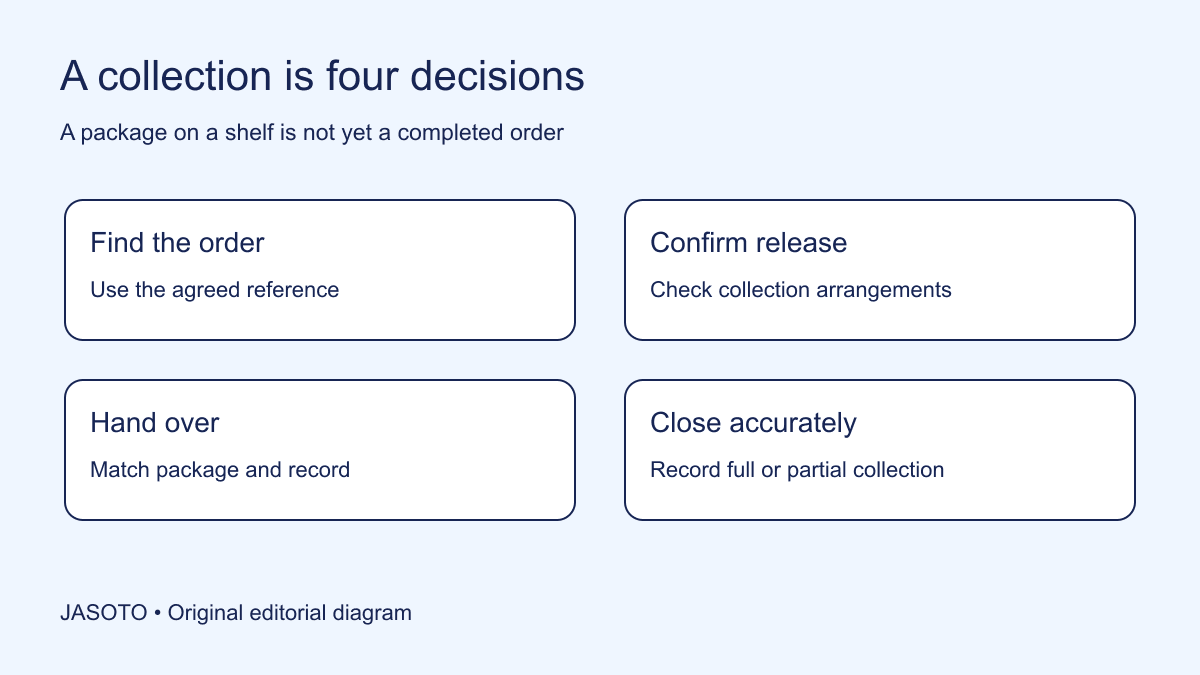
Original JASOTO editorial diagram. Its complete workflow is explained in the article; no actual customer outcome is depicted.
A useful click-and-collect desk lets staff find an order, confirm the collection arrangements, hand over the correct package and record the result. Design those steps before choosing furniture or signage. The customer message, order system and shop-floor routine should describe the same process. Otherwise a perfectly tidy shelf can still produce a confusing queue and unreliable order records.
This guide focuses on the practical handover in a UK shop. It is not a complete ecommerce compliance guide. GOV.UK provides guidance on online and distance selling, while the relevant rules and rights depend on how a transaction is made. The workflow and examples below are editorial recommendations; confirm your terms and applicable requirements before implementing collection policies.
The practical answer
- Separate locating the order from checking that it can be released.
- Make the ready-to-collect message match the actual shop arrangement.
- Keep order details away from unnecessary public view.
- Give exceptions a route that does not stop every other collection.
Follow the customer's journey from the message
Read the ready-to-collect message as someone who has never visited the shop. Can they find the address, collection point, relevant hours and information to bring? Make a distinction between an order acknowledgement and confirmation that goods are ready. Sending a ready message before staff have assembled and checked the order creates a promise the counter may be unable to fulfil.
Check which information is repeated on the website, email and order page. If the shop has a separate collection entrance, describe it consistently. If customers should join the normal queue, say so rather than implying a priority collection service that does not exist. Confirm who updates those instructions during a closure or change of hours. A useful collection journey depends on current information before arrival as much as an efficient exchange at the desk.
Give staff one reliable way to locate the order
Choose a reference that links the customer confirmation, order record and stored package. Staff should know how to search when the customer does not have that reference immediately available. Define an appropriate alternative process without requiring people to shout personal details across the shop. Test the search on the actual devices used at the counter, including during the periods when another till or terminal is occupied.
Organise storage to support the lookup method. A location code on the record can be more useful than a shelf full of packages arranged according to somebody's memory. If names are visible, consider who can see them from the public area. Keep similar orders distinguishable without placing unnecessary customer information on outward-facing labels. A storage system should remain usable when the colleague who packed the order is on a break or working elsewhere.
Define what makes an order ready
Use an internal preparation check that matches the order: correct items, quantities, variants and any agreed extras. Check the package against the current record, especially if the customer changed the order after placing it. A packed box that contains the earlier version is not ready simply because it has a label. Give staff a way to flag uncertainty before the customer is told to travel.
Record partial readiness honestly. If an order contains several items and one is unavailable, decide who contacts the customer and which options may be offered. Do not let an automated message imply that everything is waiting at the counter when staff already know otherwise. This is a communication recommendation, not a universal statement about the remedies owed in a particular transaction. Your operational record should support the correct policy rather than silently substitute for it.
Separate collection authorisation from finding a name
Finding an order is not automatically sufficient to release it. Decide what your business requires to confirm an ordinary collection and how someone can collect on another person's behalf. Explain the arrangement clearly before arrival and train staff in the exceptions. A policy that exists only in one manager's head will be applied inconsistently, particularly when the manager is not available.
Keep personal-data collection proportionate. The ICO's minimisation principle concerns using information that is adequate, relevant and limited to the purpose. Do not photograph or copy identity documents by default merely to make a collection record look thorough. If particular products or transactions need additional checks, obtain appropriate guidance and create a suitable process. An administrative blog cannot establish which verification method is sufficient for every product, customer or legal requirement.
Lay out the handover area around the task
Place the staff lookup point, waiting space and handover surface so people understand what happens next. Try the task with the packaging you actually use. A large box may need a different arrangement from a small envelope, and a stack of returned goods should not be confused with orders waiting to leave. Keep the distinction visible to staff without filling the public area with internal process notes.
Consider the full shop flow: arriving customers, existing tills, deliveries and people who need assistance. Ask staff to identify where queues currently cross or where packages are temporarily placed without an owner. Improvements may be as simple as a clearer sign or an agreed staging shelf. Do not make an unsupported claim that a particular counter height or aisle layout meets accessibility or safety requirements; check the relevant arrangements for your premises and customers.
Give exceptions a separate owner
Typical exceptions include a missing reference, an order that cannot be found, a changed collection person and a damaged package. Give staff a clear next step and a person able to resolve the problem. If the issue needs further discussion, decide where that can happen without exposing private details or stopping every other transaction. Moving someone aside without assigning help merely creates a second queue of unresolved work.
Record the actual outcome. If part of an order is collected, the record should show what remains and who will follow up. If a customer decides not to collect after discussing an issue, staff should use the applicable cancellation or return process rather than invent a status. GOV.UK's selling guidance is a starting reference for the broader obligations; a shop should distinguish its practical handling choices from rights that cannot simply be removed by a counter notice.
Worked example: two similar orders for different workshops
Imagine a craft shop preparing two orders with similar customer names. One contains materials for a Saturday workshop and the other for a later event. This is an invented scenario. Staff use unique order references and shelf locations instead of relying on names alone. Before marking the Saturday order ready, a colleague checks the item quantities and the latest customer change against the package.
At collection, the staff member locates the record, follows the shop's release process and matches the package label. A missing accessory is identified before the whole order is marked complete. The colleague explains the available next steps and records what was actually handed over. The process has not guaranteed an error-free service; it has made the relevant checks visible at the moment they matter. A simple handover surface is useful because the staff can inspect the record and package together.
Plan for capacity and bulky collections
Review periods when collections compete with other work. If staff repeatedly abandon one task to search for packages, change the storage, shift coverage or customer instructions. JASOTO jobs can help research retail staffing when demand justifies a role. JASOTO businesses can help discover relevant support providers, but give them the problem to solve rather than assuming a new system is always necessary.
For bulky items, communicate confirmed size and collection conditions before the customer travels. Avoid promising staff assistance or vehicle suitability without checking. Customers can research journeys through JASOTO travel, then confirm transport directly with the provider. A trip that reaches the shop may still be unsuitable for carrying the order. The ready message should give customers enough relevant information to plan without implying that the retailer has assessed their particular vehicle or journey.
Rehearse the process before calling it finished
Run one ordinary collection and one awkward case with the people who will use the desk. Ask a colleague to arrive with only the customer message. Can staff locate the order, follow the agreed release arrangement and close the record correctly? Then test an order with a missing item. Watch where staff need undocumented knowledge or access to a manager who is not always available.
Record those gaps and change the smallest useful part of the process. After implementation, review actual enquiries and corrections rather than claiming a faster service because the desk looks organised. Compare similar busy periods if you measure time, and distinguish full handovers from unresolved exceptions. The desired result is a collection that is understandable to the customer and traceable for the shop: the correct package goes to the intended collector, while any unfinished action remains visible and owned.
A concise completion record might contain the order reference, items released, collection time, staff identifier and any remaining action. Choose fields your team will actually review, and keep unnecessary personal detail out of free-text notes.
Put the guide into practice
- Walk through one collection from customer message to completed record.
- Use order references that staff can locate consistently.
- Check packages before telling customers they are ready.
- Define an exception owner and a handover step.
Frequently asked questions
Does the collection desk need its own till?
Not necessarily. Base the arrangement on the tasks staff must complete and the volume of collections. A clearly identified existing counter can work if people know where to wait and staff can access the order record.
Should every customer show photo identification?
Do not adopt a blanket requirement without considering the actual need and appropriate policy. Decide how orders are authorised for collection, explain the process clearly and avoid copying identity documents merely because it seems convenient.
What if one item in an order is missing?
Explain the position, check the order and offer the options permitted by your terms and applicable rights. Record any agreed partial collection accurately. Do not mark the entire order complete just to clear the queue.
Explore JASOTO tools
Continue with JASOTO
Compare your next step
Discover UK businesses, compare services and request written quotes before making a decision.