
Jobs & Careers · UK Guide 2026
Close a Recruitment Round With an Organised Record
JASOTO · Updated 5 November 2026 · 1,556 words
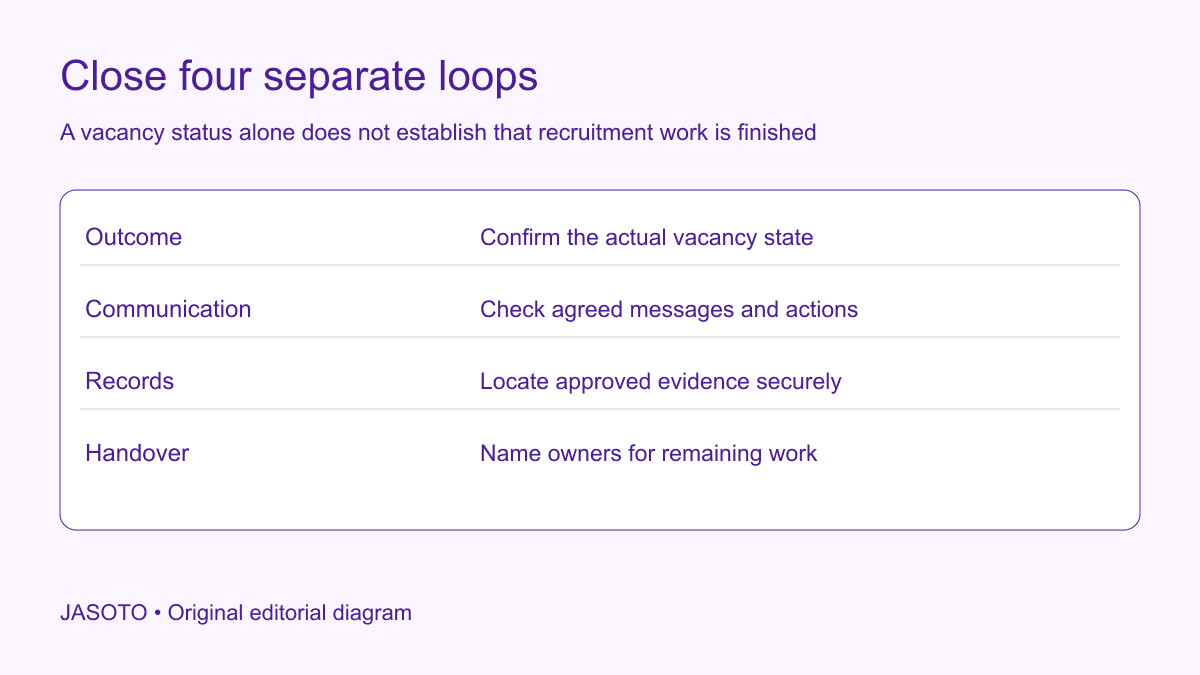
Original JASOTO editorial diagram. Its complete workflow is explained in the article; no actual customer outcome is depicted.
Close a recruitment round by reconciling the vacancy's actual status, candidate communications and approved decision records before archiving the working material. Give every unfinished action an owner. A vacancy marked closed in one spreadsheet can still have unanswered applicants, an unconfirmed offer and interview notes scattered across personal folders. Those are different kinds of unfinished work, and one completion tick should not conceal them.
This guide offers an original administrative close-out method for a small UK hiring team. Acas's selection guidance connects decisions with the information and role requirements used in the process. Use current recruitment, privacy and retention arrangements established by your organisation, obtaining appropriate specialist advice where required. This article proposes a coordination record; it does not prescribe a universal legal retention period or authorise deleting evidence because recruitment has ended.
The practical answer
- Confirm the actual vacancy outcome.
- Reconcile candidates and communications separately.
- Keep evidence in approved systems.
- Assign every unfinished action an owner.
Establish what closed actually means
Ask the recruitment owner to confirm the outcome: appointment accepted, offer outstanding, vacancy paused, recruitment cancelled or no appointment made. Use the status that describes reality. An advert disappearing from the website is only a publication change. It does not establish that the business has appointed someone or that every applicant has received the appropriate communication. Record who confirmed the status and when.
Separate the vacancy outcome from each candidate's outcome. A successful applicant may still have an unresolved next step, while another candidate may be waiting for a promised update. Avoid putting speculative comments about people into the administrative summary. The close-out owner needs enough information to route work and establish what remains open, rather than a duplicate narrative of the entire selection discussion. Keep detailed candidate records in the approved location and link to them through the appropriate permissions.
Reconcile applications against the working process
Compare the approved application source with the hiring team's working list. Identify withdrawn applications, duplicate entries, late submissions handled through the agreed process and any missing status. Do not silently discard a record simply because it appears inconvenient or does not match the spreadsheet. Ask the recruitment owner how the discrepancy should be resolved, and retain a traceable correction where the organisation's process requires it.
For an invented office administrator vacancy, the form system contains twelve applications while the meeting list contains eleven. The close-out check finds that one application was received after an export and has not been assessed. The coordinator does not invent a rejection to make the totals match. They raise the discrepancy with the responsible decision maker and record the agreed next action. Reconciliation is useful because it exposes unfinished work; its purpose is not to produce attractive totals regardless of the evidence.
Preserve the approved basis for decisions
Identify the role description, person specification and assessment material actually used. Keep the approved versions associated with the round through the organisation's normal record arrangements. A later edited job description should not accidentally replace the version applicants saw. If the team used structured notes or a scoring method, ensure the relevant approved records are stored where authorised people can retrieve them.
Do not rewrite interview notes after the event to make them more polished or consistent with the outcome. If a factual correction or clarification is needed, follow the proper process and distinguish it from the original record. The administrative summary can identify that clarification is outstanding without judging the decision itself. A tidy folder is not a reason to erase uncertainty or turn an informal memory into contemporaneous evidence. Keep professional decision review with the people authorised to perform it.
Check communications separately from decisions
For each appropriate communication, record whether it was prepared, approved and sent through the agreed channel. These are distinct states. A draft saved in a folder does not establish that the applicant received it. Where the business tracks acknowledgements or delivery problems, follow that system rather than claiming receipt merely because someone clicked send. Keep personal contact details in the appropriate recruitment system rather than copying them into a broad close-out report.
Check promises made during the round, including expected update dates and any agreed feedback route. Assign overdue actions to the recruitment owner or named delegate. Do not send speculative explanations on the hiring team's behalf. If an applicant asks a question requiring a substantive decision, route it to the right person. The coordinator can make the outstanding action visible while preserving the boundary between managing communications and inventing a rationale for an employment decision.
Transfer the successful applicant's next steps
Where an appointment proceeds, establish who now owns the transition into joining arrangements. Link the recruitment record to the approved next process without copying every application detail into an onboarding pack. The person arranging equipment needs practical information relevant to that task; they do not necessarily need all interview notes. Confirm the actual handover and the responsible receiving contact instead of assuming the manager will notice a status change.
List unresolved dependencies using careful language. A proposed start date is different from an agreed one, and an outstanding check should not disappear under a green completion label. Use the organisation's approved process for checks, offers and employment information. The close-out record can show the dependency and owner, while sensitive details remain with the appropriate team. This keeps the administrative handover useful without making the general recruitment summary a second repository for private records.
Close public notices and external activity
Identify every place the vacancy was published or distributed. Ask the responsible owner to update each channel when the status changes, using the approved wording. A closed vacancy on the business website may remain advertised through another service. Record what was checked and any pending supplier action. Do not assume that removing the original advert automatically updates copies or stops every automated message associated with it.
Where an agency or service provider supported recruitment, confirm the agreed close-out actions and any outstanding commercial matter with the accountable business contact. Do not place unverified charges or contractual interpretations in a general lessons note. If additional support is required, find business service providers and specify the narrow record or process problem. Keep enquiries free of unnecessary candidate material until an appropriate arrangement for sharing information is established.
Review access and storage through existing policy
List the working locations used during the round, such as the recruitment platform, approved shared folder and relevant administrative tools. Ask the authorised owner to confirm who still needs access. End temporary access through the supported process when appropriate. Do not ask someone to circulate passwords or export all material to a personal drive as an archiving shortcut. Access review and evidence retention are related tasks, but they are not the same decision.
Apply the organisation's established retention and deletion arrangements, including any specific reason material must be preserved. If no suitable arrangement is clear, escalate the gap to the responsible privacy or HR contact. Avoid choosing an arbitrary number of months from an unrelated online template. Record the responsible owner and review point rather than treating uncertainty as permission to retain everything indefinitely or delete everything immediately. The close-out process should make that decision visible and accountable.
Capture lessons without rating individual applicants
Review the recruitment workflow using process questions. Which instructions generated repeated questions? Did interview invitations contain the correct location? Was an application field difficult to interpret? Separate those observations from commentary about applicants. An improvement note does not need identifiable candidate details to explain that the invitation should include an arrival contact or that the task brief used an unexplained acronym.
Choose a small number of improvements with owners and expected benefits. For example, revising the invitation may reduce avoidable uncertainty about arrival; testing the form may reveal where instructions are unclear. Describe those as expected benefits until there is evidence after a later round. Do not claim that a cleaner template has already improved hiring quality. Keep the earlier approved version so an unhelpful change can be reviewed and reversed through the normal process.
Confirm the close-out with the accountable owner
Prepare a concise final view: vacancy status, communication status, receiving owner for the appointment process, record location and remaining actions. Ask the recruitment owner to check it. A useful confirmation identifies the few matters still open rather than implying perfection. If an unresolved issue prevents closure, retain a clear status and review date instead of forcing a completed label to satisfy a reporting deadline.
For a future round, use the lessons when planning roles or exploring job opportunities. If a visiting candidate or supplier still has an agreed appointment, confirm its status before anyone plans travel. The practical outcome is a round whose decisions and remaining responsibilities can be found by authorised people. If the close-out summary proves inaccurate, correct the status, restore the last reliable record where appropriate and contact the responsible owner. Organisation should make the evidence easier to follow, rather than make unfinished work harder to see.
Put the guide into practice
- Check application and decision records.
- Confirm communication status.
- Transfer joining responsibilities.
- Apply approved access and retention rules.
Frequently asked questions
Can the round close while an offer is outstanding?
Use a status that explicitly says the offer remains outstanding, and give the next step an owner. Whether your organisation calls that stage closed or active depends on its process. The important point is that the label must not conceal a dependency or stop necessary communication with other applicants.
Should the close-out summary include all interview notes?
Keep detailed notes in the approved recruitment record and give authorised people the correct route to them. The summary should identify status, owners and record locations without duplicating unnecessary personal information. Follow the organisation’s established access and retention arrangements for the underlying material.
What if records disagree?
Preserve the discrepancy and ask the responsible owner to resolve it. Do not rewrite a candidate outcome or delete an application merely to reconcile totals. Record the approved correction or next action, then check that the maintained source and administrative summary describe the same position.
Explore JASOTO tools
Discover providers and check support for your specific task.
Explore roles and responsibilities →Consider the practical responsibilities involved when recruiting or joining a team.
Plan work-related travel →Research a journey when joining, training or meeting colleagues in person.
Continue with JASOTO
Compare your next step
Discover UK businesses, compare services and request written quotes before making a decision.