
Business Growth · UK Guide 2026
Close a Supplier Account Without Losing Key Files
JASOTO · Updated November 5, 2026 · 1,633 words
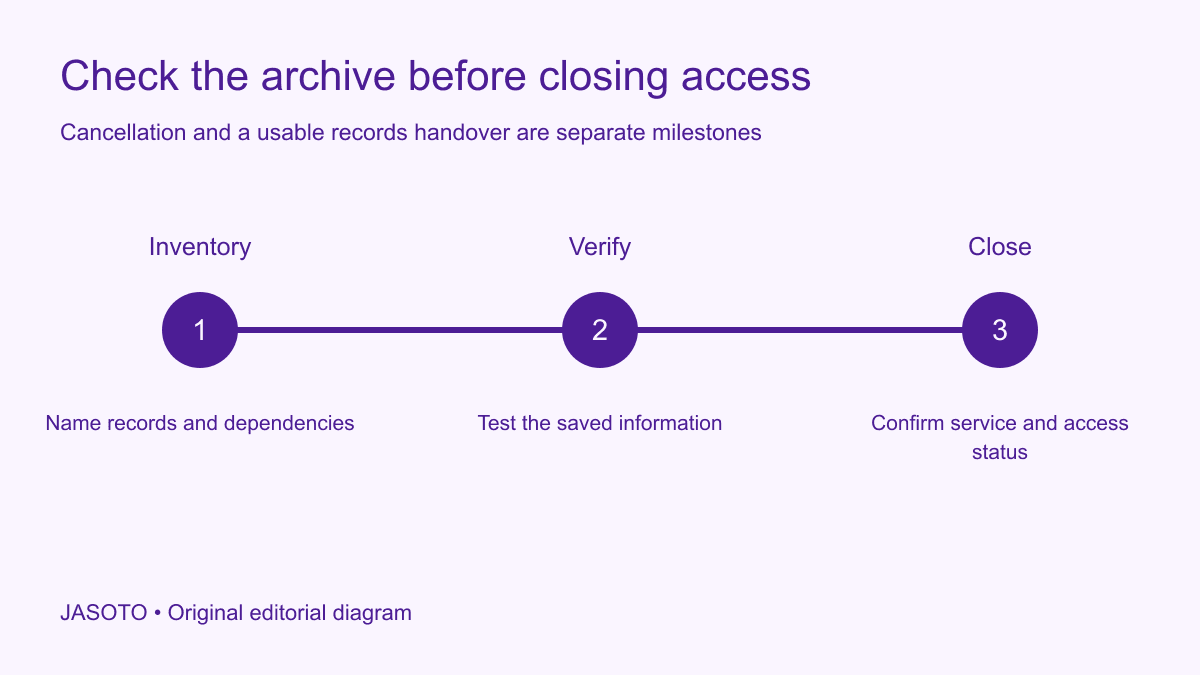
Original JASOTO editorial diagram. Its complete workflow is explained in the article; no actual customer outcome is depicted.
Close a supplier account only after identifying the important records, checking the actual export options and confirming that saved information is usable by the people who will need it. Then follow the authorised cancellation and access-removal process. A cancellation confirmation does not prove that an archive is complete, and a downloaded file does not prove that the service has stopped renewing.
For a small business in the United States, this is particularly relevant to online service portals, subscription tools and supplier accounts containing invoices, project files or support history. The method below is original administrative guidance, not a determination of tax, legal or regulatory retention. Use appropriate advice for those obligations and the actual provider's current terms for cancellation and data availability.
The practical answer
- Identify information and dependencies before cancelling access.
- Check the provider's actual export and account-closure rules.
- Test saved files with the colleague who will need them.
- Separate record preservation, service cancellation and access removal.
Name the owner of the closure
Choose one person to coordinate the account closure and identify the people responsible for the information it contains. Accounts may own invoices, operations may own project records and an administrator may control access. These responsibilities can overlap without being identical. The coordinator should bring the relevant owners together rather than deciding alone that every file is either essential or disposable.
Record the reason for closure and the intended end state. Are you ending a service, changing supplier, consolidating accounts or replacing an employee-owned arrangement with a business account? Each can create different dependencies. Keep the purpose practical and specific. A vague instruction to tidy old accounts can lead to premature cancellation of something another team still relies on.
Inventory the information before pressing cancel
List the record types the account holds and where they appear: invoices, orders, specifications, attachments, support conversations or configuration documents. Ask the people who use the service what they actually retrieve from it. A visible dashboard may hide records behind separate project pages or another billing area. Do not assume the main export button includes everything simply because it is labeled download data.
Record which information is already stored appropriately elsewhere and which exists only in the supplier account. Avoid making unnecessary duplicate archives of personal or confidential information. The question is what the business should retain for a defined purpose and how it can do that appropriately. Obtain relevant retention advice where needed rather than inventing a universal period for all account contents.
Check the provider's current closure rules
Read the terms and help information for the actual account type, purchase route and service. Ask what changes when cancellation is requested, when the subscription ends and when data may become unavailable. These can be different events. Do not apply another provider's grace period or assume that a familiar brand uses the same lifecycle for every product and contract.
For example, [Microsoft's business subscription guidance](https://learn.microsoft.com/en-us/microsoft-365/commerce/subscriptions/what-if-my-subscription-expires?view=o365-worldwide) describes changes in data and access as a subscription ends and recommends backing up data before deletion. That example is not a timetable for your supplier account. Confirm the particular rules and record the source and date checked, especially where an agent, reseller or different agreement affects the process.
Identify dependencies beyond the files
Check whether the account supports another business activity: automated reports, a shared link, a customer form, an integration or notifications sent to colleagues. Ask the responsible administrator to review relevant connections. Ending access may affect these functions even when every visible document has been downloaded. A records inventory and a service-dependency review answer related but different questions.
Name an owner for replacing or ending each dependency. Do not assume that creating a new supplier account automatically redirects old links or integrations. Test the intended replacement through the appropriate authorised process. If a dependency cannot be moved before the proposed closure, show it as an unresolved condition and decide the next step with the responsible person rather than hiding it inside a completed export task.
Use the proper business access route
Confirm who is authorised to export, cancel and manage users. The everyday user may not hold the required administrative role. If the original account owner has left, ask the provider and business administrator for the proper recovery or transfer process. Avoid using a former employee's private credentials or circulating passwords as a convenient way to get the files out.
Check whether another organisation or client owns some information. Access to a shared workspace does not automatically establish unrestricted permission to copy its contents. Clarify the relevant entitlement and confidentiality arrangements. The archive should preserve the business's appropriate records, not become an indiscriminate collection of everything the account technically permits someone to download.
Plan an export that preserves usable context
Ask what export formats are available and what each includes. A spreadsheet may preserve rows while losing attachments or conversation history. A PDF may be readable but less useful for later filtering. The suitable format depends on the purpose. Record any limitation and identify whether a separate export or provider assistance is needed for an important record type.
Give exported files meaningful names and keep an index connecting them to account, project and date references. Preserve relevant original identifiers. Avoid renaming everything into a simplified sequence that removes the link to an invoice or service enquiry. The next colleague should be able to trace a saved record back to the business event without needing access to the account that has been closed.
Test the archive with its future user
Open a representative set of saved records using the systems the business expects to keep. Ask the relevant records owner to locate a known invoice, attachment or decision from the index. Check that the information needed for its purpose is present. A successful download notification only confirms that a transfer occurred; it does not establish the completeness or practical usefulness of the contents.
Record test limitations honestly. Reviewing several examples does not prove every file is intact. For consequential or large archives, obtain appropriate technical advice about verification. Do not manufacture a precise completeness percentage from an informal spot check. The administrative goal is to discover meaningful problems while the provider can still help, and to make unresolved uncertainty visible before cancellation removes options.
Worked example: ending a project portal account
Imagine a small business ending a supplier portal after a completed project. The coordinator lists invoices, approved specifications and support history. The first export contains project documents but not billing records. Accounts identifies the missing invoices, while operations checks that the saved specifications retain their version references. The coordinator obtains the appropriate additional records through the provider's authorised process before confirming closure readiness.
A shared link in an internal guide also points to the portal, so the responsible colleague updates it and checks the replacement location. This invented example does not promise that every provider supports exports or restores deleted data. It shows why the test should involve the future users and connected processes, rather than treating the account owner pressing download as the entire handover.
Separate cancellation from access cleanup
Once the required conditions are met, use the provider's actual cancellation process and save the confirmation. Check the effective date, service status and any remaining billing arrangement. Do not assume that removing a payment method cancels a contract or that deleting a user ends a subscription. Ask the provider to clarify a mismatch rather than relying on the appearance of a dashboard.
Handle account access, integrations and credentials through the business's appropriate administrative and security process. Some actions may need to occur before cancellation and others afterwards. The sequence depends on the service. Record who owns each step and confirm what actually happened. An unchecked task named remove access should not become evidence that every connection has ended.
Keep the archive accessible and appropriately controlled
Store the retained records in a suitable business location with access aligned to their contents. An unencrypted personal device or an employee's private mailbox may not be an appropriate archive. Use the business's established controls and obtain specialist help where needed. Make sure an authorised substitute can find the index without depending on the person who coordinated closure.
Apply the appropriate retention and disposal approach over time. Preserving important records does not mean keeping every export forever. Record the owner responsible for reviewing the archive and any relevant requirements. If the archive is migrated later, preserve its context and check usability again. A file that exists but cannot be found, opened or understood may not serve the purpose for which it was retained.
Finish with a closure record someone else can understand
Check whether unresolved support enquiries still depend on the account portal. Save the relevant reference and ask the provider how correspondence will continue after access ends. Do not assume an exported conversation preserves a working route for replying. The final record should identify any matter still awaiting a response and the appropriate contact channel now available to the business.
Save a short final note identifying the account, closure reason, effective date, retained-record location and unresolved matters. Include the provider confirmation and relevant export limitations. Ask an authorised colleague to explain the end state from that note. If they cannot tell whether the service ended or where invoices now live, clarify it before the original coordinator moves to another task.
Use JASOTO businesses to discover suitable migration or administrative support and verify capability directly. If supplier and records ownership becomes continuing work, explore operations administration roles within a staffing review. For a confirmed physical handover, research travel after the appointment is agreed. A successful administrative closure leaves a clear service status and usable, appropriately retained information, with uncertainty recorded rather than concealed.
Put the guide into practice
- Name the closure owner and records owners.
- Check current terms, timing and export options.
- Test appropriate saved records and resolve missing information.
- Confirm cancellation and remaining access through the authorised process.
Frequently asked questions
Is downloading a ZIP file enough?
Check what it contains, whether it opens and whether the relevant colleague can use it for the required purpose. An export can omit attachments, context or another record type. Preserve only information the business is appropriately entitled and required to retain, using suitable access controls.
Should the account stay open forever as an archive?
Do not assume that is the right retention method. Consider the actual service terms, ongoing cost, security, access and record requirements. A suitable independent archive may be preferable, but its contents and retention need a considered decision rather than copying everything indefinitely.
Can a former employee's login be used for the export?
Use an authorised administrative process and appropriate business access. Do not rely on shared passwords or an absent person's private account. Ask the provider and the business's responsible administrator how to obtain the required records lawfully and securely.
Explore JASOTO tools
Discuss the particular export and handover requirements with suitable specialists.
Explore operations administration roles →Consider support when maintaining supplier and records ownership is ongoing work.
Research a confirmed handover journey →Plan travel if an agreed records or equipment handover requires attendance.
Continue with JASOTO
Compare your next step
Discover UK businesses, compare services and request written quotes before making a decision.