
Business Growth · UK Guide 2026
Record Collection Authorization With Less Data
JASOTO · Updated November 5, 2026 · 1,611 words
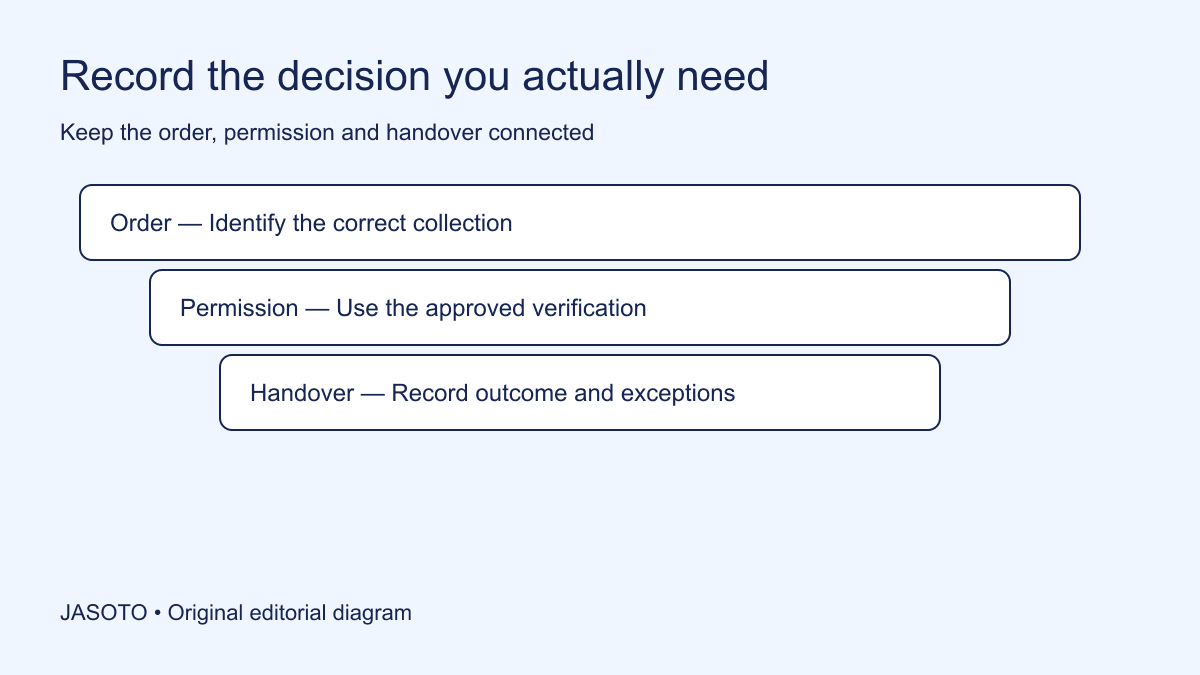
Original JASOTO editorial diagram. Its complete workflow is explained in the article; no actual customer outcome is depicted.
Record collection authorization by identifying the order, confirming permission through an approved proportionate process and recording the handover outcome. Start with the decision the employee must make, then ask which information genuinely supports it. Do not build a form that copies personal documents by default simply because more data appears to offer more certainty.
This guide gives small retailers in the United States an original administrative method for ordinary order pickup. It does not establish the rules for regulated goods, identity verification or a particular dispute. Those may require specialist advice and different procedures. The aim is a useful operational record that connects permission to the correct order while keeping unnecessary personal information out of everyday collection workflows.
The practical answer
- Define the handover decision before designing the form.
- Use a proportionate approved verification process.
- Record the authorization outcome without automatically copying identity documents.
- Separate operational needs from retention and legal requirements.
Define the handover decision first
Write the question the collecting employee must answer: is this the right order, is it ready and is this person permitted to receive it under the business's process? These are separate checks. A collector can correctly identify an order that is not ready, while a ready package may still need authorization. Do not let an order number alone silently answer every part of the decision.
Identify which order types require a different process. Some goods or arrangements may have specific requirements beyond an ordinary pickup. The responsible person should determine those rules and train staff appropriately. A generic low-data form must not be used to bypass a requirement that actually applies. Keep the scope explicit so employees know when to use the ordinary process and when to seek the relevant specialist instruction.
Separate the purchaser from the collector
A customer may want another person to collect. Ask how the business allows that permission to be given and changed. Keep the purchaser's authorization connected to the order and the proposed collector. Avoid relying on an informal note passed through several people without a way to establish its source. The process should be understandable before someone stands at the collection desk.
Do not assume that a family relationship, shared surname or possession of a forwarded message settles permission. Equally, do not make employees invent intrusive requirements in response to an unfamiliar situation. Give them an approved verification method and an escalation contact. A proportionate process supports consistent treatment while preserving a route for exceptions that the standard form cannot resolve.
Decide what information supports the process
Review a proposed form field with a practical question: what decision changes if this box is completed? An order reference helps identify the transaction, while an unrestricted free-text field may invite irrelevant personal information. If an exception note is necessary, give staff a clear factual purpose, such as recording which authorization step remains unresolved. Avoid instructions that invite them to describe a customer's private circumstances. A better field can make the record both more useful and less intrusive without weakening the approved permission check.
List each proposed field and the reason it is needed. An order reference supports finding the transaction. A relevant authorization record supports the permission decision. Another field may exist only because it appeared in an old template. Ask whether it changes the handover decision or serves an actual requirement. If not, consider removing it rather than preserving it out of habit.
The [FTC's business guide to personal information](https://www.ftc.gov/business-guidance/resources/protecting-personal-information-guide-business) advises knowing what information the business holds and keeping only what it needs. The original form design here applies a narrow operational question: can the business demonstrate the authorized handover without automatically retaining an image of a personal document? Obtain appropriate advice where the answer depends on specific goods, laws or contractual obligations.
Record verification without exaggerating what happened
Use outcome wording that matches the actual approved check. Do not mark identity verified if the employee only matched an order reference. Do not record a successful authorization if the relevant contact could not be reached. Clear statuses such as ready, awaiting authorization check, handed over or unresolved can make the current position visible without requiring unnecessary biographical detail.
If the approved process includes examining a document, distinguish examination from copying or storing it. Those are different activities and should not be conflated in the form. The responsible policy should determine what is appropriate. An employee should not improvise a photograph of a document because the standard system has no field for an exception or because a customer is in a hurry.
Give staff a safe route for uncertainty
Describe common exceptions: changed collector, mismatch with the order, incomplete authorization or a request to split the pickup. State whom to contact and what information to pass on. The employee should not be forced to choose between releasing an order without the approved check and refusing to discuss any alternative. A usable escalation process can preserve both control and ordinary customer service.
Keep the response factual and neutral. “The authorization needs confirmation through our order contact” is more helpful than accusing the collector of wrongdoing. Record what was unresolved and the next step. Avoid adding speculative notes about a person's appearance or motives. Such notes may not support the actual decision and can make the record less fair as well as more intrusive.
Keep authorization changes traceable
If a customer changes the collector, use the appropriate order channel and update the current instruction. Preserve the relationship between the change and the original authorization without leaving several conflicting versions active. Tell the collection team which instruction applies. A correct update in a customer-service inbox may be ineffective if the employee at the desk is following a printed list created earlier.
Record when a change was received and appropriately confirmed. Do not treat every incoming message as authoritative merely because it names the order. The business's process should determine how to verify the request. If that process cannot be completed, keep the status unresolved and explain the next step. Avoid inventing an approval afterwards to make the handover log appear complete.
Limit what the collection team can see
Provide the information needed to find the order, follow the authorization process and record the outcome. Staff at a pickup point may not need the customer's entire service history, unrelated account notes or sensitive documents. Use the system's appropriate access controls and seek technical help where needed. A shared spreadsheet visible to everyone is not automatically the right home for the full record.
Apply the same restraint to printed lists and labels. Do not display private contact details to other customers or attach unnecessary personal information to a package. Ask what the employee needs at the moment of handover and keep supporting information in the proper controlled system. Useful access and limited disclosure can coexist when the workflow is designed deliberately.
Worked example: a customer sends a colleague
Imagine a small office-supply shop preparing a pickup order. The purchaser asks for a colleague to collect through the shop's approved channel. The order record shows that the request has been confirmed and gives staff the appropriate collection instruction. At pickup, the employee follows that process and records the handover against the order without adding unrelated personal details.
A different scenario involves an unconfirmed message naming another collector. The employee uses the escalation route and leaves the order pending while confirmation is sought. These invented examples do not establish a universal identity-check method or guarantee against fraud. They show why the record should distinguish confirmed permission from a request still being checked, while avoiding unnecessary data collection as a substitute for a sound process.
Make the handover record useful later
Capture the order reference, relevant authorization outcome, handover time through the actual system and any appropriate exception note. Identify the employee or process responsible for the entry as required by the business's arrangements. Do not pre-complete the record when the order is packed. Ready for pickup and actually collected are different events with different consequences for customer communication and stock status.
If a dispute arises, preserve the relevant records through the appropriate process. Keep observations distinct from conclusions. A completed field may show what the employee recorded, but it should not be presented as evidence of a check the workflow never performed. Review the actual sequence and seek appropriate advice rather than strengthening the language after the event.
Review retention and unnecessary duplication
Decide where the authoritative completed record lives and who reviews its retention. A collection message may be copied into an order system, inbox and printed binder, each with different access and disposal arrangements. Remove unnecessary duplication through the business's considered process. Do not delete records that should be preserved for an applicable obligation or dispute, but do not keep everything indefinitely without a reason.
Test a revised form with fictional orders and staff who use it. Ask whether they can identify the next action without collecting extra information to compensate for confusing wording. Review actual exceptions after implementation and revise the process where evidence shows a problem. Keep the prior version so a change that obscures authorization status can be corrected or reversed.
Use JASOTO businesses to discover suitable operational support and verify capability directly. If order exceptions become continuing work, explore retail operations roles within a staffing review. For a confirmed pickup, research travel after checking readiness and location. A good collection record supports a defensible, proportionate handover decision and makes unresolved permission visible before the goods leave.
Put the guide into practice
- Identify who may authorise and collect the order.
- Agree verification and exception handling.
- Limit shared instructions to relevant information.
- Review access and retention for completed records.
Frequently asked questions
Must a shop copy every collector's identification?
Do not assume that copying is necessary or appropriate for every order. The required process depends on the goods, risks, applicable rules and business arrangements. Ask the responsible privacy or legal adviser where needed and design a proportionate process rather than collecting documents by default.
Can a customer name someone else to collect?
Use the business's actual authorization process and terms for the relevant order. Confirm what information is needed and how changes are verified. A name appearing in an unverified message should not automatically become permission to release goods.
How long should pickup records be kept?
Choose a retention approach based on the actual business purpose and applicable obligations, with appropriate advice. Do not invent one universal period or keep every identity detail indefinitely. A completed order may require some records while no longer justifying all information gathered during the handover.
Explore JASOTO tools
Discuss practical order and handover support with suitable providers.
Explore retail operations roles →Consider support when managing orders and exceptions becomes ongoing work.
Research a collection journey →Plan travel after confirming readiness, location and the collection arrangement.
Continue with JASOTO
Compare your next step
Discover UK businesses, compare services and request written quotes before making a decision.