
Business Growth · UK Guide 2026
When a Pickup Order Will Not Fit in the Car
JASOTO · Updated November 5, 2026 · 1,607 words
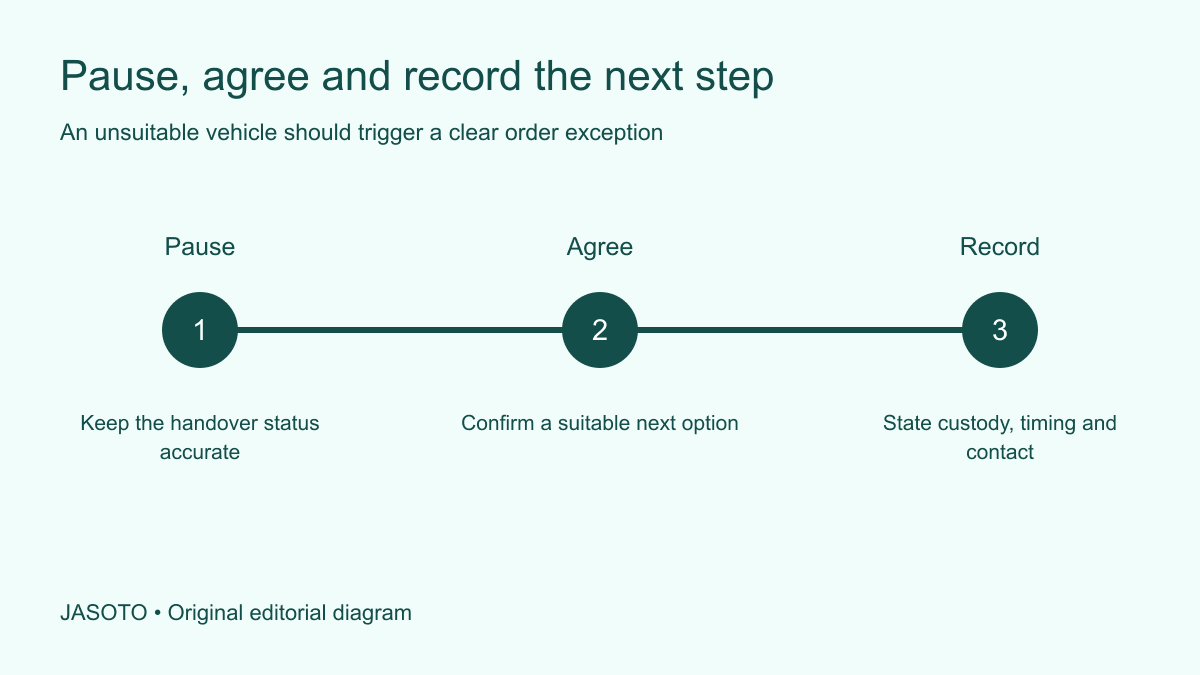
Original JASOTO editorial diagram. Its complete workflow is explained in the article; no actual customer outcome is depicted.
If a pickup order will not fit appropriately in the customer's car, pause the handover and agree a workable next step. Confirm the actual packages, use reliable dimensions and discuss the store's available hold, delivery or revised collection options. Keep the order status accurate while transport is arranged so the customer does not leave with an unclear promise or an unsafe improvisation.
This guide is an original customer-service workflow for small retailers in the United States. It does not provide load-securing, lifting or vehicle-capacity instructions. [NHTSA's load-safety guidance](https://www.nhtsa.gov/drive-safe-secure-your-load) stresses the importance of secure cargo and warns that an item not fitting in the trunk is not resolved simply by attaching it elsewhere. Use appropriate competent advice and the actual vehicle and product information.
The practical answer
- Pause the handover when the planned transport is unsuitable.
- Check packaged dimensions and the actual order contents.
- Offer only confirmed hold, delivery or alternative collection arrangements.
- Keep goods, payment and order status aligned while the next step is agreed.
Pause before turning a fit problem into a loading attempt
Give staff a clear instruction to contact the responsible person when the planned transport appears unsuitable. They should not feel that completing the sale requires finding a way to make the item fit. Use the business's proper handling and safety arrangements. A calm pause creates space to check the facts and discuss alternatives without pressuring a customer to decide while people are waiting behind them.
Describe the problem neutrally. The package dimensions may not have been clear, the customer may have brought a different vehicle or an additional carton may have been overlooked. Do not assume fault before reviewing the order and communication. The immediate priority is a suitable next arrangement; any question about responsibility or charges can be addressed through the relevant commercial process.
Confirm the actual order and package count
Match the pickup order to the item reference, variant and expected number of packages. A product may arrive in several cartons, and the largest dimension may belong to packaging rather than the assembled item. Check the relevant supplier information through the normal process. Avoid judging from a display model that has already been unpacked or assembled.
Record whether all packages are present and ready. If only part of the order is available, that is an additional issue requiring a clear explanation. Do not let the car-fit problem obscure an incomplete order. The customer and store should understand which goods are being discussed before deciding whether to hold everything, arrange another collection or consider an appropriate delivery option.
Use verified packaged information
Provide the dimensions, package count and relevant weight information the business actually has. State the source and any uncertainty. Do not estimate from a photograph or give assembled dimensions as if they describe the carton. If the product information is missing, ask the responsible supplier or colleague for an appropriate confirmation rather than inventing figures to help the conversation move along.
The driver needs to assess transport using the actual vehicle information and appropriate advice. Store staff should not promise suitability based only on a familiar car model or a customer's statement that the seats fold. Available space, safe capacity and load security are different considerations. This guide does not determine them; it asks the business to supply accurate product information and avoid unsupported assurances.
Keep packaging decisions with the right people
A customer may ask to remove packaging or separate components. Ask the appropriate product and handling people what is suitable before any change. Packaging can protect surfaces, keep parts together or support a product-specific handling arrangement. Do not assume that a smaller apparent shape resolves safe transport or that the item can be reassembled in exactly the same condition afterwards.
If an action is appropriately agreed, record what changed and keep components, instructions and references connected. Use the actual order and customer-service process for any commercial consequences. Avoid presenting a generic waiver as a way to bypass safety or applicable rights. A signature cannot make an unsuitable handling method appropriate, and a hurried conversation should not replace a considered product-specific decision.
Offer only options the business can deliver
Check the actual alternatives: a defined hold, a later collection with suitable transport, a separately agreed delivery service or another option available under the order terms. Confirm each before offering it as a promise. A staff member may want to be helpful by saying the shop can deliver tomorrow, but that commitment needs the relevant availability, service scope and approval.
Give the customer enough information to compare the options. State any confirmed charge, timing, collection conditions and service boundary. Use actual quotations rather than invented typical delivery costs. If the option is awaiting confirmation, label it as pending and identify who will update the customer. Avoid leaving a provisional suggestion in the record as though the customer has accepted a booked service.
Define a hold arrangement precisely
If the store can hold the order, record what is retained, where the authoritative status is kept and the agreed next contact point. Use the business's appropriate storage arrangements. Do not promise unlimited storage because the team wants to end a difficult conversation. Check the actual terms and capacity, and explain a realistic arrangement that an authorised colleague can carry forward.
Keep goods custody and payment status clear. An order can be paid while still awaiting collection. Do not mark it collected merely because the customer attended or inspected the packages. Likewise, do not change the payment record to solve an operational status problem. Use the correct process for any refund, cancellation or revised charge, with appropriate advice where the circumstances require it.
Arrange delivery with the actual item in mind
If delivery is considered, give the provider the relevant package details and destination requirements through an appropriate channel. Ask what service is offered and what information it needs. Delivery to a defined handover point, placement and installation may be separate services. The customer should understand the actual arrangement before agreeing, particularly if the original order was pickup only.
Do not assume that an available vehicle means a complete delivery service is available. The responsible provider should consider appropriate handling and access. Confirm the booking and customer contact route. Until those details are agreed, retain the order's unresolved status and name the person following up, rather than telling the customer that delivery is sorted when only a possible provider has been identified.
Keep partial collections clear if they are appropriate
Sometimes the customer asks to take smaller packages now and collect the rest later. Use the business's actual process and confirm whether that is suitable for the product and order. Record the exact packages handed over and those retained. Avoid describing the whole order as complete when only some components have left, especially where similar cartons could be confused later.
Give the customer an understandable record of the agreed position. Identify the remaining item reference and next arrangement without exposing unnecessary personal information on packaging or public collection lists. The next colleague should be able to reconcile the physical goods with the order system. If the business cannot support a reliable partial handover, explain the available alternatives rather than improvising one.
Worked example: a flat-pack display cabinet
Imagine a customer arriving for a flat-pack cabinet, expecting one package, while the order contains two cartons of different sizes. The larger carton is unsuitable for the planned car arrangement. Staff pause the handover, confirm the package information and review the available alternatives with the authorised colleague. They do not remove protective packaging or suggest an improvised external attachment to complete the pickup.
The customer chooses an available later collection option after appropriate transport arrangements are confirmed. The store records both cartons as retained and keeps the paid order awaiting collection. This invented example does not decide who caused the misunderstanding or who owes a charge. It shows how accurate package identity and custody records support a clear next step while those separate questions are handled appropriately.
Improve the information before future collections
Review what the customer saw before travelling. Did the product page show assembled dimensions only? Did the readiness message omit the package count? Did the team advise checking transport without supplying the information needed? Change the relevant communication based on the observed gap. A generic warning to bring a big car is less useful than verified packaged details and a route for questions.
Ask a colleague unfamiliar with the item to read the revised pickup message and explain what they would check before travelling. If the essential information is missing, improve it. Keep the earlier wording so the change can be reviewed. Do not claim that the revision eliminates failed pickups without evidence from comparable orders and actual customer enquiries.
Close the exception with a traceable handover
Tell the next shift about the agreed arrangement through the order record, rather than relying on a verbal message passed between colleagues.
When the agreed collection or delivery occurs, record the actual outcome through the authorised process and reconcile any retained packages. Link the revised arrangement to the original order so customer-service staff can understand the sequence. If the plan changes again, preserve the current status and next owner. An exception should remain visible until the goods and records match the agreed outcome.
Use JASOTO businesses to discover suitable delivery services and verify their actual scope directly. If handover coordination becomes recurring work, explore retail fulfillment roles within a staffing review. For a confirmed revised pickup, research travel after checking the appointment and transport arrangement. A useful response protects the integrity of the order and gives the customer a clear, supported next action.
Put the guide into practice
- Confirm which packages and contents belong to the order.
- Use verified package information and appropriate transport advice.
- Agree the next option and any actual charges or timing.
- Record custody, collection status and the responsible contact.
Frequently asked questions
Should staff help squeeze the item into the vehicle?
Use the business's proper handling process and appropriate transport advice. Do not improvise a loading method or encourage unsafe travel to complete the transaction. If the planned vehicle is unsuitable, pause and agree a workable alternative.
Can the packaging be removed to make it fit?
Ask the appropriate product and transport people before changing packaging. It may protect the item or contain components and instructions. Do not assume removal resolves suitability, safe loading or the customer's rights. Record any agreed action accurately through the business's actual process.
Who pays for another delivery or collection attempt?
Check the actual order terms and circumstances, then explain confirmed options and charges before agreement. This article does not decide responsibility or impose a universal fee. Keep the commercial discussion separate from the immediate decision to avoid an unsuitable transport arrangement.
Explore JASOTO tools
Discuss the actual packaged item and service requirements directly.
Explore retail fulfillment roles →Consider support where order handovers and transport coordination become ongoing work.
Research a revised collection journey →Plan travel after confirming the order, vehicle arrangement and appointment.
Continue with JASOTO
Compare your next step
Discover UK businesses, compare services and request written quotes before making a decision.