
Business Growth · UK Guide 2026
Compare Disposal Arrangements in Service Quotes
JASOTO · Updated 5 November 2026 · 1,602 words
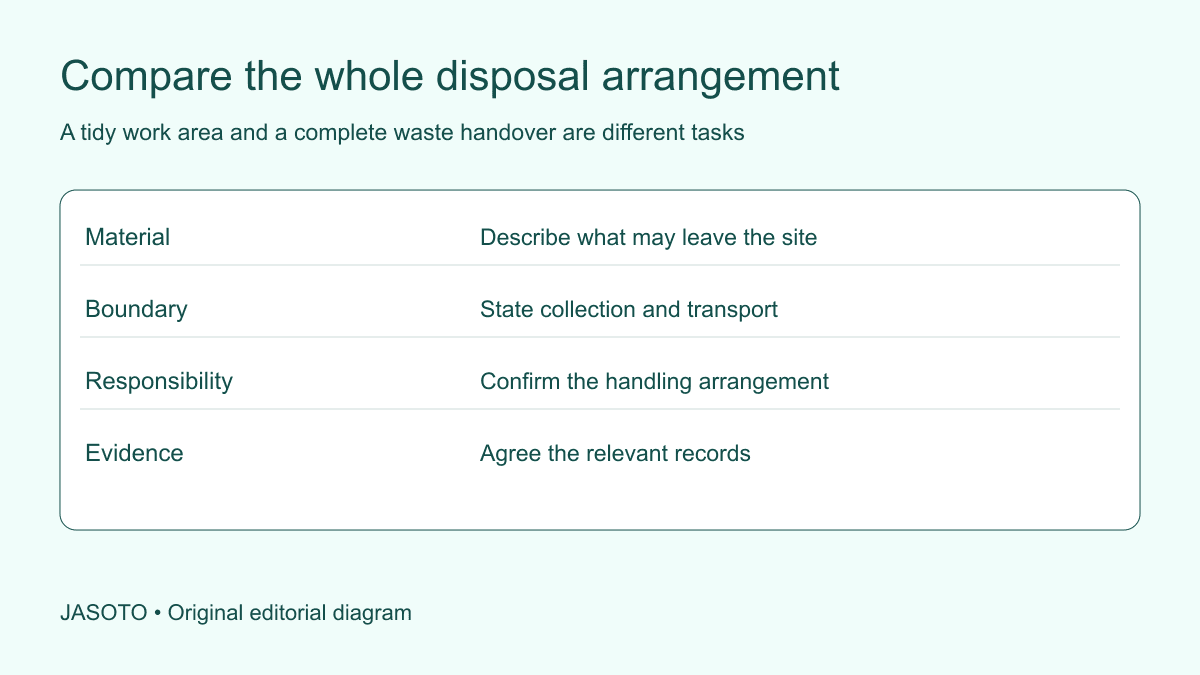
Original JASOTO editorial diagram. Its complete workflow is explained in the article; no actual customer outcome is depicted.
Compare disposal arrangements in service quotations by asking what material is included, where the provider's collection starts, who arranges further handling and which records you receive. A phrase such as “all rubbish removed” is not enough if different bidders assume different quantities, waste types or responsibilities. Resolve those differences before comparing totals or accepting the quote.
This guide is for UK small businesses purchasing services that may leave packaging, removed items or other waste. It offers an original quotation-comparison method, not a waste classification or legal determination. Check the requirements applicable to the actual activity and location. [GOV.UK's business-waste guidance](https://www.gov.uk/dispose-business-commercial-waste) identifies responsibilities around waste handling and links to separate information for Northern Ireland, Scotland and Wales.
The practical answer
- Describe the materials before comparing removal prices.
- Separate removal from the work area, transport and the final handling arrangement.
- Check responsibilities and evidence appropriate to the waste and location.
- Keep excluded items and follow-up records visible.
Describe the materials before asking for a price
List the items or materials expected from the job using the information genuinely available. Distinguish packaging from removed equipment, offcuts or existing items the business also wants cleared. Ask the service provider which details it needs to assess the arrangement. A vague volume estimate may help an initial conversation, but should not become a confirmed specification without an appropriate basis.
Mark unknown material types or quantities openly. Do not ask staff to open, disturb or handle unknown material merely to complete a quote sheet. If assessment is needed, arrange it with a suitable person through the proper process. The quotation should reveal where a specialist answer is required, rather than creating apparent certainty by using the closest familiar category in a form.
Separate the waste created by the job from existing stock
A service may include removing its own packaging but exclude an old item or unrelated stock already on site. Record those groups separately. Otherwise a provider may reasonably price only the waste arising from its work while the customer expects a general clearance. Explain whether you want both groups considered and ask the bidder to identify its actual inclusions.
Keep potentially reusable items distinct while their future is being decided. A business may want to retain an old desk for another office rather than dispose of it. Do not put it on a removal list until the responsible person has decided the intended route. The guide does not decide when something legally becomes waste; it asks the buyer to communicate the real intention and obtain appropriate advice where that distinction matters.
Identify the collection boundary
Ask where the provider expects to receive the material: at the work area, an agreed internal point or another defined place. Moving material within the premises is a task of its own, and the relevant people need suitable arrangements. Do not assume a carrier will enter upper floors or that office staff can safely bring items outside. State the actual service boundary in the comparison.
Confirm when collection occurs relative to the work. A provider might remove material as the job proceeds, collect at completion or arrange a separate attendance. Each can affect space and access. Ask who coordinates the handover and what happens if the planned collection cannot occur. A low price may reflect a different boundary or timing rather than better value for the same service.
Compare responsibility as well as activity
Ask the bidder to state which organisation arranges transport and the intended further handling. If another carrier is involved, clarify how it fits into the service and who provides the relevant information. Do not assume that accepting a single invoice removes every responsibility from the business producing the waste. Check the applicable duties with the appropriate regulator or adviser where the arrangement is unclear.
GOV.UK's guidance includes checking the waste carrier's registration and relevant transfer documentation. Keep any specific compliance check tied to the actual jurisdiction, waste and transaction rather than copying a generic statement into every quote. Ask the responsible person to verify what is required and retain appropriate evidence. A provider's broad marketing claim is not a substitute for the particular checks your arrangement needs.
Ask which materials are excluded
Request an explicit exclusions list, especially where the provider cannot confirm the material from the initial enquiry. Ask what happens if an excluded or unexpected item is found. The next step may require assessment, a revised quote or another provider. Record who decides and how work pauses while the question is resolved. Do not instruct the team to include everything regardless of the quote's assumptions.
Look for wording such as “normal waste” or “standard clearance” and ask what it means in this context. Avoid treating familiar words as technical classifications. If two bidders use the same phrase but include different items, rewrite the comparison in concrete terms. It is better to show an unanswered question than to present an apparently like-for-like price table that conceals materially different arrangements.
Understand how quantity changes the charge
Ask whether the quote is based on named items, estimated quantity, an agreed allowance or another calculation method. Record the basis and any stated limits. If measurement will occur later, ask how it will be evidenced and who approves a change. Do not invent a final total from an approximate quantity just to make one proposal look easier to compare.
Check whether transport, waiting, packaging handling or a second attendance is separately charged. Use actual quoted terms rather than assumed market prices. Where an item may remain for a later decision, ask whether that affects the service or fee. The buyer should understand what would change the price before those circumstances arise, especially if the authorised approver will not be present during the job.
Request evidence that matches the arrangement
Ask which records will be supplied and when. Keep waste documentation, service completion notes and invoices distinguishable because they establish different things. A photograph of an empty room may show that items have left that room, but it does not by itself establish how they were handled afterwards. Likewise, a payment receipt is not automatically the relevant transfer record.
Agree the business contact who will receive the documents and where they will be stored. If a provider sends records to an individual worker, ensure the authorised business team can obtain them appropriately. Do not wait until the supplier account closes to discover that the only copy sits in an unavailable mailbox. Preserve the records according to the applicable requirements and the business's considered retention approach.
Worked example: replacing office storage units
Imagine a practice obtaining quotes to replace several storage units. One quote includes collecting new packaging only. Another includes removal of the old units from an agreed point. A third assumes that all removed items will be ready at the entrance. The headline totals do not describe the same service, even though all three proposals mention leaving the office tidy.
The practice creates a comparison with separate rows for packaging, old units, movement within the building, transport and records. It asks the bidders to clarify the missing points and obtains appropriate advice about the actual waste arrangements. This invented example claims no price saving or compliance outcome. It demonstrates why a concrete list can reveal the work still owned by the buyer before the appointment is booked.
Prepare the site handover after choosing the quote
Give the receiving or site contact the accepted scope, exclusions, provider reference and escalation route. Mark retained items clearly through the business's appropriate process so they are not confused with the agreed collection. Do not expect a visiting worker to infer ownership or intention from where an object is standing. If the list changes, use the agreed approval route before treating the extra material as included.
Confirm the practical arrangements with the relevant site and provider contacts. This article does not provide handling or vehicle instructions; those require suitable planning and competence. The administrative role is to communicate the actual agreed boundary, identify unresolved conditions and keep the handover from depending on guesses made by whoever happens to be nearest when the provider arrives.
Close the service with an honest outstanding list
When reviewing the chosen quote, distinguish a scope misunderstanding from a changed requirement. If the business added items after acceptance, preserve that change and the provider's response. If an inclusion was always intended but never described clearly, improve the next enquiry rather than silently adding it to a standard comparison as though every supplier had priced it. A fair record helps both parties understand the difference. Keep a reusable blank comparison sheet, but remove job-specific assumptions before the next purchase so an old material description does not become an accidental specification for a different service.
After the job, record which agreed items were collected, which remain and why. Check that the promised documents have arrived and route any question to the responsible person. Do not mark disposal complete simply because the work area looks clearer. If an item was excluded or a record is outstanding, preserve that fact with an owner and next step. Keep the original quote and any approved changes together.
Use JASOTO businesses to discover potential service or waste providers, then verify the relevant scope and arrangements directly. If supplier coordination becomes a continuing workload, explore procurement or operations roles within a staffing review. For a confirmed assessment requiring attendance elsewhere, research travel. A useful comparison makes responsibilities visible before purchase and leaves a traceable record after the material leaves the site.
Put the guide into practice
- Identify the items or materials and known uncertainties.
- Ask each bidder to state inclusions and exclusions.
- Check the appropriate waste arrangements with responsible people.
- Confirm handover, documentation and outstanding items after the job.
Frequently asked questions
Does 'leave site tidy' include taking waste away?
Do not assume so. Ask what the phrase means for the particular quote: collecting loose material, moving it to an agreed place, transporting it away and arranging its further handling are different tasks. Have the provider describe the actual service and any exclusions.
Can I compare quotes before the waste is identified?
You can compare provisional approaches, but label assumptions and ask what information is needed for a reliable price. Different materials or quantities may require different arrangements. Do not present a guessed waste type as confirmed merely to obtain a single total.
Are the rules the same throughout the UK?
Check the requirements for the place and activity involved. GOV.UK's business-waste guidance links to separate information for Northern Ireland, Scotland and Wales. Use appropriate specialist or regulator advice when the waste type, responsibility or documentation requirement is unclear.
Explore JASOTO tools
Discuss the actual materials and handling requirements directly.
Explore procurement and operations roles →Consider support when coordinating service records and suppliers becomes ongoing work.
Research a confirmed site journey →Plan travel for an agreed assessment after checking the destination and appointment.
Continue with JASOTO
Compare your next step
Discover UK businesses, compare services and request written quotes before making a decision.