
Jobs & Careers · UK Guide 2026
Compare Interview Notes Against the Role Requirements
JASOTO · Updated November 5, 2026 · 1,612 words
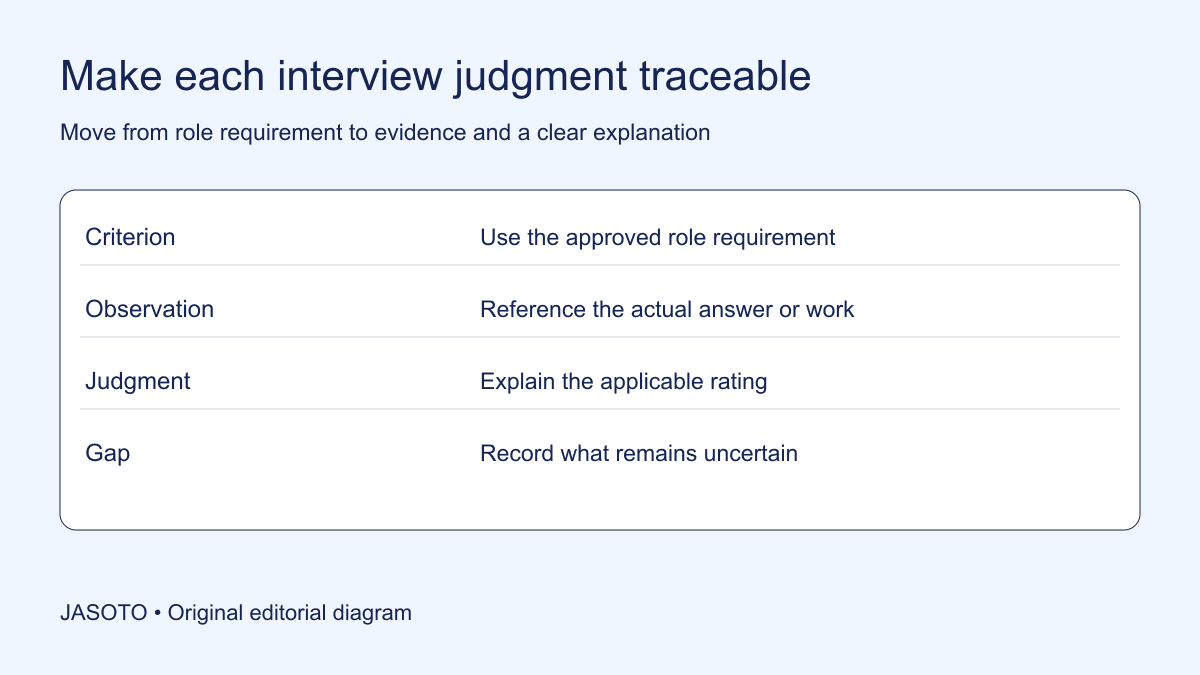
Original JASOTO editorial diagram. Its complete workflow is explained in the article; no actual customer outcome is depicted.
Compare interview notes by taking each approved role requirement in turn, locating the specific evidence collected for it and explaining the judgment using the employer's assessment framework. Record missing or uncertain evidence explicitly so the panel can address it through the proper hiring process.
For a small US hiring team, this approach makes the review easier to inspect than an immediate discussion of overall impressions. It does not replace employment guidance or the organisation's selection procedures. It gives interviewers a practical way to distinguish what a candidate demonstrated from what the panel simply assumed after a conversation.
The practical answer
- Start with the approved role criteria and assessment framework.
- Connect each judgment to a specific answer or observed work.
- Distinguish weak evidence from evidence the interview never collected.
- Resolve panel disagreements through the evidence rather than confident impressions.
Put the approved requirements beside the notes
Use the actual version of the role criteria that governed the assessment. Confirm which requirements were intended to be assessed in the interview and which were addressed elsewhere. A qualification checked through another step may not need a speculative interview score.
Bring the agreed rating descriptions or decision rules into the review. If there is no usable framework, raise that process gap with the hiring lead before panel members invent different private standards. Retrospectively adding a preferred requirement after meeting candidates can distort the comparison.
The US [Office of Personnel Management describes structured interviews using common questions and rating standards](https://www.opm.gov/policy-data-oversight/assessment-and-selection/structured-interviews/). Its guidance concerns federal assessment practice. The worksheet below is an original practical record for discussing evidence, rather than a claim that following it establishes compliance with any hiring law or federal recruitment requirement.
Review each candidate independently first
Give interviewers time to review their own notes before hearing the most confident panel member's conclusion. Each person should identify the relevant answer, the criterion it addresses and the reason for their provisional judgment.
This step makes the later discussion more useful. A panel member can arrive with “the candidate identified two conflicting instructions and explained which fact they would verify” rather than “I thought they were good.” The first statement offers something colleagues can examine.
Do not treat independent review as permission to apply a different standard. Everyone still uses the agreed criteria and rating descriptions. The value is preserving each interviewer's observation before a group narrative forms. If notes are incomplete, state the limitation. Reconstructing a polished answer from memory after hearing another person's score can make the record appear more certain than it is.
Separate observation from interpretation
An observation describes what the candidate said or did. An interpretation explains what an interviewer thinks it means. Both can matter to an assessment, but the link between them needs to be visible.
For example, “asked which deadline had been confirmed with the customer” is an observation. “Understands the importance of checking commitments before changing priorities” is a possible interpretation linked to a role criterion. “Has the right attitude” provides much less clarity about either the evidence or the standard.
Look for judgment words in the notes and ask what supports them. Terms such as confident, polished or experienced can conceal several different impressions. Replace them with the relevant answer or action where possible. Where the role requires a particular communication skill, describe that skill precisely and assess the evidence for it through the approved framework.
Use a compact evidence record
A useful working record has five fields: criterion, evidence reference, observation, judgment explanation and gap. The reference can identify a question number, exercise section or another appropriate assessment record. It should let the hiring lead locate the source without copying the whole interview into every field.
An entry might read: “Request prioritisation; question four; candidate checked the committed deadline before proposing a sequence; supports the framework's relevant prioritisation indicator; no evidence collected on handling an unavailable approver.” The last field preserves the boundary of the evidence.
Use enough detail to explain the judgment without making the worksheet a transcript. Keep personal information and recruitment records within the employer's appropriate access and retention arrangements. A shared review document should serve a defined hiring purpose, with clear ownership, rather than becoming an informal collection of comments copied across unrelated systems.
Distinguish a weak answer from a missing opportunity
When a requirement appears unsupported, check what the candidate was actually asked. Did the question invite the relevant explanation? Was the activity interrupted? Did the panel spend the available time on another topic? These are process questions with implications for the evidence record.
If the candidate answered a relevant question but did not demonstrate the expected reasoning, the panel may have evidence for its judgment under the framework. If nobody asked about the requirement, the panel has an assessment gap. Those situations should not be described in the same words.
Avoid silently filling a gap with an assumption based on a job title, a familiar employer or personal rapport. Ask the hiring lead how the gap should be handled within the recruitment process. Any additional question or activity needs an appropriate, consistent approach; an informal private follow-up can create a new comparison problem.
Discuss disagreements one criterion at a time
Ask each interviewer to state the evidence and the rating explanation for the disputed criterion. Compare the exact observations before debating the overall candidate. This often reveals that panel members are assessing different aspects of the same answer.
One person may reward a quick proposed action while another focuses on the missing check before that action. The panel should return to the agreed requirement and decide which behaviour the framework actually values. Neither speed nor caution is automatically the right answer for every role.
Where the notes conflict, mark the uncertainty and resolve it through the appropriate assessment process. Do not manufacture a consensus by averaging incompatible interpretations without understanding them. If the framework permits a combined rating, record why that rating represents the evidence. A short explanation is more useful than an unexplained number accompanied by a claim that everyone agreed.
Work through a purchasing-assistant example
Consider a fictional interview for a purchasing assistant. One requirement concerns handling an order discrepancy. The candidate explains that the supplier confirmation lists twelve units while the internal request lists twenty. They propose checking the approved request and asking the authorised colleague before contacting the supplier with a correction.
One interviewer writes “slow to resolve”; another writes “checked authority correctly.” During review, they locate the question and discuss the role's approved decision boundaries. The relevant issue is whether the candidate recognised and handled the discrepancy appropriately, rather than which interviewer preferred the speaking style.
The panel also notices that it never explored what the candidate would do if the authorised colleague were unavailable. It records that gap instead of inventing an answer. This example illustrates evidence review only; it does not establish a recommended score or imply a real hiring result.
Keep comparisons at the same level of detail
Once each candidate's evidence has been reviewed against the criteria, examine whether the records support a meaningful comparison. One candidate should not receive a detailed explanation while another has only an adjective. Uneven records can hide uneven assessment opportunities or inconsistent reasoning.
Check that the same requirement is being discussed in each case. Evidence of recognising an issue is different from evidence of carrying a solution through. If the role needs both, the framework should make that expectation clear; interviewers should not silently treat them as interchangeable.
Use comparison to identify a process issue as well as a candidate difference. If every record lacks evidence for a supposedly essential requirement, the interview design may have missed it. Escalate that issue rather than presenting a precise ranking built on a shared hole in the assessment. The hiring lead owns the consequential next step.
Document the decision without rewriting history
Keep a clear distinction between notes made during the interview, subsequent clarification and the panel's decision explanation. A later addition should be identifiable as a later addition. Avoid polishing the original record until it seems to contain reasoning that was never written down at the time.
The decision explanation should state how the relevant evidence connects to the role requirements through the employer's process. It can also record important limitations or agreed follow-up. Broad statements about cultural fit, instinct or likability do little to explain a role-based conclusion.
Check the record with the responsible hiring lead before any candidate outcome is communicated. Use appropriate HR or legal support where the assessment raises discrimination, accommodation, privacy or other consequential employment questions. The practical aim is a traceable decision record, with the right people responsible for the standards and final action.
Improve the next review from specific gaps
At the end of the round, identify one weakness in evidence collection or interpretation that the team can address. Perhaps a question did not invite enough detail, the rating descriptions overlapped or the panel lacked a common way to reference exercise sections.
Make the improvement before the next assessment, with the responsible hiring owner. Avoid changing the meaning of the current criteria simply to make the completed records look more consistent. Useful review learns from the process while preserving an accurate account of what occurred.
Find relevant hiring support providers, keep the assessment connected to the advertised job requirements, and confirm any follow-up appointment before making travel arrangements. A sound comparison lets a reviewer see the requirement, the evidence, the reasoning and the remaining uncertainty without relying on the panel's confidence alone.
Put the guide into practice
- Confirm the role criteria and applicable rating descriptions.
- Review notes independently before panel discussion.
- Reference specific answers and record evidence gaps.
- Document the reason for the decision through the proper hiring process.
Frequently asked questions
Should interviewers compare candidates with each other first?
Begin by reviewing each candidate against the approved role criteria. That creates a clearer basis for any later comparison than starting with who felt strongest overall. Follow the employer's assessment framework and use specific evidence to explain the rating assigned to each requirement.
What if two interviewers remember an answer differently?
Compare their contemporaneous notes and identify the specific point of disagreement. Separate direct observations from inferred meaning. If the evidence remains uncertain, record that limitation and let the hiring lead determine an appropriate next step rather than treating the most confident recollection as established fact.
Does a missing answer automatically mean the candidate lacks the skill?
No. First check whether the interview actually gave the candidate a clear opportunity to address the requirement. Evidence that does not demonstrate a skill and evidence that was never collected are different problems. Handle any further assessment consistently through the proper recruitment process.
Explore JASOTO tools
Discuss evidence records and interview administration with relevant providers.
Check the advertised role requirements →Keep assessment linked to the actual responsibilities and criteria communicated for the vacancy.
Plan confirmed follow-up attendance →Research a further interview journey after its purpose and appointment are agreed.
Continue with JASOTO
Compare your next step
Discover UK businesses, compare services and request written quotes before making a decision.