
Jobs & Careers · UK Guide 2026
Compare Responsibilities Behind Similar Job Titles
JASOTO · Updated November 5, 2026 · 1,575 words
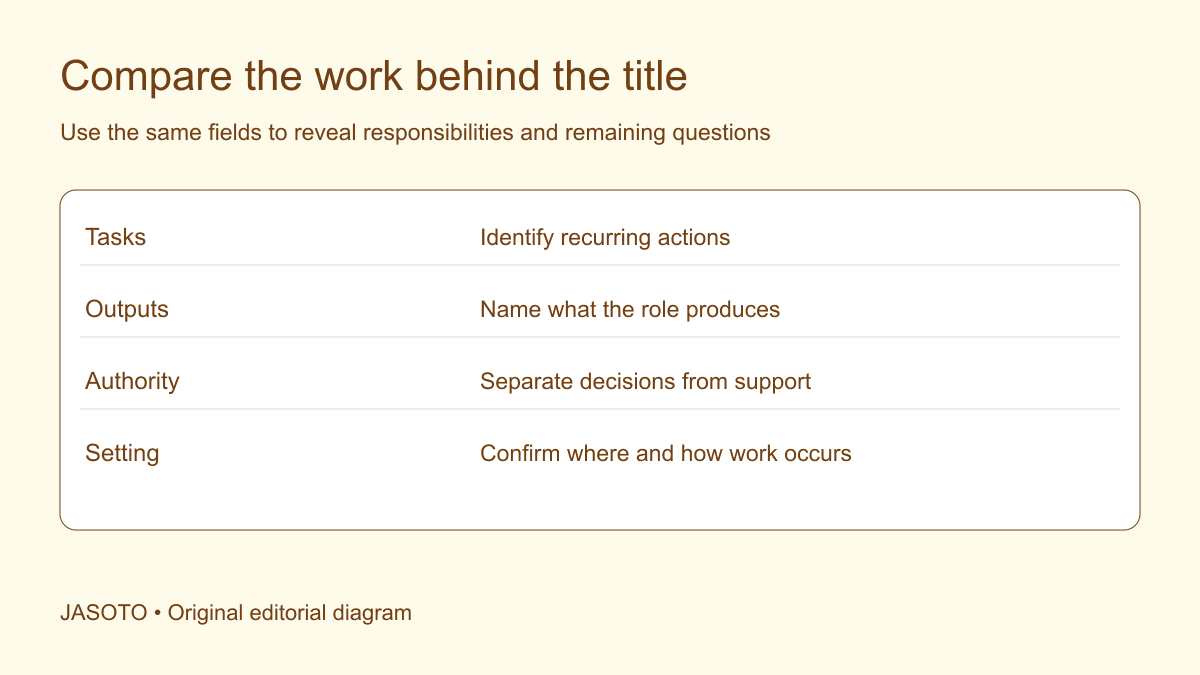
Original JASOTO editorial diagram. Its complete workflow is explained in the article; no actual customer outcome is depicted.
Compare jobs with similar titles by extracting their actual responsibilities into the same set of fields: recurring tasks, outputs, decision authority, collaborators and working conditions. Then identify what each posting still leaves unclear. A familiar title can describe different work at two employers, while different titles can contain much of the same task. The comparison should make those differences visible before you tailor an application.
This original guide is for US applicants evaluating related vacancies. The Bureau of Labor Statistics Occupational Outlook Handbook provides occupation-level information such as duties, work environment and entry routes. Use that as background, while each employer's current posting and recruitment contact remain the sources for its actual vacancy. The comparison method below does not rank employers or infer pay, seniority or employment conditions from a title alone.
The practical answer
- Compare recurring tasks and outputs.
- Check authority separately from title.
- Use occupation guides as context.
- Choose role-specific factual evidence.
Choose a small comparable set
Select a few active postings that appear related to your search. Save the employer version, date and role reference where available. Avoid comparing an abbreviated third-party advert with a full employer description without marking the difference in information. A short summary may simply omit responsibilities that exist in the longer version. Establish the source before drawing conclusions about how the jobs differ.
Keep the set focused on a useful decision. You might compare operations coordinator, service coordinator and office coordinator roles in a particular area. A broad collection of every title containing “manager” is unlikely to produce a clear application plan. State what you need to learn: which roles involve the work you want, which require different evidence or which have a practical constraint to clarify. The comparison becomes easier when it serves a specific next action.
Extract tasks using the employer's verbs
Copy the key responsibility phrases into private notes, then summarize them accurately in plain language. Look for actions such as schedule, analyze, approve, maintain, sell, supervise and implement. Avoid replacing a narrow verb with a broader one. “Support the report process” does not establish that the employee owns the report's conclusions or final approval.
Group repeated actions so you can see the ordinary work pattern. One posting may devote several responsibilities to customer communication while another emphasizes internal records. Do not count sentences as a precise measure of time spent; advertisements vary in writing style. Use the pattern to identify a question for the manager, such as which tasks occupy most of a representative week. Keep the difference between a textual emphasis and a confirmed workload visible in your notes.
Identify the output each task produces
Ask what the person creates, maintains or hands to someone else. Outputs might include a checked schedule, a customer response, a recommendation or a completed service record. This helps distinguish superficially similar activities. Two roles may both “coordinate projects”, but one maintains the action log while another sets the delivery plan and manages resources. The output gives the phrase a more inspectable meaning.
Where the posting does not state the output, mark it as unknown and prepare a specific question. Avoid inventing a deliverable based on your previous employer's use of the title. A candidate who previously prepared management reports should not assume every analyst role uses the same reporting process. The useful comparison preserves uncertainty until a reliable source resolves it, rather than filling every table cell with a plausible guess for the sake of completeness.
Separate authority from participation
Look for the decisions the role can make and the decisions it prepares for someone else. A person may attend senior meetings without owning approval. Another may work independently on routine exceptions without supervising staff. Ask how responsibility is defined in the actual vacancy instead of inferring it from words such as senior, lead or manager. Titles can reflect different organizational conventions.
For an invented pair of coordinator roles, both maintain a booking schedule. In one, the employee can adjust routine appointments within an approved process; in the other, all changes need manager confirmation. That difference affects the judgement and evidence required. Record it only when supported by the description or confirmed conversation. If the authority is unclear, write a question about the boundary. A confident-looking hierarchy drawn from title words alone is not a reliable comparison.
Map collaborators and handoffs
Identify who supplies work, who receives the output and which teams the role regularly coordinates with. A customer-facing service role and an internal operations role can use similar tools while involving different communication demands. Ask what information is passed at each handoff. This reveals practical responsibilities that a general statement about collaboration may leave hidden.
Use the map to select relevant examples from your experience. If the role supports sales, determine whether it involves preparing information, contacting clients or making commitments. These are different tasks. You may have transferable evidence for one and a genuine learning need for another. The comparison should help you choose an accurate example, rather than encourage a broad claim that you have done every activity associated with a familiar department name.
Compare work settings as well as duties
Record confirmed location, schedule, travel, onsite requirements and the practical environment where the work occurs. Keep those facts separate from assumptions based on industry. An office-based title might include site visits, while a role advertised by a national employer may cover only one location. Ask the employer about material uncertainty through the appropriate recruitment route.
Consider whether the setting changes how a task is performed. Maintaining a schedule in a live customer environment may involve different interruptions from preparing a weekly planning document. Do not assume one setting is easier or better without evidence relevant to your circumstances. The objective is a clearer description of the work and its constraints. This can support a personal decision about fit without turning the comparison into unsupported claims about an employer's culture or management quality.
Use occupational references at the right level
The Occupational Outlook Handbook can help you understand broad occupational categories and find related work to explore. Read its explanation of what each section covers and keep national occupation information distinct from a specific posting. A general work-environment description does not establish the conditions of an individual team. Similarly, an occupation's typical entry route does not override the employer's stated requirements.
Use the reference to improve questions and search terms. If the posting combines activities from several areas, ask which is central to the role. Avoid assigning a vacancy to a category solely to infer a salary or future prospect the employer has not stated. This article does not make financial or career-outcome predictions. The useful application step is to understand the task and ask for the current requirement, with broader references serving as context rather than a substitute for confirmation.
Create an evidence match for each role
Beside each confirmed responsibility, identify a factual example you can use. State what the example demonstrates and where the match is partial. A record-checking task from another field may be relevant to accuracy, while it does not establish experience with the employer's specialist system. This distinction helps you tailor the application honestly and identify what you need to learn.
Do not build one generic answer merely because the titles overlap. For a service coordinator application, emphasize the relevant customer handoff if supported by the tasks. For an office coordinator role, a different example may better show internal planning. Preserve the facts across versions: dates, ownership and outcomes should not change with the emphasis. The comparison pays off when it guides selection, rather than creating different labels for the same inflated claim.
Rank questions by their effect on your decision
Choose the unknowns that change whether you proceed or how you prepare. Ask about a central responsibility before a minor tool preference. Route process questions to the recruiter and detailed work questions to the appropriate manager where available. If a contact cannot answer, ask who owns the information and what can be confirmed at that stage.
For example, the distinction between approving customer credits and preparing a credit request may materially change your understanding of a role. A question about the color of a reporting template probably will not. Keep the list short enough for a useful conversation, then update the comparison with the actual answer. If two sources conflict, preserve the discrepancy and ask for clarification instead of selecting the version that makes the role look most appealing.
Choose the next application action
Summarize what each role actually contains, what evidence you have and what remains unclear. Decide whether to apply, ask a targeted question or remove it from the active list. You do not need a universal numeric score for every field. A single practical constraint can matter more than several attractive but minor similarities, and your decision should keep that constraint visible.
Use job opportunities to discover relevant postings while keeping employer-specific facts tied to the original source. If you obtain career-document support through business providers, ask the editor to preserve responsibility boundaries. Confirm any interview location before planning travel. If your initial title-based assumption proves wrong, return to the task comparison and revise the evidence. The result is a more focused application plan based on the work you can verify, rather than the familiarity of the name printed above it.
Put the guide into practice
- Save current employer descriptions.
- Mark unknown details explicitly.
- Prepare decision-critical questions.
- Revise applications around verified responsibilities.
Frequently asked questions
Does “manager” always mean supervising people?
Do not infer supervision from the title alone. Read the responsibilities and ask what decisions, processes or people the role manages. Record the employer’s actual answer so your application addresses the right kind of responsibility.
Can occupational guides replace asking the employer?
Use them for broad context and related search ideas. They do not establish the duties, authority or conditions of a particular vacancy. Confirm material role details through the current employer posting and appropriate recruitment contact.
Should I use the same application for similar titles?
Preserve reusable factual information, but select evidence and answer the requirements of each actual posting. Similar titles can contain different tasks. Keep your contribution, dates and outcomes consistent while changing the relevant emphasis.
Explore JASOTO tools
Discover providers and check support for your specific task.
Explore roles and responsibilities →Consider the practical responsibilities involved when recruiting or joining a team.
Plan work-related travel →Research a journey when joining, training or meeting colleagues in person.
Continue with JASOTO
Compare your next step
Discover UK businesses, compare services and request written quotes before making a decision.