
Jobs & Careers · UK Guide 2026
Work Examples When Your Projects Are Confidential
JASOTO · Updated 5 November 2026 · 1,701 words
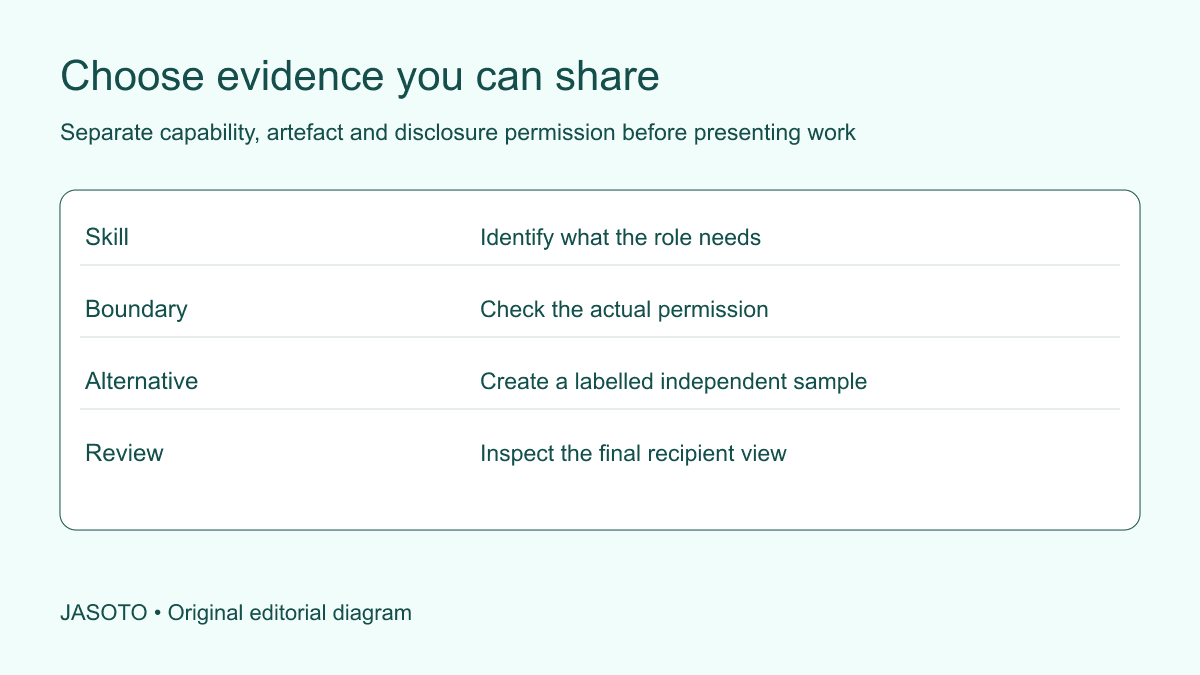
Original JASOTO editorial diagram. Its complete workflow is explained in the article; no actual customer outcome is depicted.
When a project is confidential, demonstrate the relevant skill without assuming you can show the original files. Check what you are allowed to disclose, describe your contribution at an appropriate level and prepare a clearly labelled independent example if the real artefact cannot be shared. Removing a client name alone does not establish permission or make every underlying detail suitable for an interview.
This original guide supports UK applicants selecting portfolio and interview evidence. Intellectual Property Office guidance explains that copyright ownership depends on the circumstances and can involve employers or other contributors. Ownership, confidentiality and permission to disclose are separate questions. Check your actual agreements and obtain appropriate professional advice if the boundary is uncertain. The practical alternatives below help you prepare evidence while leaving legal interpretation to the relevant owner or adviser.
The practical answer
- Start with the skill the role needs.
- Check disclosure permission separately from authorship.
- Use honest independent examples when necessary.
- Review the entire file and sharing route.
Identify the skill the interviewer needs to assess
Start with the advertised responsibility and the capability you want to demonstrate. You might need evidence of organising a handover, comparing design options or explaining a technical decision. Write that capability separately from the confidential project's name. This often reveals that the employer needs to understand your reasoning, rather than see a particular customer's records or a commercially sensitive deliverable.
For an invented service coordinator, the useful evidence may be how they turned incomplete information into a clear request for a decision. The original request could contain private customer details, but the underlying skill can be discussed through a permitted general account or a new fictional exercise. Avoid choosing a sample only because the project sounds prestigious. Relevance to the role should drive the selection, with confidentiality determining the form in which suitable evidence can be presented.
Establish the actual disclosure boundary
Review the relevant agreement, policy and previous permission through the appropriate route. If you need clarification, ask the accountable owner what may be shared, with whom and in which format. A colleague's informal reassurance may not answer the question. Record the specific permission where appropriate so you do not later broaden it from a private discussion to a public website without checking again.
Do not assume permission to work on a project includes permission to retain or display its files after leaving. Equally, do not infer that an item visible online gives you unrestricted rights to reproduce internal drafts or supporting data. The IPO's ownership guidance is useful background, but it cannot settle the facts of your particular contract. When the boundary is unclear, choose another form of evidence while obtaining appropriate advice instead of making a convenient guess under application pressure.
Separate an artefact from an account of your work
An artefact is the actual document, design, code, image or other material. An account describes the task, actions and learning. You may be able to provide a limited account even when the artefact is unavailable, but that still depends on what you are allowed to discuss. Avoid treating a spoken explanation as automatically exempt from confidentiality simply because no file changes hands.
Prepare the account with the minimum relevant context. Name the type of task and your role without including unnecessary commercial or personal details. Explain a decision you made and what information you were permitted to use in making it. If the outcome cannot be disclosed, say so without hinting at a dramatic hidden success. A truthful boundary is more credible than an unsupported claim that the project achieved exceptional results which nobody is allowed to inspect.
Do not rely on superficial anonymisation
A project can remain recognisable after names are removed. Dates, unusual locations, distinctive figures, screenshots, branding and combinations of operational details can identify the organisation or reveal the confidential point. Do not assume that blurring a logo resolves every issue. Ask the owner to review the proposed version if that is the agreed route, and use a different example where the material cannot be made appropriate for sharing.
Check the surrounding file as well as the visible page. Comments, hidden sheets, revision history, filenames and embedded images can contain information absent from the main view. This is a practical review prompt, not a promise that a quick check makes a file safe. If you are not confident about what a document retains or what may be disclosed, do not send it. A new independent sample can be easier to explain and control than a heavily altered confidential original.
Build an independent example honestly
Create a new sample using fictional inputs and a different setting if that helps demonstrate the relevant capability. Label it as a self-initiated exercise made for illustration. State which skill it demonstrates and which aspects differ from real work. Do not present invented activity as a client commission or imply that fictional data reflects actual customer behaviour. The sample is useful because the interviewer can examine your approach directly.
For an invented scheduling exercise, you could create a small fictional list of appointments with conflicting arrival windows and write a handover note explaining the unresolved decisions. This demonstrates structure and judgement without reproducing a customer's diary. Keep the scope proportionate to the role and the employer's instructions. A short clear sample may be more useful than an elaborate project created to simulate an entire business, particularly when its fictional assumptions would take most of the interview to explain.
Show process without recreating sensitive detail
Explain the sequence of decisions you would use for the independent task. Identify the information needed, options considered, chosen approach and remaining uncertainty. This gives the panel a route into your judgement. Avoid using the new sample as a disguised reconstruction of confidential strategy or a distinctive original design. Changing labels does not necessarily change the substance of what is being disclosed.
Be clear about the difference between past experience and current illustration. You might say, “In my previous role I worked on structured handovers; this new fictional example shows how I approach one.” Only make the first part if it is accurate and permitted. The sample can stand on its own as evidence of a current skill, while the account of employment remains bounded. That distinction prevents a well-intended alternative from turning into a misleading portfolio story.
Select public work with appropriate care
A published piece may be an option when you can legitimately point to it and accurately describe your contribution. Link to the official public version where appropriate instead of distributing internal copies. Explain what you did and what others owned. The fact that a result is public does not establish that every development note, source file or discussion around it is also available for disclosure.
Check whether your description adds a non-public fact. A website can be visible while its budget, internal performance and customer research remain private. Keep statements limited to what you can support and share. If the role requires evidence you cannot provide, tell the recruitment contact and ask what alternative would be useful. The employer may propose a different exercise, but do not assume it must accept a particular substitute or that disclosure pressure changes your existing obligations.
Prepare a brief explanation of the boundary
Use a calm factual statement: “I cannot share the original client files, but I can discuss the permitted outline and show this independent example of the same skill.” Then move to useful evidence. A lengthy apology can consume the discussion without helping the interviewer assess you. You do not need to reveal the confidential information in order to prove that you are withholding it responsibly.
Practise responding if the panel asks for a prohibited detail. Acknowledge the question, explain the boundary and offer the relevant permitted reasoning or sample. Do not invent an answer or imply approval that has not been obtained. If you genuinely do not know whether something can be shared, say that you would need to check. A useful preparation plan lets you maintain that boundary without appearing unable to discuss any aspect of the work.
Keep a permission and evidence register
Maintain a private preparation list containing the example, skill demonstrated, allowed format, approval source and current status. Keep sensitive agreements and original material in their proper location; the register need only point to what you need to check. Distinguish permitted public material, permitted private presentation and material not cleared for use. One approval should not quietly migrate across all three categories as applications accumulate.
When exploring job opportunities, select evidence from that list rather than rebuilding the permission question from memory each time. If you use business support for portfolio editing or specialist advice, confirm what may be shared with the provider before sending files. If you will show physical material at an interview, confirm the arrangement before planning travel, including how the work will be carried and whether copies are expected to remain with the panel.
Review the final pack from the recipient's view
Open the files and links exactly as an interviewer would. Check that the independent sample is visibly labelled, your contribution is clear and no confidential original appears as an accidental attachment. Remove unnecessary drafts from the sharing folder. Use the agreed delivery route and avoid changing permissions broadly just to make a link easier to open. Access convenience should follow the approved disclosure plan, rather than override it.
If you discover an unsuitable example before sending, replace it with the cleared alternative and update your notes. If a concern arises after sharing, use the appropriate owner or adviser promptly rather than assuming deletion from your own device recalls every copy. The practical goal is evidence you can explain accurately and legitimately. A confidential project can inform your skills without becoming an entitlement to publish its contents, and a clearly labelled independent sample can support a useful discussion without claiming a customer outcome that never occurred.
Put the guide into practice
- List possible evidence and allowed formats.
- Clarify uncertainty with the appropriate owner.
- Label fictional or self-initiated material.
- Practise a concise confidentiality explanation.
Frequently asked questions
Is removing the client name enough?
Not necessarily. Other details may identify the project or reveal information you are not allowed to share. Check the actual permission and the complete file, including supporting material. If the boundary remains uncertain, choose a cleared alternative or a new independent example instead of relying on superficial edits.
Can I make a fictional version of the work?
You can prepare an independent sample that demonstrates a skill, provided it does not reproduce protected or confidential substance and you label it honestly. Use fictional inputs and explain that it is an illustration. Do not present it as a real commission, measured outcome or approved client deliverable.
What should I say if an interviewer asks for confidential figures?
Explain that you cannot disclose those figures and offer a permitted account of your decision or an independent example. Do not invent numbers to fill the gap. If you are unsure about the boundary, say you need to check with the appropriate owner rather than implying permission.
Explore JASOTO tools
Discover providers and check support for your specific task.
Explore roles and responsibilities →Consider the practical responsibilities involved when recruiting or joining a team.
Plan work-related travel →Research a journey when joining, training or meeting colleagues in person.
Continue with JASOTO
Compare your next step
Discover UK businesses, compare services and request written quotes before making a decision.