
























Jobs & Careers · UK Guide 2026
Keep Application Documents Consistent and Specific
JASOTO · Updated 5 November 2026 · 1,607 words
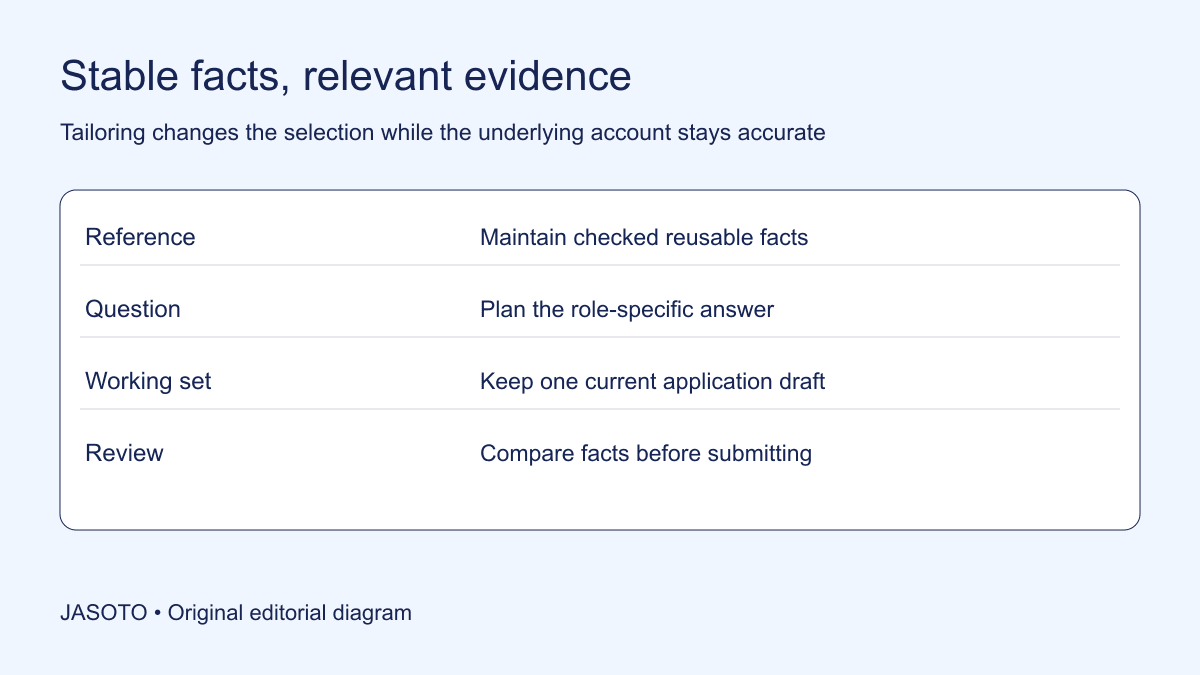
Original JASOTO editorial diagram. Its complete workflow is explained in the article; no actual customer outcome is depicted.
Keep application documents consistent by maintaining a checked set of facts and tailoring the selection and explanation of evidence for each role. Dates, qualifications, contribution and outcomes should remain accurate across a CV, form and interview. The wording can change to answer a different question, but the underlying experience should not change with it. Use a final cross-document review before submitting.
This original guide is for UK applicants handling several active applications. National Careers Service guidance recommends keeping a CV current and tailoring it to the opportunity. The fact sheet, version record and review method below help you do both without turning every answer into the same generic paragraph. Follow each employer's instructions for required information and format.
The practical answer
- Maintain a checked private factual reference.
- Plan each answer from the actual question.
- Keep contribution and outcomes consistent.
- Record the version each employer received.
Create a private factual reference
Record accurate employer names, role titles, relevant dates, qualifications and other facts you repeatedly need. Check the information against appropriate records instead of relying entirely on memory. If a date is uncertain, resolve it where possible or preserve the uncertainty honestly in your preparation notes. Avoid creating a precise-looking figure simply because a form field makes an approximate answer inconvenient.
Keep sensitive supporting documents in an appropriate location and include only what the reference needs. The fact sheet can point to a certificate without becoming a broadly shared folder of personal records. Give the maintained version a clear location and update it when something changes. The purpose is a reliable source for your own drafting, so you do not have to reconstruct the same history under every application deadline.
Separate fixed facts from tailored emphasis
Identify which details should stay stable and which can be selected for the role. The dates of a job stay factual; the two responsibilities you emphasize may differ. Your qualification title stays accurate; the explanation of a relevant project may become shorter or longer. This distinction lets you tailor useful material without treating consistency as a reason to send identical answers everywhere.
For an invented coordinator applicant, one application emphasizes maintaining records and another emphasizes arranging appointments. Both accounts can draw on the same employment period if those were genuine responsibilities. Neither should convert a support role into final approval authority. Keep a short note explaining your contribution and outcome for each reusable example so later editing does not gradually remove the boundary that made the original account accurate.
Read the new question before opening an old answer
Start each application answer by identifying what the employer actually asks. Note the capability, context and requested evidence. Then choose a suitable factual example. Opening a previous answer first can make it tempting to reshape the question around the text you already have. The result may contain relevant words while still missing the decision or responsibility the employer wants to assess.
Write a brief answer plan in ordinary language: which example, what you did and why it addresses the requirement. Use the old material only as a factual reference once that plan is clear. If the previous example does not fit, choose another or acknowledge a genuine gap. A reusable document system should save administrative effort so you can give more attention to the question, rather than encouraging increasingly polished answers to a different role.
Keep contribution language aligned
Compare verbs across the CV, form and portfolio. Prepared, recommended, implemented and approved describe different responsibilities. A shorter CV line can become misleading if it drops the fact that another person made the decision. Use wording that remains accurate even when compressed. If a title does not make the role clear, explain the responsibility instead of substituting a more senior title.
Check team results as well. A project-wide outcome should be identified as such, with your contribution stated separately. Do not let one application describe a figure as a team result and another present it as caused solely by you. If you have no measured result, describe the output or observed endpoint. Consistency is strongest when each version preserves the same evidence boundary, even while emphasizing a different skill or stage of the work.
Give each application its own working set
Create a clearly named folder or approved equivalent for the role's current posting, draft documents and submitted material. Include the employer and role reference where useful. Keep it separate from the maintained factual reference so a role-specific edit does not accidentally overwrite your source information. Avoid scattering files across several devices without a clear current location.
Use a simple status such as draft, checked and submitted. A document becomes checked only after the relevant factual and role review, and submitted only after it has actually been sent through the required route. A filename containing “final” is not evidence of either event. Record the version and date submitted so you can reopen the same material before an interview and identify any correction that needs to be raised through the recruitment process.
Review automated form entries carefully
Check any information copied or parsed into an application form. A correct CV file does not establish that every imported field is correct. Review dates, job titles, qualification names and the placement of text in the intended sections. If the form asks for information in a different structure, answer that structure accurately rather than pasting a paragraph into an unrelated field merely to complete the page.
Read the question's scope. A form may ask for a complete relevant history while a CV summarizes selected experience. Those can differ in detail without contradicting each other, provided the answers meet the instructions and preserve the facts. Do not deliberately omit required information because it is absent from the short CV. Where a field or requirement is unclear, ask the appropriate contact or use the employer's guidance rather than inventing a convenient interpretation.
Check the story across formats
Place the CV, form answers and sample captions side by side for a focused factual review. Compare the same project across them: setting, dates, responsibility, actions and outcome. Ask whether a reader would understand them as different views of the same work. Note any contradiction and return to the reliable source before changing it. Do not make the documents agree by copying the most impressive version into all of them without verifying it.
Keep interview preparation connected to the submitted version. You can prepare additional detail, but the account should explain rather than contradict what the employer has. If you notice a material error after submission, use an appropriate recruitment route to correct it. A quiet edit to a private master file does not update a document already received by the panel. Record the correction and any version the employer asks you to provide.
Review personalization beyond the employer name
Check whether the answer addresses the actual work, uses a relevant example and explains the connection. Replacing the employer name in a generic paragraph is rarely enough to establish relevance. Identify the task or requirement that makes this evidence useful for this application. Keep claims about the employer tied to verified information rather than adding flattering statements that could apply to almost any organization.
For example, a scheduling role may require handling missing information across locations. A tailored answer can focus on how you identified an unconfirmed detail and routed it to the decision owner. Another role may ask about written communication, making a different part of the same event relevant. The factual account remains stable while the explanation responds to a distinct question. This is more useful than copying every task from the job description into a claim that you already perform them all.
Use a fresh reader for the final pass
Ask a trusted person to read for a specific purpose, such as factual consistency or whether the answer addresses the question. Provide the relevant context without sharing unnecessary sensitive material. An editor cannot verify your history from polished prose alone, so give them the boundaries you need preserved. Review any suggested change that increases authority, expands an outcome or turns a tentative fact into a definite one.
If you obtain help through business service providers, confirm the scope and how the documents will be handled. Use job opportunities to explore roles while keeping each active application clearly identified. Confirm appointment and location details before planning interview travel. The review should end with a checked application set and a known next step, rather than an untraceable collection of edits distributed among several people who each believe they hold the current file.
Maintain the system after submission
Record what was sent and the next expected action. Update the factual reference when you gain a qualification, complete relevant work or correct a genuine error. Apply substantive corrections to active drafts where appropriate, while preserving the submitted record you need for ongoing conversations. Do not revise every historical application merely because your preferred style changes.
When the process becomes cumbersome, reduce it to one factual reference, one working set per active role and one submission record. Restore the last checked version if an edit introduces a contradiction, then tailor again from the actual requirement. The practical outcome is a set of documents that a recruiter can read consistently and a candidate can explain with confidence in its accuracy. Relevance comes from thoughtful evidence selection, while factual stability comes from checking the source rather than memorizing several competing versions of your experience.
Put the guide into practice
- Verify repeated dates and qualifications.
- Separate master facts from role drafts.
- Review imported form fields.
- Cross-check the final application set.
Frequently asked questions
Does consistency mean using identical wording?
No. Keep dates, responsibilities, qualifications and outcomes accurate while choosing the evidence and emphasis needed for each question. Different formats can contain different levels of detail, provided they meet the instructions and do not create conflicting accounts of the same experience.
What if a form asks for more history than my CV contains?
Follow the form’s actual instructions and provide the required accurate information. A concise CV and a fuller form can coexist without contradiction. Do not omit required details simply because the short document does not include them.
What should I do with an error discovered after submission?
Decide whether it is a material factual issue and use the appropriate recruitment contact to correct it where needed. Record what was corrected and any updated document requested. Updating your private master file alone does not change the version already received by the employer.
Explore JASOTO tools
Discover providers and check support for your specific task.
Explore roles and responsibilities →Consider the practical responsibilities involved when recruiting or joining a team.
Plan work-related travel →Research a journey when joining, training or meeting colleagues in person.
Continue with JASOTO
Compare your next step
Discover UK businesses, compare services and request written quotes before making a decision.