
Jobs & Careers · UK Guide 2026
Give Candidates Consistent, Useful Interview Information
JASOTO · Updated 5 November 2026 · 1,606 words
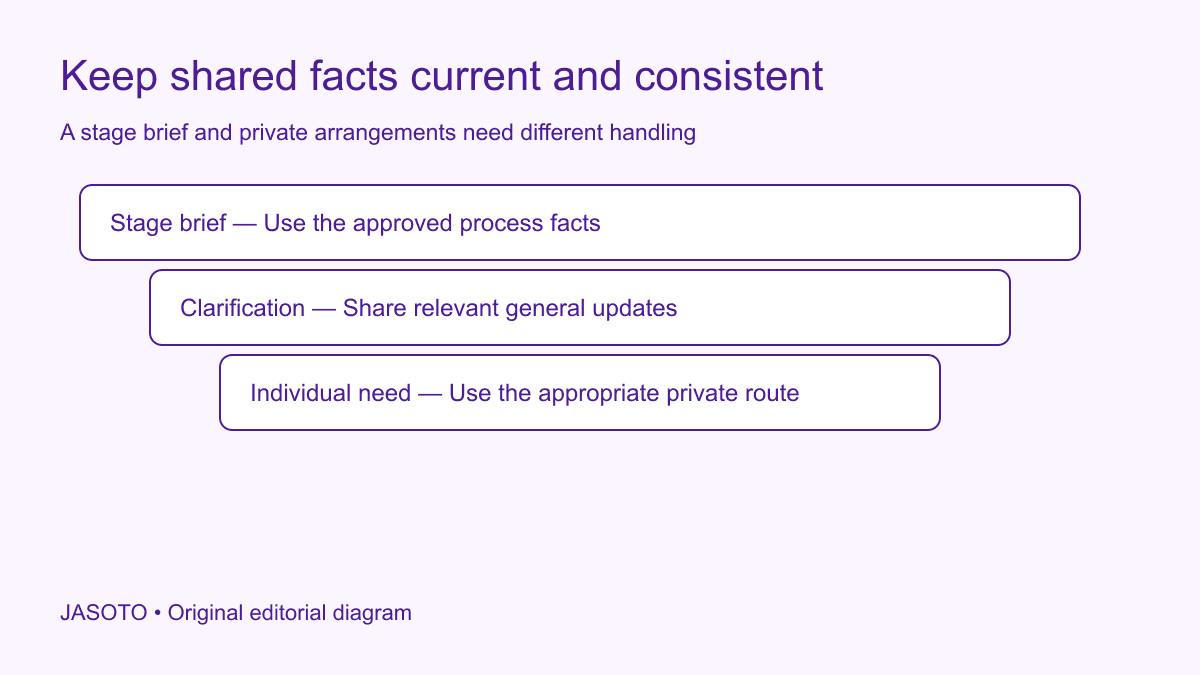
Original JASOTO editorial diagram. Its complete workflow is explained in the article; no actual customer outcome is depicted.
Give candidates consistent useful interview information by maintaining one approved process brief for the relevant stage, then managing clarifications and changes through a named owner. Keep individual appointment details and appropriate private arrangements separate. Candidates should understand the preparation and format that apply to them, while the hiring team should know which version was shared and what changed.
This guide is an original coordination method for small UK employers running several interviews for one role. It focuses on information consistency across the candidate group, rather than the wording of an individual arrival invitation. Use current appropriate HR and legal advice for recruitment, adjustments and data handling. The worked example concerns an invented employer clarifying a presentation stage before scheduled interviews.
The practical answer
- Keep a current approved brief for the recruitment stage.
- Separate shared preparation facts from private individual arrangements.
- Review material clarifications for consistent distribution.
- Track versions and changes across the hiring team.
Approve the process before describing it
Confirm the actual interview stage, assessment elements and responsible people before issuing preparation instructions. A coordinator cannot create reliable candidate information while interviewers disagree about whether a presentation or practical exercise will be used. Resolve that internal decision through the appropriate authority and keep the record connected to the advertised role and recruitment plan.
Distinguish confirmed arrangements from proposals. An interviewer suggesting a new exercise has not necessarily changed the process. Avoid telling early candidates one format and later candidates another simply because a conversation evolved informally. If the format needs to change, review the implications appropriately and identify what information and arrangements affected candidates require.
Create a shared stage brief
Record the preparation facts common to the stage: format, relevant task instructions, permitted resources, appropriate timing information and the route for questions. Keep the brief concise and connected to the actual assessment. Do not include internal scoring commentary, private panel notes or information the hiring team has not approved for candidate use.
Use a clear reference and version so the team can identify the current brief. A general document named latest information can become ambiguous when copied into several messages. Keep the authoritative source in the appropriate system and explain who may update it. The purpose is practical consistency, not a new bureaucratic layer that staff bypass because it is harder than improvising another email.
Separate stage facts from appointment details
The common brief describes the process, while an individual appointment includes the relevant date, place or joining route. Keep those relationships clear. A candidate's rescheduled time should not require rewriting shared assessment instructions from memory. Conversely, updating the shared task should not accidentally alter a person's confirmed appointment or private arrangements.
Check the actual communication templates and systems used by the team. A mail merge, recruiter message or calendar invitation may draw from different sources. Identify where each relevant fact originates and who maintains it. Consistency depends on the actual delivery route, not only on a well-written master document that nobody uses when sending messages.
Define who receives the relevant information
Identify the candidates at the same stage and what shared information they need. A person not yet invited to that stage may need a different message. Keep the scope factual and appropriate to the recruitment process. Avoid a broad group email exposing candidate identities or private contact details merely because it is convenient to distribute one update.
Use the business's appropriate privacy and communications arrangements. The team needs a reliable distribution record without circulating unnecessary personal information. A simple controlled checklist can show which version was issued through the approved route. Do not assume that a recipient appearing on a draft list proves the message was actually sent or that every attachment was included correctly.
Give interviewers the same current process reference
Interviewers should know what candidates have been told. Share the relevant stage brief and approved clarifications with the panel through the proper channel. A candidate may prepare exactly as instructed while an interviewer expects an element that was never communicated. Check that the panel's actual plan matches the approved information before the interviews begin.
[Acas's interview guidance](https://www.acas.org.uk/recruitment/interviewing-job-applicants) discusses preparation and consistent interviewing within the recruitment process. Use the actual applicable guidance and suitable advice. This original coordination method makes the shared preparation record visible so staff can identify a discrepancy before evaluating a candidate against an expectation the employer did not communicate appropriately.
Route candidate questions to an approved answer
Give candidates an appropriate contact for preparation and process questions. Identify who can answer and who must approve a substantive clarification. The coordinator may be able to confirm the issued document while a hiring lead decides how to explain an ambiguous task. Keep those responsibilities clear so a helpful reply does not accidentally change assessment conditions for one person.
Preserve the actual question and approved response appropriately. Avoid recording only answered when the content may matter to later consistency. At the same time, do not collect unrelated personal detail or treat a candidate's question as a character judgment. The process should help resolve uncertainty, not penalise someone for asking a reasonable clarification through the route the employer provided.
Distinguish general clarification from private arrangements
Ask whether the answer changes or explains a shared preparation fact. If it does, review who else needs the relevant information at that stage. Keep the distribution fair and appropriately timed under the actual recruitment process. Do not silently give one candidate an important general clarification while others continue with an ambiguous brief.
Handle individual needs and appropriate adjustments through the proper private route. [GOV.UK's recruitment guidance](https://www.gov.uk/employer-preventing-discrimination/recruitment) addresses discrimination and limits around certain recruitment questions. Obtain suitable advice for the actual case. Consistent useful information does not mean broadcasting a person's private circumstances or refusing an appropriate individual arrangement merely to make every message look identical.
Manage changes with a visible current version
When a material correction is approved, record what changed and why, which candidates are affected and how the update will be communicated. Keep the earlier version for appropriate traceability. Do not overwrite the only source and leave the team unable to determine what early candidates received. The current brief should remain easy to find without erasing the history.
Check the practical effect of timing. A clarification issued shortly before one interview may require an appropriate process decision, not just another email. Ask the responsible hiring owner and suitable adviser where comparability or preparation is affected. Do not assume that sending an identical update automatically resolves every consequence of changing the task after candidates have begun preparing.
Worked example: a presentation instruction clarified
Imagine an employer asking candidates to prepare a short presentation from a fictional scenario. One candidate asks whether external research is expected because the brief is unclear. The hiring owner confirms the intended preparation scope and approves a general clarification. The coordinator updates the stage brief, identifies affected candidates and follows the appropriate distribution process, while the panel receives the same current instruction.
Any individual arrangement remains in its proper private record. This invented example claims no legal compliance finding or hiring outcome. It shows how a useful candidate question can reveal a shared information gap, and how a controlled clarification can improve consistency without turning the process into an unrestricted group discussion or sharing private candidate details.
Check the issued materials before the stage runs
Use a small distribution check that distinguishes prepared, sent and corrected states. A candidate appearing on a mailing list does not prove the current attachment reached them, while a returned message needs an appropriate follow-up route. Keep the actual system evidence and relevant ownership rather than creating an unsupported receipt claim. The process should be proportionate and respect privacy; it does not require intrusive tracking. Its practical purpose is to notice a known delivery problem or obsolete version before the team assumes every candidate has the same relevant preparation information and assesses them on that basis.
Review a representative actual message against the approved brief. Check the document version, relevant preparation facts and the route for questions. Ask an authorised colleague unfamiliar with the recruitment to identify what a candidate is expected to do. If the interpretation differs from the panel's plan, resolve the actual mismatch before assessment.
Use appropriate controlled test details and review the real output format. Attachments, calendar text and links can lose information or point to a draft. A correct source document does not prove every delivery route preserves it. Ask the responsible administrator to resolve technical issues rather than relying on the coordinator's private access or a manually corrected message that other candidates never receive.
Review consistency after the interviews
Record meaningful process questions or discrepancies and use the proper hiring review route. Do not change assessment criteria retrospectively to accommodate a preferred outcome or conceal an information error. Preserve the relevant evidence and obtain suitable professional advice where the issue is consequential. The communication record should support a fair review of what candidates and interviewers actually knew.
Improve the next brief based on recurring uncertainty and retire obsolete templates appropriately. Keep the rationale for changes and a rollback version. Avoid claiming that the process improves hiring quality without evidence. Its immediate value is a traceable shared account of preparation information, with private arrangements handled through the appropriate channel.
Use JASOTO businesses to discover suitable recruitment administration support and verify capability directly. Use JASOTO jobs to present clear role information connected to the selection process. For a confirmed interview, research travel after checking the current appointment details. Consistent candidate information depends on shared ownership and controlled changes as much as on the words in an invitation.
Put the guide into practice
- Approve the actual format and preparation requirements.
- Identify who receives each stage's current brief.
- Define clarification and correction ownership.
- Check that candidates and interviewers use consistent information.
Frequently asked questions
Must every candidate receive identical messages?
Provide consistent relevant process information while handling individual circumstances and appropriate adjustments through the proper route. Different appointment details or private arrangements do not belong in a general group message. Use suitable hiring advice for the actual requirements.
What if one candidate asks a useful preparation question?
Check whether the answer reveals a material clarification others need for the same stage. Have the appropriate owner approve and distribute relevant general information consistently, while keeping personal or individual arrangement details private.
Can an interviewer change the assessment format on the day?
Use the actual recruitment process and appropriate authority. A material change can affect preparation and comparability, so review its implications and candidate communication properly. Do not treat a spontaneous preference as automatically suitable for every candidate.
Explore JASOTO tools
Discuss process communication and coordination needs with suitable providers.
Present clear role information →Keep the advertised role connected to the actual selection process.
Research a confirmed interview journey →Plan travel after the current appointment and location information are confirmed.
Continue with JASOTO
Compare your next step
Discover UK businesses, compare services and request written quotes before making a decision.