
Business Growth · UK Guide 2026
Prepare a Contractor Information Pack for Reception
JASOTO · Updated 5 November 2026 · 1,623 words
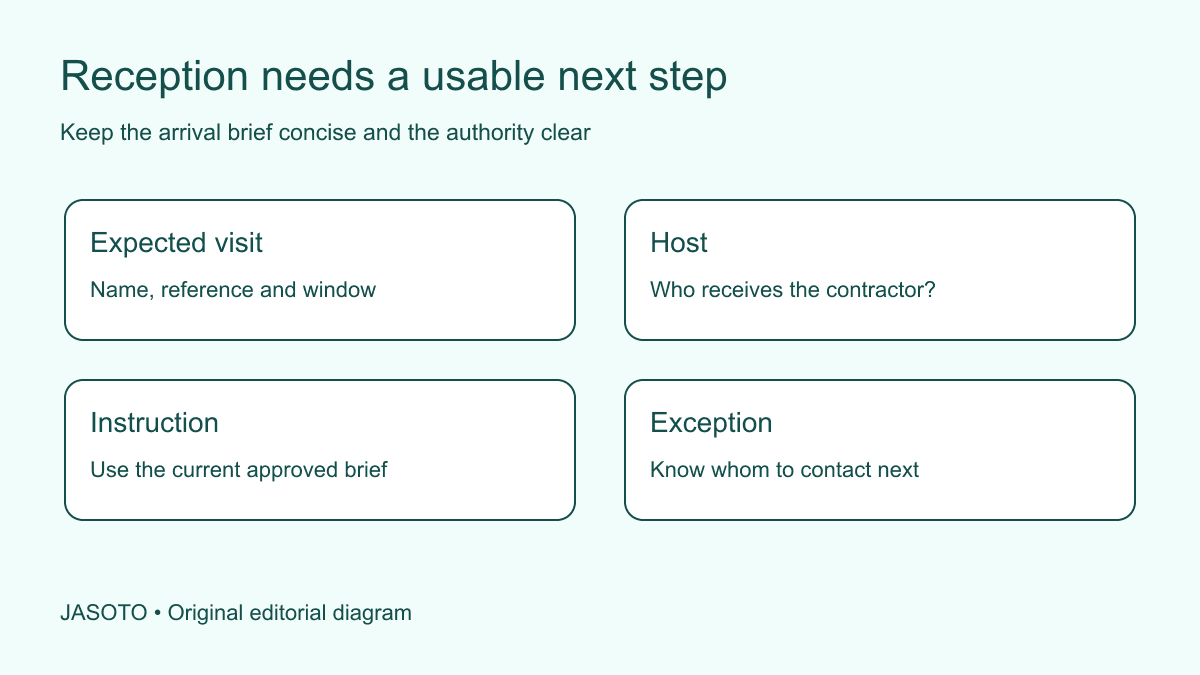
Original JASOTO editorial diagram. Its complete workflow is explained in the article; no actual customer outcome is depicted.
Prepare a contractor information pack for reception by giving staff the expected visit, the authorised host, the current arrival instructions and a clear route for exceptions. Design it around what the receptionist must actually do. The pack should help them recognise and hand over the visit, not require them to approve technical work, interpret a contract or invent access arrangements.
This guide provides an original administrative format for UK business premises. It sits alongside the site's proper security, safety and visitor processes. [ProtectUK's visitor and contractor guidance](https://www.protectuk.police.uk/tactic-db4-ensure-visitors-and-contractors-are-accompanied-all-times) highlights the need for staff to understand the relevant process and contacts. The examples here show how to make that information usable at a busy desk without circulating sensitive details unnecessarily.
The practical answer
- Write the pack around the decisions reception actually makes.
- Identify the expected visit and authorised host.
- Keep security and technical instructions in their proper controlled records.
- Test the exception route with the person covering the desk.
Begin with reception's actual role
Ask the staff who cover the desk what decisions they are expected to make. They may need to identify the expected appointment, notify a host and follow an approved sign-in process. They may not be authorised to release keys, admit someone to a restricted area or approve an extended visit. State the boundary plainly so a helpful employee does not feel obliged to solve every problem on arrival.
Check the role across different shifts and cover arrangements. A permanent receptionist may know the host by sight, while a colleague covering lunch will not. Build the brief for the authorised substitute as well as the usual person. Avoid relying on informal knowledge such as the engineer who always comes on Thursdays when a provider may send a different employee or change its schedule.
Identify the expected visit precisely
Include the provider, appointment reference, expected contact and agreed arrival window. Add the purpose in a short description reception can understand. “Investigate the booked printer issue” may be enough; an entire technical fault history usually is not. If several appointments involve the same provider, make the references distinguishable so reception does not hand a visitor to the wrong host or assume a cancelled visit is still current.
Label provisional arrangements clearly. A quotation discussion, tentative appointment and confirmed attendance should not look identical in the pack. Tell reception when the details were last checked and where the current record lives. If the provider has not supplied a name, show that as an unresolved point and explain the approved verification process rather than inserting a guessed person to complete the form.
Name the host and an appropriate backup
The host should know the visit is booked and understand what the reception handover involves. Give reception the appropriate contact route and a backup. Check whether those people will actually be available during the arrival window. A name on a form is not a reliable arrangement if the host is off site and nobody has agreed to cover.
Explain the backup's authority. They may be able to receive and escort the visitor without approving a scope change. If the main host cannot be reached, reception needs a clear next action consistent with the site's policy. Do not leave staff choosing between admitting an unfamiliar visitor and appearing obstructive. An agreed waiting or rescheduling process can make the situation manageable without improvisation.
Keep the arrival instruction short and current
Use the site's approved wording for reporting, sign-in and handover. Point to the controlled procedure where details are held. Avoid creating a competing visitor policy inside each contractor pack. If every organiser writes different instructions, reception may face conflicting rules for similar visits. The appointment entry should apply the established process, with any authorised exception clearly identified and traceable.
Make important changes prominent. If a visit moves to a different reporting point or host, tell the receiving team and update the working copy. Do not assume a calendar revision has been read. A brief can be factually correct in the organiser's mailbox while the desk follows a printed page from yesterday. Agree who removes or marks superseded copies through the actual reception workflow.
Separate sensitive information from general instructions
Reception needs usable access to relevant instructions, but the pack should not become a broadly shared security map. Keep detailed key, alarm or restricted-area information in the proper controlled system. Use an approved contact route where a visitor needs a specific arrangement. Do not place sensitive details in a generic calendar description simply because it is easy to copy to all participants.
Apply the same restraint to personal information. A receptionist may need the expected visitor's business identity and appointment details, not unrelated personal explanations from the organiser's email chain. Remove material that does not support the receiving task. If a specific access need must be communicated, use the appropriate process and keep it understandable without exposing unnecessary background information.
Provide a route for discrepancies
List the common situations reception should escalate: an unexpected person, wrong reference, early arrival, unconfirmed extra attendee or unavailable host. Use plain instructions that identify the next contact. Do not ask the receptionist to determine whether an unfamiliar explanation is commercially reasonable. The person who authorised the visit should resolve changes through the proper channel.
Keep the response realistic. If a contact route is not monitored immediately, do not present it as an instant answer. Agree what reception does while waiting and whom to contact next. Use the business's proper urgent and emergency procedures for those situations; the contractor brief should not invent a parallel process. The purpose is to make the ordinary exception pathway visible before staff need it.
Explain which questions belong elsewhere
A visiting worker may ask for extra work to be approved, a different room to be opened or a completion document to be signed. Reception should know which contact handles each request and what the receptionist may acknowledge. Signing attendance and accepting technical completion may be different acts. Use the actual agreement and role instructions rather than assuming every signature at the desk means the same thing.
Do not overload the front page with every possible commercial scenario. A short statement of authority and the correct contact often serves better than an elaborate decision tree. Keep supporting detail available to the authorised people. The receptionist should be able to respond helpfully without reading a purchase order, risk document and entire email history while other visitors queue behind the contractor.
Worked example: a booked engineer during lunch cover
Imagine a small office expecting an equipment engineer while the usual receptionist is at lunch. The cover colleague has a one-page brief identifying the appointment, provider and host, plus the approved sign-in process. A different employee from the provider arrives. The brief tells the cover colleague whom to contact for verification rather than asking them to rely on recognition or decide the substitution alone.
The authorised contact confirms the current arrangement, and the normal handover proceeds through the site's process. This invented example makes no claim that a particular security outcome is guaranteed. It shows why a brief should work for someone who lacks the usual receptionist's memory, while preserving the responsibility of the person who can actually authorise the changed visit.
Test the pack at the desk
Review the brief at the actual point of use. If staff normally work from a daily printed sheet, an important instruction accessible only through a separate system may be missed during cover. If they work digitally, check that the authorised cover colleague has the necessary access. Resolve that mismatch through the business's normal controls. Do not solve it by printing sensitive information indiscriminately or sharing another employee's account. The pack needs a practical delivery method as well as accurate content.
Ask an authorised colleague who did not write the brief to explain what they would do for the expected visit and one discrepancy. Check whether they can find the host, backup and current instruction quickly. If they need to infer missing authority from a job title, clarify it. This is a communication review, not a substitute for training or a security assessment.
Ask reception what information interrupts their work most often. Perhaps appointment references are missing, hosts do not answer or cancelled visits remain on the printed list. Fix the observed problem instead of adding more fields to every pack. Keep the previous version so an unhelpful layout change can be reversed. A concise brief should reduce ambiguity without hiding an important exception route.
Record departure and unresolved follow-up appropriately
Use the site's approved sign-out and handover process. If reception is expected to record departure or receive an item, state that role and how to report an exception. Do not assume the visit is complete because the calendar window ended. The host or responsible person should deal with outstanding work and technical status through the relevant process.
After the visit, preserve the appropriate attendance record and remove obsolete working instructions according to the business's arrangements. Keep unresolved questions with an owner rather than leaving them in reception's handwritten notes. The pack has served its purpose when it helps staff receive and hand over the visitor accurately, while keeping subsequent project or service decisions with the people responsible for them.
Use JASOTO businesses to discover contractors and discuss attendance requirements directly. If receiving and coordinating visits becomes continuing work, explore reception or facilities roles within a staffing review. For a confirmed visit requiring travel, research the journey after checking the reporting point. A useful pack gives reception a clear next step and preserves the boundary between welcoming a visitor and authorising their work.
Put the guide into practice
- Confirm visit details and the authorised host.
- Provide a current concise arrival brief.
- Explain differences, delays and unavailable-contact handling.
- Withdraw outdated instructions and record the handover.
Frequently asked questions
Should reception hold the whole contractor file?
Give staff access to the information they need for their role through the appropriate system. A complete commercial or technical file may be unnecessary and harder to use. The concise brief should point to the authorised host or controlled record when a question exceeds reception's responsibility.
What if a different contractor employee arrives?
Use the site's approved verification and escalation process. Reception should not assume a substitution is authorised because the company name matches, or invent a new requirement alone. Give staff a known contact who can confirm the change through the proper channel.
Can the pack replace a site induction?
No. It is an administrative aid for receiving the expected visit. Any required induction, safety briefing or security process remains separate and should be delivered through the site's proper arrangements by the appropriate responsible people.
Explore JASOTO tools
Discuss the scope and attendance requirements directly with suitable providers.
Explore reception and facilities roles →Consider support when receiving and coordinating visits is ongoing work.
Research travel for a confirmed visit →Plan a journey once the correct reporting point and appointment are agreed.
Continue with JASOTO
Compare your next step
Discover UK businesses, compare services and request written quotes before making a decision.