
Global Business · UK Guide 2026
Prepare a Cross-Border Project Kickoff Question List
JASOTO · Updated 5 November 2026 · 1,513 words
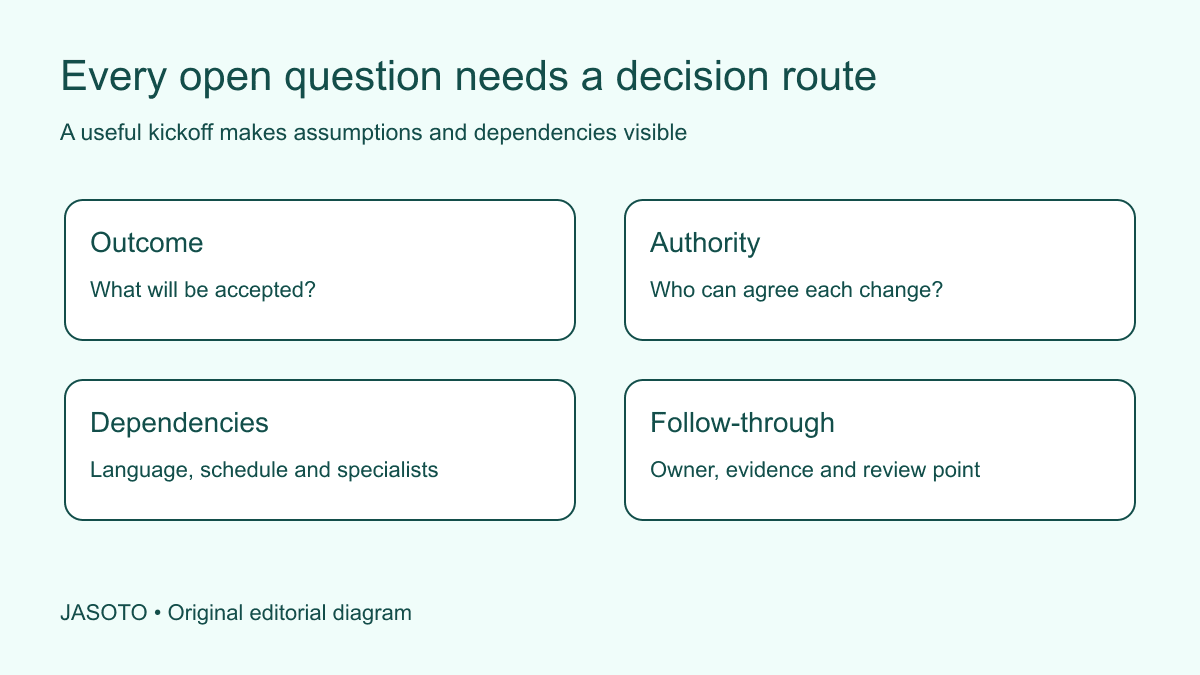
Original JASOTO editorial diagram. Its complete workflow is explained in the article; no actual customer outcome is depicted.
Prepare a cross-border project kickoff question list by identifying the outcome, the people authorized to agree it and the dependencies that could prevent delivery. Ask about communication, language, schedule, deliverables and specialist issues in the actual project context. Close each unresolved question with an owner and a next decision point. A productive kickoff makes uncertainty actionable instead of recording broad agreement that different participants interpret differently.
This guide uses a UK business coordinating a fictional international supplier project. It provides an editorial question structure rather than jurisdiction-specific advice. Legal, tax, employment, data and other specialist matters need the appropriate qualified owner. The kickoff should identify those needs early without turning a general planning meeting into an unsupported answer to every cross-border issue.
The practical answer
- Ask questions that expose decisions and dependencies before delivery starts.
- Separate settled agreements from assumptions needing confirmation.
- Assign commercial, technical and specialist questions to appropriate owners.
- Close with an action record and a clear change route.
Ask what outcome the parties are actually agreeing
Begin with the problem the project should solve and the deliverables expected. Ask what completion looks like and what evidence will be used to review it. Avoid broad goals such as “improve operations” without a defined task. Different organizations may use the same project title while expecting materially different outputs.
Ask which assumptions underpin the proposed outcome. Does the plan depend on access to a location, an approved source document or a customer's decision? Record those dependencies with owners. A clear scope discussion should identify what is included and what remains outside the current agreement, using the actual commercial and technical process to settle boundaries.
Confirm the relevant parties and decision-makers
Ask who provides, receives, reviews and approves each part of the work. Identify the contracting and operational roles through the responsible owner rather than inferring them from email signatures. A person coordinating a call may not have authority to approve budget, scope or acceptance. Keep the distinction practical and visible.
For each likely decision, ask who can make it and how their approval is recorded. If the authorized person is absent, assign a route and review point. Do not treat enthusiastic discussion as settled approval. The list should help the team obtain a decision without making assumptions that later become a dispute about who agreed what.
Establish the current agreement and source documents
Ask which proposal, scope, specification or other record governs planning. Confirm versions and identify known differences between parties' copies. If a document is still under review, label it accordingly. A kickoff based on several unaligned drafts can create a detailed schedule for different versions of the work.
Record the owner for factual and contractual questions. Do not ask a translator or coordinator to resolve an underlying commercial discrepancy by choosing smoother wording. The source documents need a controlled route for clarification. Keep the meeting's action record linked to those documents so later participants can understand the basis of the decisions.
Ask how changes will be proposed and authorized
Discuss the route for a changed requirement, schedule or deliverable. Identify who assesses consequences and who authorizes the outcome. [Scottish Government's change-control guidance](https://www.gov.scot/publications/project-initiation-business-cases-handbook/pages/16/) illustrates recording changes and their consequences within its construction context. Use the general principle with a process appropriate to your actual project rather than importing its governance as a universal requirement.
Ask how approved changes reach affected people and documents. A decision in a meeting is not automatically an updated supplier instruction or revised customer expectation. Give implementation and verification separate owners where useful. The question list should make follow-through explicit, including what happens when a decision supersedes an earlier approved arrangement.
Agree working languages and communication support
Ask which languages are needed for meetings, working documents and approved deliverables. Distinguish those tasks instead of assuming one choice covers everything. Confirm appropriate reviewers and support where consequential meaning is involved. A translated overview does not establish that all future discussions or specialist documents can be handled in that language.
Use language services research to explore suitable assistance, then verify requirements with the actual provider. Ask how terminology questions and misunderstandings will be raised. Avoid making one bilingual colleague the default interpreter for every technical or sensitive discussion without assessing suitability. The kickoff should identify the real communication need and give it an accountable preparation route.
Check schedule anchors and local availability
Ask which location or reference anchors recurring meetings and milestone dates. Confirm the actual calendar occurrences and relevant working arrangements. Do not assume a fixed time difference or a shared holiday schedule. Give schedule uncertainty an owner who can obtain the appropriate current information for the participating locations.
Ask what response and review periods are genuinely supported. A document sent late in one location's day may not receive immediate attention elsewhere. Record dependencies and escalation routes without inventing universal turnaround targets. The schedule should reflect the real work and availability, not simply a set of dates everyone accepted before understanding the review effort.
Define deliverable formats and acceptance evidence
Ask what files, physical items or service records will be delivered and how they will be reviewed. Specify relevant format, language, version and destination through the responsible technical and operational owners. A named deliverable such as “report” can conceal differences in structure, editability and approval status.
Ask who accepts the work and what happens if a question remains open. Keep review, acceptance and payment decisions aligned with the actual agreement rather than improvising terms. The kickoff record should point to the approved process and identify unresolved details. That gives the delivery team useful clarity without making the question list itself a substitute contract.
Identify commercial questions requiring approval
Ask who confirms the quotation, currency, amount basis, relevant charges and payment arrangements. Record uncertainties for the appropriate owner and advice. Avoid selecting an exchange rate or deciding tax treatment in a general coordination discussion. The useful action is to identify what must be settled before a dependent commitment is made.
Check that translated or localized commercial documents represent the same approved offer, or clearly identify authorized differences. Ask how revisions will be controlled and which version the parties are considering. A correct-looking total does not resolve contradictory currency or scope wording. Keep document review connected to actual authority and evidence.
Surface specialist and jurisdiction-specific dependencies
Ask which legal, regulatory, data, employment, customs or other specialist issues may apply to the actual work. Do not presume every category is relevant, and do not assert requirements from memory. Assign investigation to suitable qualified people with a clear description of the project and locations. Record the evidence or advice needed for the next decision.
Keep the dependency status visible. “Legal to check” is too vague if the schedule assumes the question is already settled. Identify the decision affected and review point. The kickoff can continue with independent tasks where appropriate while the responsible owner determines what unresolved issues prevent commitment or delivery under the actual project process.
Ask about onsite work and travel dependencies
Identify whether anyone or anything must cross a border or attend a location. Ask who arranges access, travel, delivery and local coordination, and which matters require specialist advice. Do not promise a site milestone before the relevant dependencies are confirmed. The questions should reflect the actual delivery model, including remote alternatives where genuinely available.
Research project journeys alongside the agreed work, using current provider information and appropriate advice. Keep travel estimates separate from authorized attendance or entry arrangements. A convenient route on a booking site does not establish every condition needed to perform the work. Assign the complete practical question to the responsible owner and record what remains uncertain.
Work through a fictional unresolved-review question
Imagine a supplier project whose draft schedule assumes a target-language deliverable will be approved immediately after delivery. At kickoff, the customer explains that a specialist reviewer must assess it first. The question list captures the reviewer, required material and actual decision route. The team then revises dependent dates through the authorized process.
The meeting closes with a clear action rather than a vague agreement to communicate better. This fictional example shows how a question can uncover a dependency before it becomes a missed milestone. It does not establish an appropriate review duration or approval hierarchy for another project, and it makes no claim about measured savings from the exercise.
Close with decisions, owners and a usable record
Summarize what was agreed, what remains assumed and who obtains each answer. Read back consequential decisions and identify the governing document versions. Give the record a maintained location and correction route. A long meeting transcript is less useful for follow-through if nobody can find the next required action.
Research project support providers against distinct unmet needs, or consider coordination roles when continuing responsibility requires capacity. Preserve the question list and decision history through the project. The practical result is a kickoff record that makes outcomes, authority and cross-border dependencies understandable, allowing the team to progress on approved facts and investigate uncertainty without manufacturing answers.
Put the guide into practice
- Define the intended outcome and acceptance evidence.
- Confirm parties, authority and communication arrangements.
- Identify schedule and language dependencies.
- Escalate jurisdiction-specific questions to qualified advisers.
- Record decisions, owners and next review points.
Frequently asked questions
Should the kickoff settle every legal or tax issue?
Use the meeting to identify which questions need appropriate advice and who obtains it. Do not improvise cross-border legal, tax or employment conclusions in a general project discussion. Keep unresolved dependencies visible and let the responsible owner decide their effect on the plan through the actual process.
Can we use the same question list for every country?
Use a reusable structure, then adapt it to the actual parties, work and delivery model. The list should prompt relevant investigation rather than imply identical rules or buying practices everywhere. Remove irrelevant questions and add distinct needs supported by the project's evidence.
What if the person in the meeting cannot approve a decision?
Record the decision needed, the authorized owner and when an answer is required. Distinguish discussion from approval and avoid starting dependent work on an assumption. The meeting can still make progress by clarifying evidence, options and the route to a decision.
Explore JASOTO tools
Find suitable specialists for defined cross-border questions.
Explore project coordination roles →Assign ownership for decisions, dependencies and follow-up.
Plan project journeys →Identify travel dependencies before promising onsite milestones.
Explore language support →Arrange appropriate communication and document review.
Continue with JASOTO
Compare your next step
Discover UK businesses, compare services and request written quotes before making a decision.