
Business Growth · UK Guide 2026
Organise Evidence for a Customer Complaint Review
JASOTO · Updated 5 November 2026 · 1,611 words
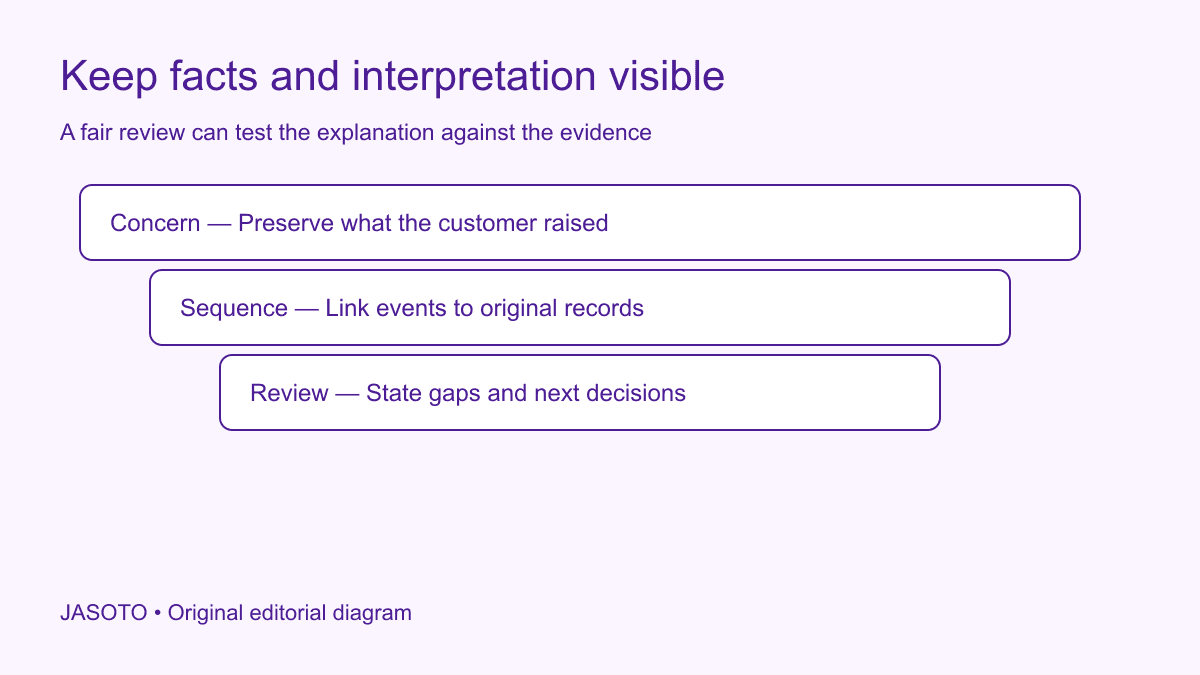
Original JASOTO editorial diagram. Its complete workflow is explained in the article; no actual customer outcome is depicted.
Organise complaint-review evidence by preserving the customer's actual concerns, building a sourced chronology and separating facts from interpretation. Include relevant material that challenges the business's first explanation as well as material that supports it. Give the reviewer a concise index and clear unresolved questions, then identify who is responsible for the next customer response.
This guide is an original administrative method for UK small businesses reviewing ordinary service complaints. It does not determine legal responsibility, a remedy or a regulated complaint process. Use the requirements and appropriate advice that apply to the actual business and circumstances. The worked example concerns an invented appointment dispute where the customer and service team initially describe different communication sequences.
The practical answer
- State the customer's concerns without rewriting them into a defence.
- Separate chronology, evidence and interpretation.
- Include material that challenges the first explanation.
- Assign the next review and customer-response actions.
Define the complaint in the customer's terms
Record what the customer says happened, which part of the service concerns them and what outcome they are asking for. Preserve the relevant original message and any appropriate later clarification. Avoid replacing the concern with a defensive label such as customer unhappy or an untested conclusion that the service was correct. The reviewer needs to understand the actual question before considering the evidence.
Separate distinct concerns where useful. A customer may raise a missed appointment, an inaccurate message and the way a later enquiry was handled. Those issues can have different evidence and next actions. Do not resolve one and report the whole complaint closed without addressing the others through the appropriate process. Keep the scope understandable and confirm ambiguity rather than guessing the desired outcome.
Identify the applicable review route
Check the business's actual complaint process and any relevant contractual, sector or legal requirements. Identify who can review, decide and communicate the response. A general evidence worksheet should not override a required route or deadline. Obtain suitable advice where the complaint is consequential or the applicable process is uncertain, and keep those responsibilities visible in the case record.
The [Parliamentary and Health Service Ombudsman's principles](https://www.ombudsman.org.uk/about-us/our-principles/principles-good-complaint-handling) discuss fair, accountable handling within its public-service context. They are not automatically a private business's mandatory procedure. The original method here uses a narrow practical principle: organise the material so the explanation can be examined, rather than constructing a pack whose purpose is to defend the first account at any cost.
Preserve relevant originals appropriately
Identify the records that may matter: booking confirmations, service notes, messages, relevant system events and appropriately obtained observations. Keep originals through the business's suitable security, privacy and retention process. Do not rely only on a screenshot stripped of its date, sender or surrounding context when the underlying record is available appropriately.
Avoid gathering everything about the customer indiscriminately. Focus on the actual concern and use an appropriate route for sensitive material. A complaint pack can contain personal information and should have suitable access controls. Ask the responsible person how to preserve material where a dispute or another obligation affects ordinary deletion or retention. This guide does not set a universal period.
Build a chronology with sources
List relevant events in sequence and attach a source reference to each. Distinguish the event time from the time someone later reported or entered it. A note written on Tuesday about Monday's call should not silently appear as a contemporaneous Monday record. Where the timing is approximate, say so. Reliable chronology depends on honest uncertainty as well as accurate dates.
Use plain event descriptions. A message was sent, a customer reports not receiving it and an employee attempted a call are different facts. Do not automatically convert one into the conclusion that notification was effective or that a customer refused contact. Keep the relevant delivery or contact evidence available and ask the appropriate specialist where technical interpretation is required.
Separate observation from explanation
Create distinct fields or sections for what the evidence shows, what someone says it means and what remains to be checked. A staff member's theory can be a useful lead without being an established cause. Preserve the basis for the theory and the question that would test it. Avoid making the summary more certain than the records supporting it.
Apply the same standard to every account. A customer recollection and employee recollection may each have limits. Do not treat one as inherently conclusive because of who supplied it. Compare the relevant records and seek clarification fairly. The aim is a review that can identify a supported finding or a genuine unresolved point, not a narrative that becomes stronger through repetition.
Index the evidence for the reviewer
Use a concise index with a reference, description, relevant date, source and location. Link the controlled record rather than duplicating sensitive attachments in several places. Identify which concern each item relates to. This helps the reviewer move between the summary and original evidence without reading an entire mailbox or guessing why a photograph was included.
Keep working commentary distinguishable from evidence. A reviewer note can ask whether an appointment update reached the customer, while the underlying message remains the source. Do not insert the commentary into the original record or edit a document to make it appear to support the interpretation. Preserve appropriate version history and a clear correction route if the index itself contains an error.
Look deliberately for missing and contrary material
Ask what evidence would challenge the initial explanation and whether it has been reviewed appropriately. A confirmation sent to an old address may change the account of what the customer was told. A later correction may explain why staff acted on information that has since changed. Include relevant context even when it makes the business's first summary less comfortable.
Record gaps without inventing their contents. If a call was not recorded or a message cannot be located, say what is known and how the search was conducted appropriately. Absence of a record does not always prove absence of an event, and a claim that an event occurred does not create missing evidence. State the limitation and identify whether another proportionate check can help.
Give each open question an owner
Turn a meaningful gap into a specific review action, such as verifying the address used for a booking update or obtaining the relevant service note. Assign someone with suitable authority and access. Add an agreed update point or dependency. A status reading investigate complaint does not explain what remains uncertain or how the next person should progress it.
Keep the customer-response owner separate where appropriate. Evidence gathering and communicating an update may need to proceed together under the actual complaint process. Do not leave the customer uninformed because an internal record is incomplete. Use accurate status information and appropriate commitments, without promising a final outcome the reviewer has not yet established or been authorised to offer.
Worked example: a disputed appointment update
Imagine a service business receiving a complaint that an appointment changed without useful notice. The team preserves the customer's concern and requested outcome, then builds a chronology from the booking record and messages. It distinguishes the time an update was entered from the time a message was sent. The reviewer asks whether the contact route was current instead of assuming the existence of a message proves the customer received the change.
Relevant gaps remain visible, and the response owner provides the appropriate update through the actual process. This invented example makes no finding of fault or promise of a remedy. It shows how a fair evidence structure can test the communication account without rewriting uncertainty into either a complete defence or an unsupported accusation.
Record findings and the basis for them
Make a distinction between a finding and a limitation that prevents one. Evidence may establish that a message used an old contact address without establishing whether the customer saw it elsewhere. State both points rather than choosing a simplified complete explanation. If the decision must proceed despite uncertainty, record the appropriate authority and advice behind that decision. This gives later reviewers a fair account of the reasoning available at the time, rather than a polished narrative that conceals the actual evidential limits the business faced.
For each concern, state the finding supported by the review, the evidence relied on and any remaining limitation. Keep recommendations and authorised response decisions distinct. A proposed remedy should not appear as an agreed customer outcome until the proper process reaches that point. Obtain appropriate professional advice where technical, legal or regulated questions require it.
Write the response so the customer can understand the relevant reasoning without receiving unnecessary internal or third-party information. Use the business's appropriate review and communication process. If a record or earlier statement was wrong, explain the correction accurately. Do not preserve a known error in the final account merely because acknowledging it complicates the original narrative.
Learn from the actual information gap
Review what the case reveals about records, responsibility or service communication. A missing contact check may need a targeted process change, while an isolated unclear note may need better wording. Avoid claiming a wider cause or improved complaint rate without suitable evidence. Preserve the earlier process so a revision that creates another problem can be reviewed or reversed.
Use JASOTO businesses to discover suitable customer-service support and verify capability directly. If reviews become continuing work, explore service administration roles within a staffing review. For an agreed inspection or meeting, research travel after confirmation. A useful complaint pack makes the concern, evidence and next decision visible while preserving a fair account of what remains unknown.
Put the guide into practice
- Identify the complaint, requested outcome and scope.
- Preserve relevant original records appropriately.
- Build a chronology with sources and explicit uncertainty.
- Review gaps, authority and the next response step.
Frequently asked questions
Should every email go into the review pack?
Preserve relevant original records through the appropriate process, then create a focused index for the reviewer. Avoid overwhelming the summary with unrelated correspondence or circulating unnecessary personal information. The reviewer should be able to access the material needed to test the account fairly.
Does the chronology prove who is responsible?
A chronology helps establish sequence and identifies supporting evidence. It does not automatically determine causation, legal responsibility or the appropriate remedy. Keep interpretations and unresolved questions explicit, and obtain suitable advice for consequential or specialist matters.
Can the business correct an inaccurate internal note?
Use an appropriate traceable correction process. Preserve the relevant original account and explain what changed and why. Do not silently rewrite the history to make it appear that the business always knew the corrected information.
Explore JASOTO tools
Discuss the actual review and communication needs with suitable providers.
Explore customer-service administration roles →Consider support where evidence review and follow-up become ongoing work.
Research a confirmed review appointment →Plan travel only if an appropriate inspection or meeting has been agreed.
Continue with JASOTO
Compare your next step
Discover UK businesses, compare services and request written quotes before making a decision.