
























Customer Communication · UK Guide 2026
Create a Useful Customer Language Preference Question
JASOTO · Updated November 5, 2026 · 1,593 words
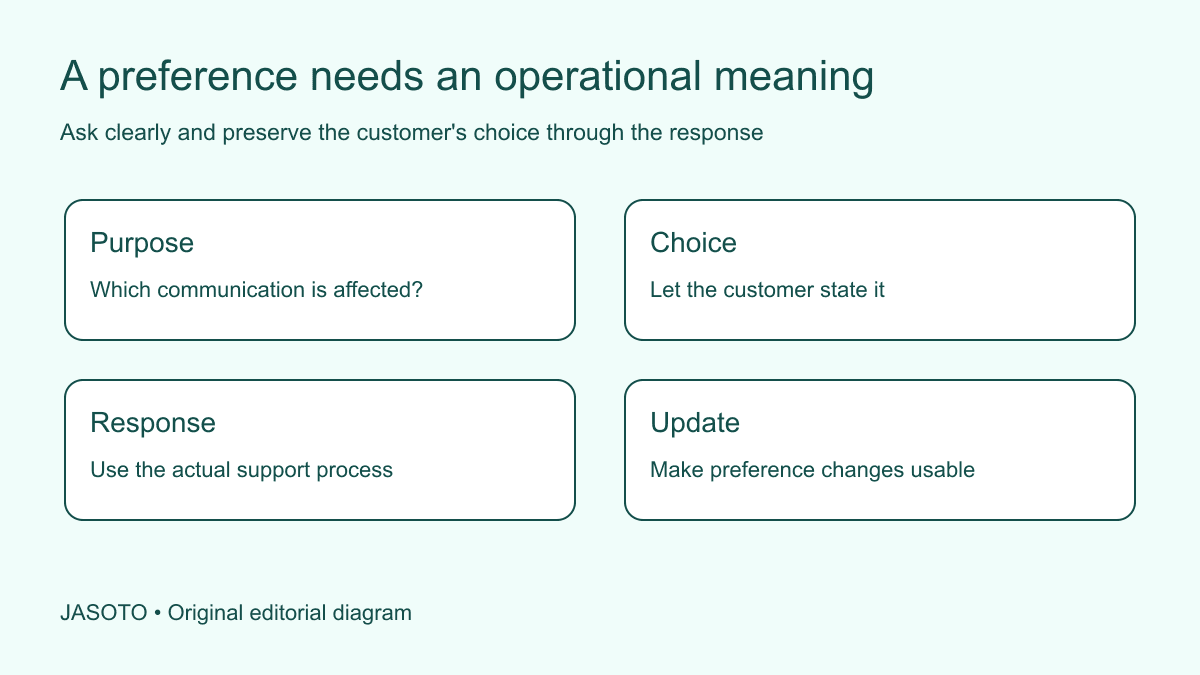
Original JASOTO editorial diagram. Its complete workflow is explained in the article; no actual customer outcome is depicted.
Create a customer language preference question by naming the communication it affects and explaining what the business can do with the answer. Let the person state their preference, give a truthful route for choices needing review and ensure the response team receives the information. A language field adds little value if staff ignore it or if the list implies support the business cannot provide.
Start with a specific task, such as written replies about a service request or communication for an agreed appointment. The examples here concern a small United States business and are fictional. Handle personal information through the organization's appropriate process, and use qualified support where the conversation requires specialist language or accessibility assistance.
The practical answer
- Define which communication the preference affects.
- Offer only language options the business can explain honestly.
- Let customers express or change their own preference.
- Test how the answer reaches the person responsible for responding.
Define the decision the question supports
Ask what will change when someone selects an option. The answer might choose a translated information sheet, route a message to a capable team or trigger a review of assistance needs. Record that purpose before adding the field. If nothing in the process can respond to the answer, resolve the operating gap rather than collecting a preference for appearances.
Distinguish website display from customer-service communication. A person choosing a page language has not necessarily asked for every future message in that language. Write the question for the relevant context. “Which language would you prefer for our written reply about this request?” is more precise than a bare “Language” label when that is the actual service being offered.
Inventory the support genuinely available
Confirm which communications the team can provide, through whom and during which coverage periods. Separate a maintained translated document from a live conversation requiring additional arrangements. Do not present both as an identical immediate service. A person may choose a document language without receiving a promise of real-time support in that language.
Record the route for an unlisted preference. If the business can review a request for assistance, explain that review accurately. If it cannot provide the requested service, it needs a clear and respectful answer rather than an unattended “other” field. The option design should make the actual choices understandable without implying that every possible selection guarantees a particular response.
Ask the person instead of guessing identity
Keep language preference separate from nationality, ethnicity, address or country of residence. Those fields may serve other legitimate tasks, but they should not silently determine the communication language. A person's name or location does not establish what they want to use for a specific written or spoken exchange.
For website language, [W3C's language-negotiation guidance](https://www.w3.org/International/questions/qa-when-lang-neg) explains limitations of automatic choices and the importance of user controls. Apply the same respect for explicit choice to the service process. Automatic display and a customer's stated communication preference are different pieces of information; ensure the system and staff know which one governs the current response.
Write the question and explanation together
Use a direct question naming the relevant communication. Add brief help explaining available support or a review step where necessary. Avoid bureaucratic wording such as “linguistic classification” or an unexplained proficiency scale. Customers should understand why the business is asking without needing to infer whether the answer affects eligibility, speed or treatment.
Only describe consequences the business actually applies. If the field helps provide information in an available language, say that. Do not promise a faster reply or specialist staff member unless the operating process supports it. If a request may need clarification, explain how the team will contact the person through the established route.
Design recognizable options with suitable review
Ask appropriate language reviewers to check labels, scripts and any language-variety distinction relevant to the service. A list written entirely in English may be hard to use for the people it is meant to assist. Choose a format suited to the audience and number of actual options, then test it through the site's accessibility and form-review process.
Avoid decorative flags as the only language labels. Countries and languages do not map neatly to one another, and the relevant choice should be expressed clearly in text. Do not invent a language distinction because a dropdown template includes it. Conversely, raise meaningful variety questions with the provider when they affect understanding or the material the business supplies.
Keep optionality and uncertainty truthful
Decide whether the answer is needed to deliver the current service and handle a missing answer through an explicit process. If an option is optional, staff should know what default communication follows and how to ask for clarification. Do not label the field optional while blocking submission or treating unanswered requests as invalid behind the scenes.
Allow a person to say they have no preference or need to discuss support where that reflects a workable process. Some customers use several languages and may not want a single permanent label. Keep the question scoped to the task so they can answer accurately. Avoid forcing a proficiency judgment when the business only needs to know which available document they prefer.
Route the answer to the responsible person
Trace the preference from form submission to the working case. Check that the relevant team sees it before replying and understands its scope. A field can save correctly in a database while remaining invisible in the email staff actually read. Test the route rather than assuming the information will be noticed because it appears in the form design.
Define the next action for each supported option and for review-needed requests. Give exceptions an owner and review point. If the team uses templates, ensure the selected version matches the current service information. Research customer support providers with this actual routing requirement when external assistance is needed, instead of asking only for a translated dropdown.
Separate written, spoken and access needs appropriately
Consider whether the service needs different questions for written information, live conversation or other communication assistance. Do not collect extra detail by default; ask only where it informs the actual arrangement. A written-language choice does not establish whether an interpreter is required or what access support an individual needs.
Provide a respectful route to discuss relevant requirements through the organization's process. Explore language support where suitable expertise is needed. Keep sensitive details restricted appropriately and avoid broad labels that staff may interpret as a general inability. The useful record describes the agreed communication preference or arrangement for a task, with the person retaining a way to clarify it.
Work through a fictional service request
Imagine a repair business offering written request updates in two maintained languages and reviewing other assistance requests individually. Its original form lists many languages without explaining support. Customers reasonably assume every option receives the same service. The revised question names written updates and distinguishes the available options from a request for discussion.
A test confirms that the selected preference appears in the case record and reaches the coordinator before the first reply. The acknowledgement explains the current status accurately. This fictional example shows a question connected to a real response process. It does not establish which languages another business should support or imply that a preference field alone provides an accessible service.
Test a change of preference
Ask how a customer can update their choice for the current case and future communications where relevant. Check that the change reaches templates, staff notes and any connected system that uses the record. Avoid treating an early selection as permanent when the person later asks for another available arrangement.
Test a realistic scenario in which a customer reads one language but requests a phone conversation in another. Verify what staff do and which uncertainty requires follow-up. For visitor communication and travel planning, ensure the agreed arrival message uses the relevant current arrangement. Keep version and preference changes visible enough that staff do not send an outdated set of instructions automatically.
Check reporting does not enlarge the answer
If the business summarizes preferences for planning, preserve what the field actually asked. A count of preferred written-update languages should not become a claim about customers' nationality, identity or ability to speak English. Label the report with the relevant question, period and missing responses. Keep access and retention within the organization's information-handling process.
Use the evidence to investigate practical service needs without assuming every unselected language has no demand. People who could not use the form may be absent from the record, and some customers may choose the available default for convenience. Note those limits when deciding whether to commission another translated document or review staffing. The report can inform a question for further research while remaining faithful to the limited preference information customers actually supplied.
Review outcomes and maintain honest availability
Monitor specific issues such as unanswered assistance requests, wrong-language replies or unclear option labels. Compare observations with actual request volume and note changes in staffing. Do not claim that adding the question improves satisfaction or sales without evidence. The immediate check is whether the answer produces the intended operational action.
Assign continuing ownership and consider multilingual support roles if coverage needs dedicated capacity. Review the field when languages, templates or staffing change. Keep earlier wording and a rollback path for publishing errors. A useful preference question remains a clear invitation to express a choice the business can understand and act on honestly.
Put the guide into practice
- Choose the actual service decision the question supports.
- Separate language preference from nationality and location.
- Explain availability and any review step.
- Check labels with suitable language reviewers.
- Verify routing, updates and staff response.
Frequently asked questions
Can we infer language preference from the customer's country?
Ask the person when a preference is relevant. Location, nationality, name and browser settings do not reliably tell you which language they want for a particular conversation. Use an appropriate explicit choice and make any automatically selected website language easy to change.
Should every language in the world appear in the list?
Design the options around the actual purpose and support available, with a useful route for another preference where the business can handle it. A long list can imply that every choice is immediately supported. Explain what happens when a request needs review rather than promising an unavailable service.
Does choosing a written language establish the same preference for calls?
Not necessarily. Ask about the relevant communication or clarify the distinction where it affects the service. A person may read one language comfortably and prefer another for a live conversation. Keep the wording and record specific enough that staff do not make a broader assumption than the answer supports.
Explore JASOTO tools
Compare providers against the actual language and routing requirement.
Explore multilingual support roles →Define coverage before promising language-specific responses.
Plan visitor communication →Check language preferences for agreed visit information.
Explore language support →Consider suitable assistance when a requested language needs additional support.
Continue with JASOTO
Compare your next step
Discover UK businesses, compare services and request written quotes before making a decision.