
Business Growth · UK Guide 2026
Set Up a Damaged-Parcel Evidence Checklist
JASOTO · Updated November 5, 2026 · 1,616 words
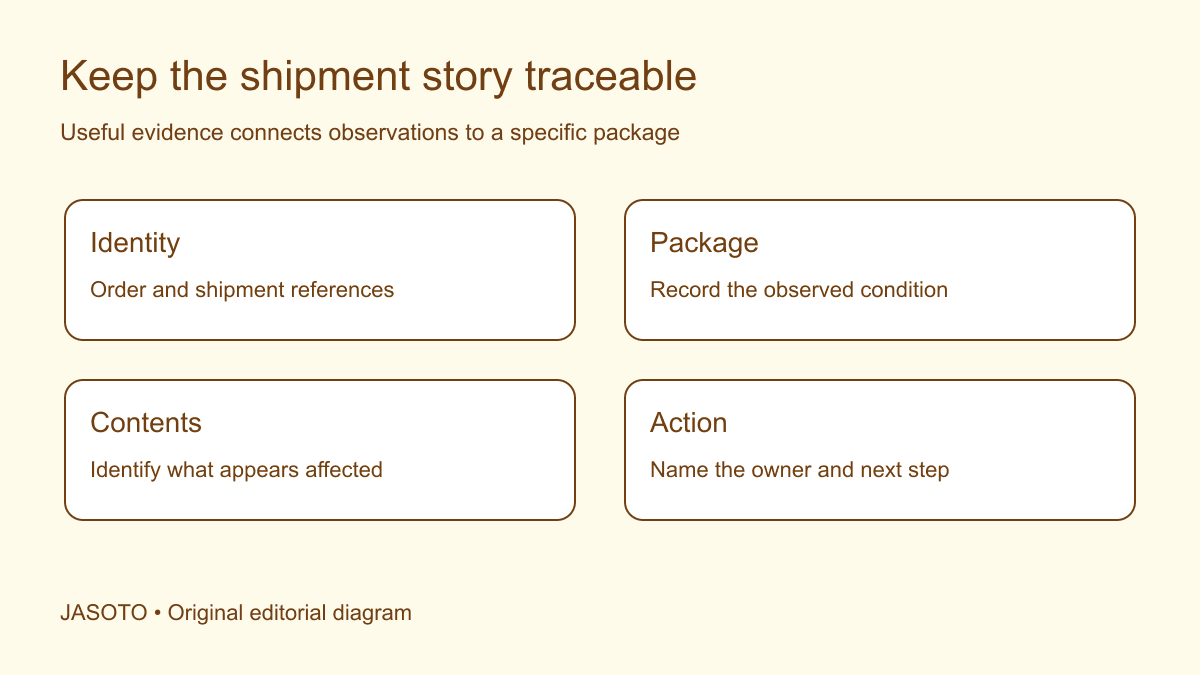
Original JASOTO editorial diagram. Its complete workflow is explained in the article; no actual customer outcome is depicted.
Set up a damaged-parcel evidence checklist around shipment identity, observed condition, affected contents and the next action. Connect photographs and messages to the correct order and carrier reference. Check the current requirements for the actual shipping service promptly, then keep a clear record of what was submitted and who is responsible for follow-up.
This guide is an original administrative method for small businesses in the United States handling ordinary goods. It helps organise a factual report and customer response. Carrier eligibility, insurance and consumer obligations depend on the actual circumstances. If damaged material presents a hazard, use appropriate safety arrangements and professional advice; evidence collection should never require unsafe handling or attempts to operate a damaged product.
The practical answer
- Connect every photograph and message to the actual shipment.
- Describe what is observed without deciding the cause prematurely.
- Check the relevant carrier and service requirements promptly.
- Assign the claim and customer-response actions separately.
Identify the exact shipment before collecting attachments
Record the order reference, carrier, tracking or label reference and relevant delivery information from the business's actual records. Check whether the order was split across packages or sent in separate dispatches. A customer may describe the whole order as damaged when only one carton is involved. Keep that distinction visible so the evidence is attached to the correct shipment.
Give the case a stable internal reference that customer service and dispatch can both use. Avoid opening separate unconnected cases for a photograph, an email and a carrier message about the same package. A single index can link them while preserving their original dates and sources. This helps the next colleague understand the sequence without searching several inboxes for matching product names.
Record the first observation accurately
Ask for a factual description of what was noticed, when and by whom. Distinguish visible packaging damage, damaged contents and missing pieces. A crushed corner of a carton does not establish the condition of every item inside, while a damaged product does not prove precisely when the damage occurred. Keep observations separate from conclusions about cause or responsibility.
Use plain descriptions with useful location information. A split along one side of the carton is clearer than badly damaged packaging. If the reporter is uncertain, retain that uncertainty. Do not turn an approximate account into a precise timestamp or rewrite a customer's words into a technical diagnosis. A reliable evidence pack preserves what people actually know, including the limits of their account.
Check the actual carrier process early
Read the relevant carrier and service instructions, including who may claim, evidence, filing requirements and any applicable time limits. [USPS's domestic claims page](https://www.usps.com/help/claims.htm) describes supporting records and preservation of damaged articles and packaging in its insured-mail process. That is a specific service context, not a universal timetable or entitlement for every parcel sent in the United States.
[UPS's claims guidance](https://www.ups.com/us/en/support/file-a-claim) likewise identifies shipment information and retaining damaged contents and packaging. Confirm what applies to the particular shipment and account. Do not copy a remembered deadline from another carrier or tell a customer that a photograph alone guarantees payment. Keep the source and date checked in the internal case so another colleague can verify the basis of the instruction.
Plan appropriate photographs with context
Where safe and suitable, useful images can include the overall package, relevant damage, the shipment label and affected contents. Check the actual carrier's requirements rather than treating this as a complete universal list. Connect each image to the case reference and explain what it depicts. A close-up can be hard to interpret without an overall view showing which package or item it belongs to.
Avoid asking a customer to recreate the delivery event, move hazardous material or handle broken components for a better angle. If something cannot be photographed safely, record that and seek appropriate instructions. The checklist should help the business ask relevant questions, not become a rigid demand that overrides sensible safety decisions or a specialist's directions for the actual product.
Preserve originals and make review copies carefully
Keep original evidence files through the appropriate business process. If a smaller or cropped copy is needed for review, preserve the relationship with the original and do not alter the relevant condition. Name files meaningfully, such as case reference and package view, rather than relying on several attachments all called image. Avoid edits that make the evidence appear more conclusive than it is.
Review images for unrelated personal information before wider sharing. A shipping label can contain contact details, while a background may show private documents or identifiable people. Use the appropriate controlled channel for the actual recipient. Do not post a public album merely because a carrier or colleague needs access to a few relevant files. Ask the responsible person how sensitive evidence should be handled.
Identify the affected contents specifically
Match each affected item to the order line, variant and relevant quantity. If several identical items were delivered, record how many appear affected and what remains uncertain. Do not claim the whole shipment is unusable based on a single observed issue unless appropriate evidence supports that conclusion. Likewise, do not describe an item as unaffected merely because its outer packaging looks intact.
Keep technical assessment separate. A customer-service employee can record a reported cracked surface, but may not be competent to determine repairability or safe use. Follow the product's appropriate support process and seek suitable advice. Preserve any professional assessment or quotation with the case where relevant, while avoiding unsupported statements about a replacement component or a repair method.
Assign the customer response and carrier action
Name the person responsible for communicating with the customer and the person handling any carrier claim. They may be the same employee, but the tasks should remain clear. The customer needs an appropriate response under the actual sale arrangements, while the business may separately need to pursue its carrier process. Avoid treating one task as automatically completed because the other has started.
Confirm who can make commercial decisions about replacement, refund or another remedy through the business's proper process. This article does not determine what is owed in a particular case. Keep promises supported by actual authority and availability. A well-organised evidence pack is useful, but it should not become an excuse to delay an appropriate customer response while an unrelated internal question remains open.
Build a short case index
Preserve the difference between the time an event occurred and the time a file reached the business. A photograph received on Tuesday may depict Monday's delivery, according to the reporter. Record that account accurately rather than assuming the attachment timestamp establishes when damage happened. If a date is unknown, label it unknown and ask only relevant follow-up questions. This makes the chronology easier to review without creating false precision, especially when a customer forwards files through several devices or a colleague uploads them later to a shared case system.
A practical index can contain the shipment identity, factual summary, file references, carrier requirements checked, submission reference and next action. Link supporting documents instead of copying them into every status message. Record when a new request for information arrives and who will answer it. A deadline or action in a carrier portal can be missed if nobody owns checking that channel.
Distinguish drafted, submitted, acknowledged and resolved states. A completed internal form does not prove a claim was filed. An automated acknowledgement does not establish approval. Preserve the actual reference and response. If the process is blocked by missing information, identify exactly what is needed and who is obtaining it, rather than leaving a generic awaiting evidence status that nobody can act on.
Worked example: one damaged carton in a split order
Imagine a retailer sending a customer two cartons of desk accessories. The customer reports damage to one carton and one item inside it. The team connects the report to the correct tracking reference, obtains appropriate factual images and records the item and quantity affected. It keeps the other carton distinct instead of describing both as damaged based on the order-level complaint.
The customer contact follows the sale's appropriate response process, while the dispatch owner checks the actual carrier requirements and records the submission separately. This invented example claims no successful reimbursement or finding of fault. It shows how package identity and assigned ownership preserve a useful history even when the eventual commercial and carrier decisions have not yet been made.
Close the case with an evidenced outcome
Record the actual response, any agreed customer action and the carrier outcome separately. Preserve relevant conditions and unresolved questions. Do not mark a claim paid simply because it was approved if another step remains. Likewise, a customer receiving a replacement does not necessarily close the carrier process. The case index should show which part is complete and who owns anything outstanding.
Review patterns only where the evidence supports comparison. Repeated damage associated with a packaging configuration may justify a focused investigation, but a few reports do not prove a cause. Keep original case references and seek appropriate packaging expertise where needed. Change a specific process based on the actual finding, and retain the previous instruction so an ineffective revision can be corrected.
Use JASOTO businesses to discover suitable shipping or packaging support and verify relevant capability directly. If claims coordination becomes continuing work, explore dispatch support roles within a staffing review. For a specifically arranged inspection or depot visit, research travel after confirmation. A useful checklist preserves the real evidence and moves the case toward a clear next decision without manufacturing certainty or a promised outcome.
Put the guide into practice
- Identify the shipment, order and affected contents.
- Use appropriate safe evidence collection and preservation.
- Check current carrier instructions and applicable terms.
- Record submissions, next actions and the responsible contact.
Frequently asked questions
Do photographs guarantee compensation?
No. They can support a factual record, but eligibility and the outcome depend on the actual service, terms, evidence and circumstances. Check the carrier's current process and preserve the relevant records rather than promising a successful claim.
Should the customer throw away the packaging?
Check the actual carrier and seller instructions first. USPS and UPS give guidance about retaining damaged contents and packaging for their claims processes. If material presents a hazard, use appropriate safety advice and tell the responsible party rather than handling it to satisfy a generic checklist.
Who should file the claim?
Confirm the appropriate claimant for the actual shipment and carrier account. The seller's customer-service action and the carrier's claim process may have different owners. Keep them connected so a customer is not left waiting because each participant assumes someone else has submitted the case.
Explore JASOTO tools
Discuss the actual packing, carrier and evidence process with suitable specialists.
Explore dispatch support roles →Consider staffing where shipment records and customer follow-up become ongoing work.
Research a confirmed inspection journey →Plan travel only after an inspection or depot visit has been specifically arranged.
Continue with JASOTO
Compare your next step
Discover UK businesses, compare services and request written quotes before making a decision.