
Websites & Visibility · UK Guide 2026
Plan Content Removal When a Service Is Discontinued
JASOTO · Updated November 5, 2026 · 1,510 words
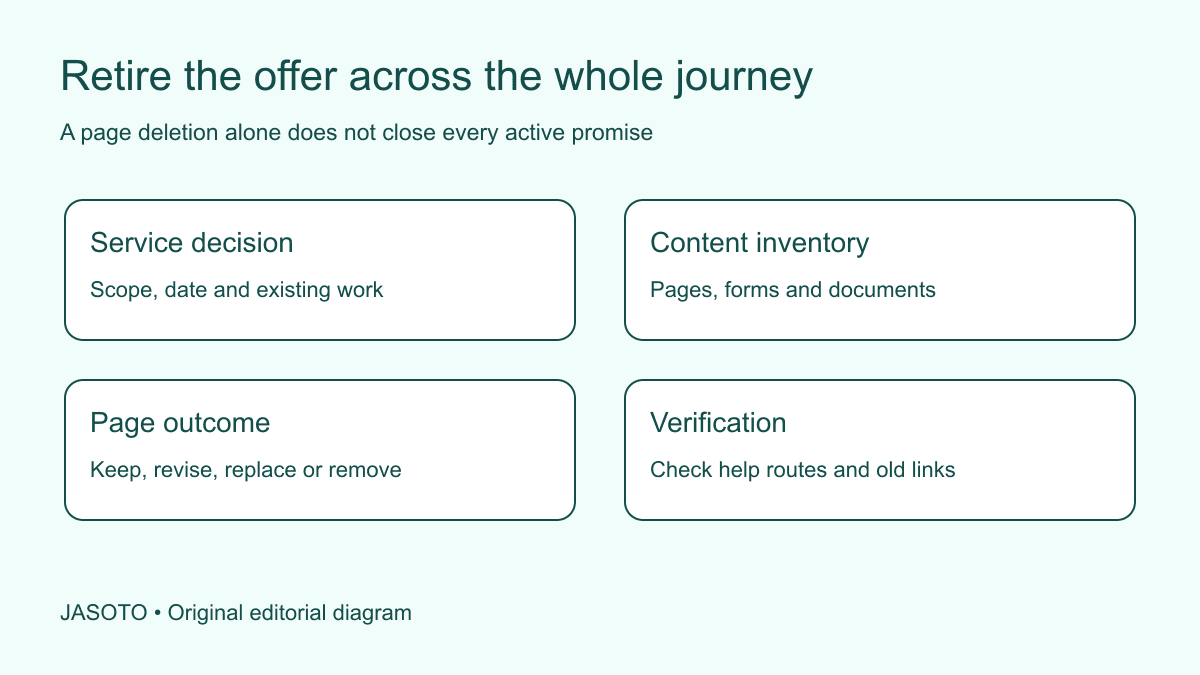
Original JASOTO editorial diagram. Its complete workflow is explained in the article; no actual customer outcome is depicted.
Plan content removal for a discontinued service by confirming what ends, identifying every place it is offered and deciding what each customer route should do afterwards. Preserve accurate help for existing customers while removing misleading sales actions. Give the technical team a page-by-page brief rather than asking it to delete a service page and assume the surrounding website will become consistent automatically.
This workflow focuses on a small business in the United States permanently withdrawing an ordinary service. It covers editorial coordination and a handover to technical owners. Decisions about existing agreements, records and customer rights need the relevant business process and professional advice. The sample retirement record is fictional and illustrates how to organize the work.
The practical answer
- Approve the permanent service decision and existing-customer arrangements first.
- Inventory every active claim, form and linked document.
- Choose a useful outcome for each page rather than one blanket destination.
- Separate public removal from records the business needs to retain.
Confirm the service decision and its boundaries
Write down the service ending, effective date, affected locations and whether related offerings continue. Distinguish a permanent withdrawal from a temporary capacity pause. If the business is undecided, do not publish final language because it simplifies the website. Give the uncertainty a decision owner and review point before scheduling irreversible customer-facing changes.
Check the boundary with the people delivering the work. A broad service name may contain several activities, some of which remain available. An incorrect blanket removal can make useful services harder to find and misinform staff as well as customers. Record the approved scope so editors, support teams and developers work from the same decision.
Agree the route for existing customers
Identify what people with current work, past purchases or agreed appointments need to know. Confirm the maintained contact team, relevant information and any individual communication required through the normal authorized process. A public page cannot resolve private arrangements for every customer, but it should not strand them after the sales offer disappears.
Keep the support route distinct from new sales. A remaining form may need to say it handles existing cases only, if that is the actual arrangement. Avoid inviting fresh requests into a mailbox retained solely for support. The content plan should identify who checks the route after publication and what happens if a customer still uses an older reference or contact method.
Build a service-claim inventory
List landing pages, service cards, navigation, forms, booking links, FAQs, pricing information, downloadable material and active announcements. Include relevant external profiles and ads where the business controls them. Record URL or location, owner, current claim, proposed outcome and dependency. Search for synonyms and product names as well as the formal service title.
Separate an active offer from a clearly historical reference. A dated project story can remain useful without implying that the service is available today, provided its context and actions are accurate. An active quote button has a different role. The inventory helps the team make those decisions deliberately instead of deleting all history or leaving every old claim untouched.
Choose the outcome for each page
Use plain editorial decisions: retain with revised context, replace with genuinely relevant information, consolidate useful material or remove. Record the reason and intended visitor task. A page explaining aftercare may need to remain accessible even when the original service is no longer sold. A thin promotional page with no continuing purpose may require a different outcome.
Do not choose one blanket destination merely because it is easy to implement. A person following an old service link should understand what happened and where appropriate help remains. Where there is a replacement service, describe its actual relationship and limits. Avoid implying equivalence when its scope, delivery method or customer requirements differ materially from the discontinued offer.
Separate editorial outcomes from technical implementation
Give the developer the intended customer outcome and supporting inventory. Ask them to choose and verify the appropriate routing, indexing and response behavior for the actual site. [Google's removal guidance](https://developers.google.com/search/docs/crawling-indexing/remove-information) distinguishes temporary search removal from lasting changes to the underlying content or access. Follow current official guidance for technical decisions.
Keep the distinction visible in the project record. Hiding a result in one search engine does not necessarily remove a page, form or direct link that customers can still access. Equally, removing a public page does not automatically resolve every cached reference or external profile. The editorial owner and technical owner should each verify the parts they control without claiming instant disappearance everywhere.
Write a useful retirement explanation
State that the service is no longer offered, identify any date that matters and give the relevant next action. Include existing-customer help where it remains available. Keep the tone direct and avoid a long promotional story before the status. A visitor following a saved link needs to understand the current position quickly.
Use only verified alternatives. If another provider is mentioned, confirm the relationship and appropriateness instead of inventing a referral partnership. Research business services can support independent comparison, but a directory link does not guarantee suitability or availability. A clear statement that the business cannot provide the service is more useful than an unrelated sales pitch designed to prevent a visitor leaving.
Close or repurpose forms deliberately
Review what happens if someone submits an old service request. Remove misleading entry points and update the form itself where needed, including confirmation and automated reply messages. A hidden navigation link does not stop visitors arriving through bookmarks or external references. Test the direct address in an appropriate environment and verify the customer-visible result.
If a form remains for existing customers, explain its scope and route requests to a team that still monitors it. Do not preserve a promise of a quote or response that the business no longer supports. Record any data-handling or system-retention decision with the responsible owner. Content cleanup should not improvise rules for records, payments or private case information.
Check connected plans and communications
Review appointments, supplier arrangements and any active campaigns affected by the withdrawal. Individual commitments need their own owners and appropriate communication. A changed website does not establish that a customer has been informed or that a supplier booking has been canceled. Keep those operational actions alongside the content plan without treating one as proof that the others are complete.
Where visits are affected, check the agreed arrangements before customers plan travel. If a location remains open for other services, avoid an announcement implying that the whole business has closed. Use the service boundary agreed at the start and ensure staff can explain it consistently. Broad closure language can create unnecessary confusion beyond the discontinued activity.
Work through a fictional retirement record
Imagine a printing business ending onsite event setup while continuing print production. The inventory finds a setup landing page, several package cards, a quote-form option and two historical project stories. The team decides to keep the stories with accurate context, revise the production pages and remove the unsupported setup request path.
Existing event customers receive individual handling through the responsible team. The old landing address gives a clear current answer and relevant support route according to the agreed technical implementation. This fictional example shows why the plan needs several coordinated decisions. It does not establish what URL response or commercial arrangement another business should use, and it does not claim a search benefit from the retirement.
Verify the old journey as well as the new navigation
Test saved links, direct form addresses, related-page links and important external references. Ask a reviewer unfamiliar with the change whether the discontinued service appears available and how an existing customer obtains help. Inspect public results where changes may take time, recording pending items separately from completed checks.
Fix discrepancies with named owners and retain the original wording and route plan for rollback if the wrong content was removed. Keep a controlled record of technical changes. A successful review is not merely the absence of the old page in the menu; it is a customer route that accurately reflects the service decision and preserves the help the business has agreed to provide.
Maintain the retirement record and learn from residual demand
Review continuing requests for the ended service and identify their sources where possible. They may reveal a missed profile, old document or partner reference. They may also be legitimate inquiries from people who remember the prior offer. Do not interpret every request as proof that the website change failed. Investigate the route and correct the specific stale claim when found.
Assign ongoing maintenance, considering content roles where capacity is missing. Keep records according to the business's established arrangements and review any replacement page when its support purpose changes. The result should be a traceable service retirement: the offer is accurate across active channels, existing customers have a useful route, and the team knows which content was retained, replaced or removed and why.
Put the guide into practice
- Confirm what ends and when.
- Map affected pages and customer routes.
- Assign keep, revise, replace or remove decisions.
- Have the technical owner implement appropriate URL behavior.
- Check support access, old links and residual claims.
Frequently asked questions
Should every old service URL go to the home page?
Choose a destination based on what a visitor using that address needs. An unrelated home page can hide the fact that the service ended and leave existing customers searching for help. A clear status page or genuinely relevant replacement may be more useful. Have the technical owner review the correct URL behavior for each decision.
Does removing a page end existing customer commitments?
No editorial change should be treated as deciding the business's obligations. Agree the actual handling of existing work, support and records with the responsible owner and appropriate advice. The website should communicate those arrangements accurately and preserve a usable route for affected customers.
Can we leave the page unchanged to retain search visits?
An unchanged page may keep inviting requests for a service the business cannot provide. Decide what useful information remains and revise or remove the offer accordingly. Search traffic is not a sound reason to leave a misleading service promise or an unattended booking action in place.
Explore JASOTO tools
Continue with JASOTO
Compare your next step
Discover UK businesses, compare services and request written quotes before making a decision.