
Business Growth · UK Guide 2026
Equipment Loan Register: What a Small Business Should Record
JASOTO · Updated 5 November 2026 · 1,537 words
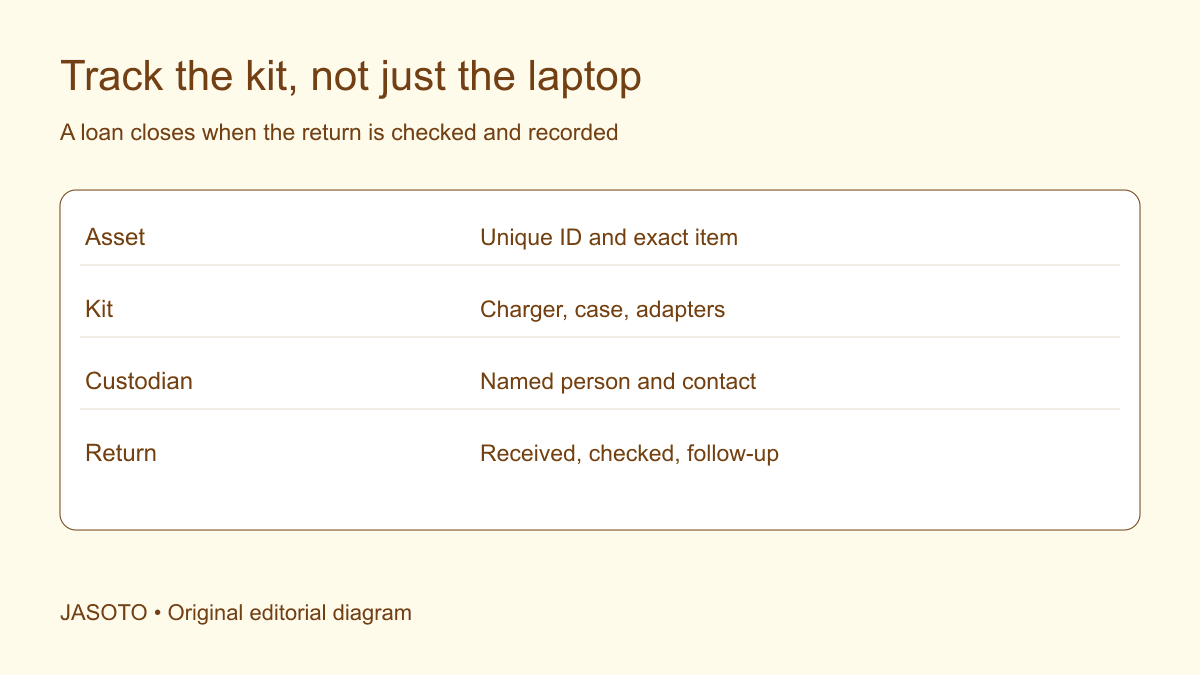
Original JASOTO editorial diagram. Its complete workflow is explained in the article; no actual customer outcome is depicted.
An equipment loan register should identify the exact item, the person currently responsible for it, what accessories were supplied and what happens when it comes back. Add the expected return point and a contact for damage, loss or access problems. The register is useful when somebody can act on it; a long inventory with no owner or return process provides much less control.
This guide covers ordinary small-business equipment loans such as laptops, cameras and presentation kits. It proposes an administrative workflow, not a safety certification or a standard employment deduction policy. Specialist equipment requires its own competent instructions and checks. The examples are invented, and the exact fields should reflect what your organisation genuinely needs to manage the items it lends.
The practical answer
- Track identifiable items and complete kits, not just broad equipment names.
- Agree a custodian, return point and contact for problems.
- Keep condition observations separate from conclusions about responsibility.
- Close the loan only after return, inspection and any account-access work.
Decide which items need individual records
Give separately trackable items a stable identifier. That may be an existing asset tag or another controlled internal reference. Link it to the model and serial number where appropriate, but do not rely solely on a nickname such as “the good camera”. The person arranging a return should be able to distinguish the borrowed item from a similar one in the cupboard without asking whoever first bought it.
Choose a sensible level of detail. A replaceable cable may belong on a kit checklist rather than in a separate asset record. An expensive lens may need its own entry because it is lent independently. The test is operational: would separate tracking change a decision about custody, maintenance or replacement? Avoid collecting details simply because an inventory template contains empty columns. Begin with a manageable set of assets and expand only when a real handover problem justifies it.
Describe the complete kit before it leaves
List the accessories that must return with the main item, including chargers, cases, adapters, memory cards or mounting pieces. Be precise where compatibility matters. “Charger included” can leave a colleague with the wrong connector or insufficient information to request a replacement. A photograph of the laid-out kit can support the list, provided it does not expose confidential labels or account information.
Check that the borrower can recognise the components and understands which items belong together. For a presentation kit, identify which adapter is needed for the intended display rather than adding several unexplained cables. Record whether consumables are expected to be returned, replenished or simply accounted for. A useful kit checklist reduces the chance that the next person discovers a missing part at the venue, after the equipment has already been marked available for another booking.
Agree custody and the return arrangement
Name the current custodian and the person authorising the loan. Record the purpose, handover date and expected return point. The return point might be a specific date, the end of a project or a review after an assignment changes. Avoid open-ended entries that nobody revisits. If an employee passes the equipment to a colleague, require the register to reflect the transfer rather than preserving an outdated name indefinitely.
Make the return practical. Specify where and to whom the kit should be delivered, especially if the usual administrator works remotely. Decide how an extension is requested and who can approve it. A calendar reminder can help, but it is not the same as confirming the item has returned. If another person has already booked the kit, a late return affects them too; the owner of the register needs a way to see that dependency before approving an extension.
Record condition without pretending to diagnose it
At handover, note relevant visible condition and any known limitation. A dated photograph or short written description can establish that a case already had a mark or a key was missing. Use neutral language. “Crack visible on lower left corner” is an observation; “borrower mishandled item” is a conclusion that requires evidence. Keep the distinction clear in both outgoing and return records.
Do not use the register as a substitute for technical inspection or safety procedures. If an item appears damaged or unsuitable, follow the organisation's arrangements and obtain competent help rather than passing it to the next borrower with a note. The register can show that an issue was reported, who is handling it and whether the item is unavailable. It should not imply that an unqualified colleague has declared equipment safe merely by ticking a condition box.
Arrange device access outside the asset list
For laptops and similar devices, separate physical custody from access to systems and information. A borrower may need an individual account, a suitable connection method and support instructions. Those should follow the organisation's approved setup. Do not place passwords or recovery codes in a widely shared register just because the equipment needs them to function. Physical possession does not mean every previous user's files or accounts should remain available.
The NCSC's device guidance is a primary reference for the technical protection of devices. Use it alongside supported vendor instructions; this article's register does not configure security controls. Agree who checks the device at return and who handles any required account or data work before reuse. Mark that work separately from physical receipt. An entry saying “laptop returned” should not silently mean “prepared for another user” if nobody has completed the appropriate process.
Plan for a problem during the loan
Give the borrower a clear contact for a missing part, a fault or a lost item. Explain what information to provide, such as the asset reference and last known location, without requiring someone to improvise a technical diagnosis. An incident process should be available when the usual equipment administrator is away. Include a backup contact or an established internal channel rather than a personal phone number nobody else monitors.
Record reports promptly and factually. A colleague who notices a missing adapter should be able to say so without inventing a reason. Link the issue to the loan record and identify the next action. Disputes about liability, reimbursement or employment consequences need the applicable policies and appropriate advice; the register itself should not make automatic findings. Its value is a clearer sequence of custody and reports, helping the responsible person investigate rather than encouraging unsupported blame.
Worked example: a camera kit for a customer event
Imagine a business lending a camera kit to a colleague attending a customer event. The kit record lists the camera, two separately identified lenses, battery charger, case and agreed accessories. The colleague confirms receipt and knows the return location. A small mark on the case is noted before departure. This is an invented example of administration, not a claim that the kit has been tested or insured for a particular journey.
After the event, the colleague reports that one adapter is missing. The register records the report and the person handling replacement, while the rest of the kit is received and checked. The camera remains separately available or unavailable according to the organisation's actual assessment, not an automatic assumption based on the missing accessory. JASOTO travel may help research an event journey, but carrier rules, equipment cover and suitable transport arrangements must be checked directly before a kit is taken away.
Close the loan in stages
Use distinct fields for received, checked and ready for reuse if those are separate activities in your organisation. Record who performed each one and any unresolved issue. Do not remove the active loan immediately on physical return if nobody has checked the kit. Otherwise a missing item may be discovered later with no clear link to the handover that needs reviewing.
Keep maintenance, charging, cleaning and approved data-handling tasks visible where relevant, with the right person responsible for them. A simple status such as “returned, awaiting preparation” may be enough to prevent an accidental rebooking. When the work is complete, update availability and close the loan. Retain records according to an appropriate policy rather than keeping every piece of personal information indefinitely. The useful history is the minimum needed to understand custody and actions, not a permanent dossier about each borrower.
Review the register against the cupboard
Periodically compare the records with the items actually held and the loans still active. Investigate mismatches rather than editing the list to make it look tidy. Repeated missing chargers may point to a poor kit checklist; repeated late returns may reflect unrealistic scheduling. Use those observations to improve the process instead of adding more columns that nobody reads.
For each mismatch, record a concrete next action and the person who will check it. If an item cannot be located, keep that status visible until the issue is resolved rather than quietly removing it from the active inventory.
If setup or repair needs outside help, find business support providers on JASOTO and describe the specific requirement. If managing loans is sustained operational work, explore relevant jobs. Assigning responsibility matters more than choosing a sophisticated asset platform. A good register should let a colleague answer three questions without detective work: where is the item, who will act if something is wrong, and what must happen before it can be used again?
Put the guide into practice
- Label the asset and its accessories consistently.
- Agree the purpose, custodian and expected return.
- Check condition and necessary access before handover.
- Record the return outcome and unresolved follow-up.
Frequently asked questions
Can a spreadsheet work as an equipment register?
Yes, if authorised colleagues can find it and updates are controlled. It needs identifiable items, clear custody and an actual return process. A spreadsheet left on one absent person's laptop is not a dependable shared record.
Should the register contain login details?
No. Keep passwords, recovery codes and other secrets out of the loan record. Arrange account access through the organisation's approved process and the relevant provider's supported controls.
Does a signature prove who caused damage?
Do not assume so. Keep factual condition records and follow the applicable policy and advice for disputes. An asset register helps establish a sequence of events; it should not turn an unverified suspicion into a finding.
Explore JASOTO tools
Discuss maintenance or secure device setup with a suitable provider.
Explore operations support roles →Research staffing if equipment coordination needs a dedicated owner.
Plan travel involving work equipment →Check journeys and carrier conditions before transporting a kit.
Continue with JASOTO
Compare your next step
Discover UK businesses, compare services and request written quotes before making a decision.