
Travel · UK Guide 2026
Ask Equipment Transport Questions Before Buying a Fare
JASOTO · Updated November 5, 2026 · 1,619 words
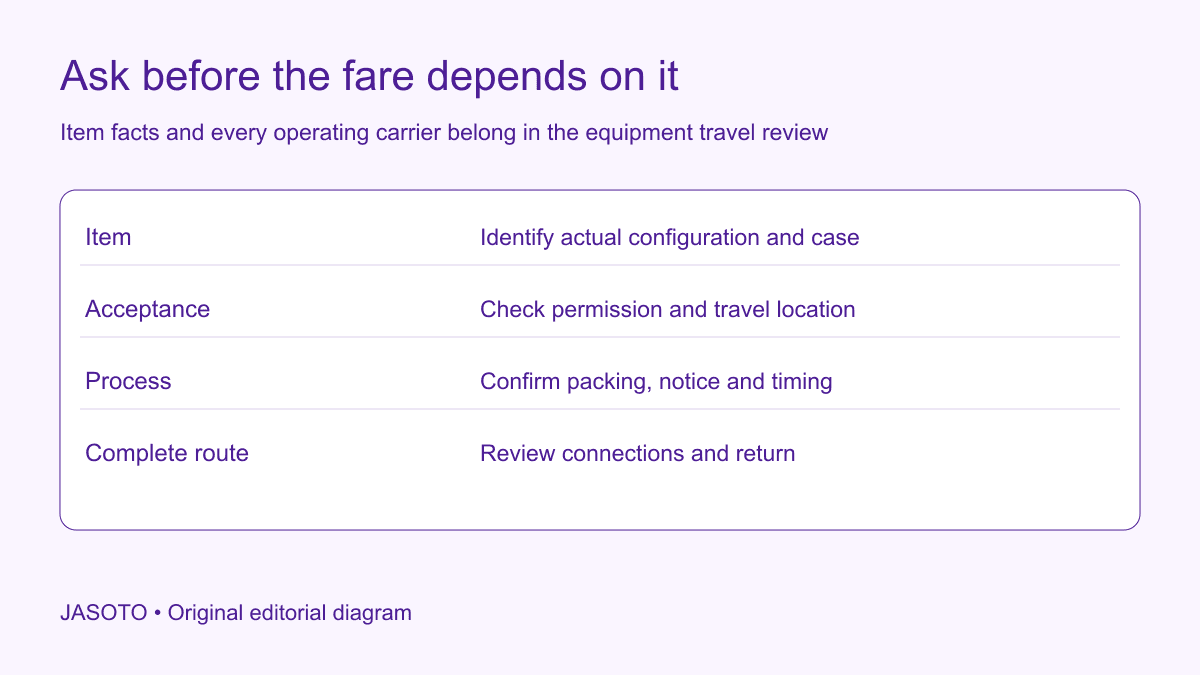
Original JASOTO editorial diagram. Its complete workflow is explained in the article; no actual customer outcome is depicted.
Before buying a fare for a trip with equipment, identify the exact items and ask each relevant carrier what acceptance, packing, handling and booking requirements apply. Include the local transfer as well as the main service. A passenger reservation does not by itself establish that a demonstration case, battery-powered device or other work item can travel in the form you intend.
This original guide is for US work travelers preparing questions rather than making their own transport classification. FAA PackSafe addresses dangerous goods in passenger air travel, and Amtrak publishes baggage and special-item information. Use current official guidance and the actual carriers' instructions for your items and route. Seek appropriate specialist support where needed, and do not conceal, relabel or modify equipment to bypass an acceptance question.
The practical answer
- Describe the actual item and packed form.
- Check every operating carrier.
- Separate acceptance from size compliance.
- Resolve essential equipment arrangements before committing.
Inventory the item before choosing the fare
Record the equipment's identity, purpose, quantity, packed dimensions and weight where those can be established appropriately. Include the case and accessories in the packed description. A small device can become a substantial item once protective packaging and supporting components are added. The provider needs the actual transport form rather than a vague description such as “presentation kit”.
Identify the manufacturer information and the responsible person who can answer technical questions. Do not guess a battery rating, material or equipment specification because a similar-looking product has that detail online. Mark missing information and obtain it through the proper source. The question set is stronger when it distinguishes known facts from assumptions, allowing the carrier or specialist to assess the actual item rather than an incomplete account designed to make approval sound straightforward.
Identify every carrier in the route
List the main airline, train or coach service and any connecting operator, local vehicle or other service. Check who actually operates each leg, not just the name on the booking website. Different parts of the route can use different acceptance arrangements. Amtrak's baggage page notes that certain connecting services use the operating carrier's policies, illustrating why one company's general page may not answer the whole trip.
Ask how an item transfers between legs and who handles it. A permitted item on the main service can still be unsuitable for the booked local vehicle or station route. Keep the last mile and return in the same review. The equipment needs a complete path to the work location and back, with each responsible provider's actual conditions considered. A fare comparison that ignores a connecting carrier may select an itinerary the equipment cannot use.
Ask about acceptance separately from size
Confirm whether the item is allowed before treating dimension or weight compliance as sufficient. Some equipment can raise a question unrelated to how small the case is. FAA PackSafe explains that ordinary-looking items may be regulated dangerous goods, and that security screening rules are a separate consideration. Check the applicable official guidance and carrier process rather than assuming an item is acceptable because it fits a bag allowance.
Describe batteries, liquids, pressurized components or other relevant features accurately through the proper route. This guide does not classify a particular product or give packing instructions for regulated material. Ask the carrier or qualified specialist what information and arrangement are required. If the answer is uncertain, do not buy a fare on the assumption that the traveler can negotiate acceptance at departure. Resolve the essential question while there is still time to change the transport plan or work method.
Clarify where the equipment may travel
Ask whether the item can accompany the passenger, must use another process or is not accepted under the proposed arrangement. Use the actual provider's categories and instructions. Do not assume a fragile or valuable item can be carried into a passenger area solely because you prefer to keep it nearby. Equally, do not place something in checked handling without checking whether that is appropriate and permitted.
Record what the carrier actually confirms and any condition attached to the answer. A general statement about baggage is not necessarily a decision about a specific work item. Keep the confirmation with the equipment description so later changes can be reviewed against the same facts. If a component or packing method changes, revisit the relevant answer. Acceptance based on one configuration should not be silently extended to another because the case retains the same external label.
Ask who provides packing and handling advice
Identify the manufacturer, carrier or qualified service responsible for the relevant packing instruction. Protective packaging and transport compliance can involve different questions. A case that protects the device from ordinary movement does not automatically satisfy a regulated-material requirement, and a general online packing tip may not apply to the actual product. Obtain the appropriate instruction rather than improvising a solution from unrelated examples.
Consider the practical movement through stations, terminals and venues. Ask what assistance or equipment is actually available where needed, and confirm it through the relevant process. Do not assume staff can lift, store or carry an unusual item because they are present at the location. Keep specialist handling and safety decisions with competent people. The travel planner's role is to expose the need and establish the approved arrangement, rather than perform an unplanned workaround to preserve the itinerary.
Check reservation and timing requirements
Ask whether the equipment needs advance notice, a separate booking or a particular acceptance step. Check the actual service and departure location. A fare purchase may not reserve space or handling for a special item. Keep each booking status explicit: passenger confirmed, equipment request pending or equipment arrangement confirmed under stated conditions. This prevents a polished itinerary from hiding the only unresolved dependency that makes the trip workable.
Include the required time before departure and at collection in the schedule once confirmed. Do not copy a generic passenger arrival allowance into an equipment plan that needs another process. Ask about the practical handoff and what the traveler must present or do. Record relevant references privately and provide the traveler a usable summary. They should not have to reconstruct a specialist discussion from a forwarded chain of messages while standing at an unfamiliar counter.
Review the work requirement if transport is unsuitable
Ask the business owner what the appointment actually needs. A venue-supplied item, approved local rental, a different demonstration method or a different travel arrangement may be worth investigating. Each alternative needs its own suitability and approval checks. Do not assume shipping is a simple way around passenger restrictions; it can involve separate rules, handling and specialist requirements.
For an invented product presentation, the team discovers that the proposed device cannot be confirmed under the intended passenger plan in time. The business owner considers a permitted static demonstration and a locally arranged equivalent, with the relevant specialists assessing suitability. The team does not rename the item or omit a component from the description to obtain an easier answer. This keeps the decision focused on delivering the actual work through an appropriate arrangement, with the limits of the alternative understood.
Include the return and any changed condition
Check that the return uses a compatible arrangement and that the item remains in the state described to the carrier. A different operator, smaller connecting vehicle or changed equipment configuration may require another review. Do not treat outbound acceptance as automatic permission for every future route. Keep the actual provider and service facts visible for both directions.
Identify what happens if the demonstration changes the item's condition or adds material that was not present at departure. Ask the responsible specialist or provider before travel where relevant. The planner should record the question and owner without attempting an unqualified technical answer. A complete equipment itinerary includes the end of the work activity, the appropriate pack-up and the actual return handoff, rather than stopping once the item reaches the meeting room.
Build a concise carrier question brief
Organize the known item facts, proposed route and questions into a short current brief. Ask about acceptance, travel location, packing instruction, reservation process, timing and contact for changes. Keep the source and date of each important answer. If two responses conflict, ask the carrier's appropriate contact to clarify the actual arrangement rather than choosing the convenient answer from an informal exchange.
Use travel research to explore possible routes and confirm actual conditions with operators. For specialist support or local services found through business listings, verify capability for the specific equipment and task. If this coordination is a continuing responsibility, describe it accurately in relevant roles, including when a qualified person owns classification or handling decisions. A clear brief helps specialists answer efficiently without transferring their authority to the person maintaining the itinerary.
Commit only when the essential arrangement is clear
Review passenger travel and equipment acceptance together before purchasing the dependent fare through the appropriate approval process. Identify any remaining condition and who must satisfy it. Keep evidence of the checked arrangement accessible to the traveler, with sensitive or technical supporting material handled appropriately. Recheck material changes through the actual carrier rather than assuming an earlier general answer covers them.
If an essential acceptance question cannot be resolved, return to the work requirement and revise the transport or demonstration plan. Preserve confirmed facts and remove unsupported assumptions. The practical rollback is a different approved route or task method, rather than arriving with an item that nobody has accepted. Useful preparation gives each provider an accurate description and gives the traveler a complete, appropriate path for the equipment from departure through the work activity and return.
Put the guide into practice
- Collect reliable equipment specifications.
- Ask the appropriate carrier and specialist.
- Record conditions and request status.
- Recheck return and material changes.
Frequently asked questions
Does meeting the baggage size limit establish acceptance?
No. Check whether the actual item is permitted and which handling or travel location applies. Equipment features can raise questions separate from size and weight. Use current official guidance and the actual carrier’s process, obtaining qualified support where needed.
Can I assume connecting services use the main carrier’s rules?
Check who operates each leg and what conditions apply. A connecting service can have different baggage arrangements, and the local transfer also needs review. Build a complete equipment route rather than relying on one general policy page.
What if the equipment cannot travel under the proposed fare?
Return to the business requirement and investigate an approved alternative, such as another suitable arrangement or task method. Each alternative needs its own checks. Do not conceal features, relabel the item or assume shipping bypasses applicable requirements.
Explore JASOTO tools
Discover providers and check support for your specific task.
Explore roles and responsibilities →Consider the practical responsibilities involved when recruiting or joining a team.
Plan work-related travel →Research a journey when joining, training or meeting colleagues in person.
Continue with JASOTO
Compare your next step
Discover UK businesses, compare services and request written quotes before making a decision.