
Business Growth · UK Guide 2026
Evaluate a Product Sample Without Assuming a Match
JASOTO · Updated November 5, 2026 · 1,617 words
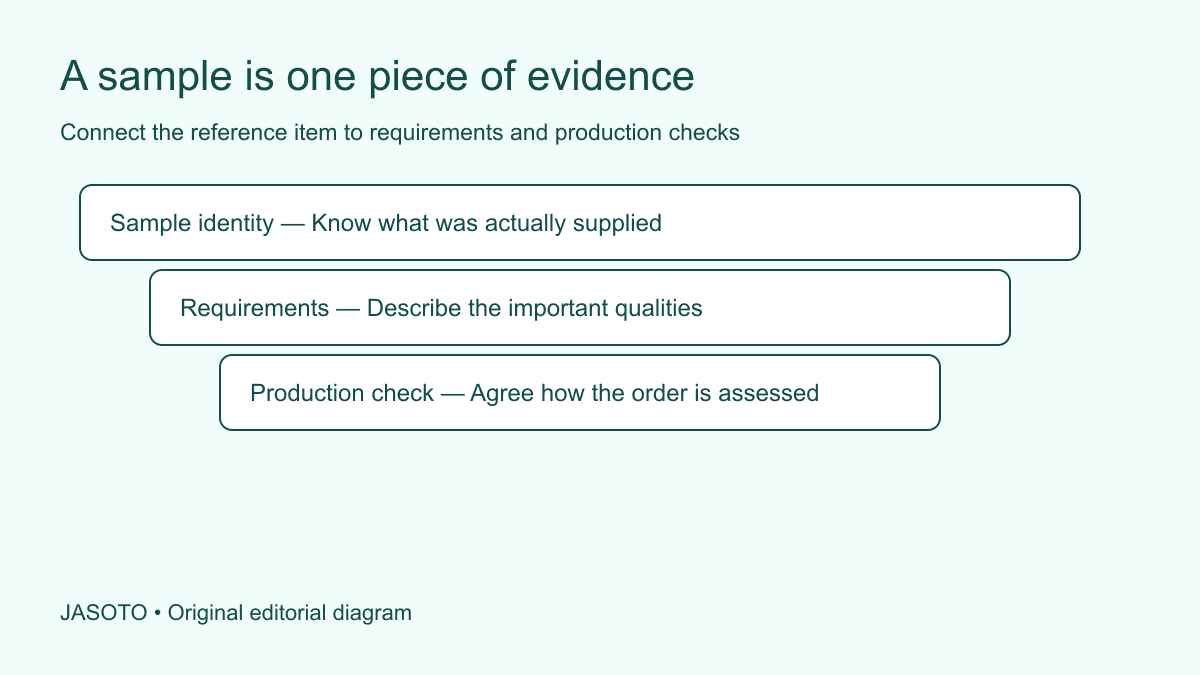
Original JASOTO editorial diagram. Its complete workflow is explained in the article; no actual customer outcome is depicted.
Evaluate a supplier sample by identifying what it represents, comparing it with written requirements and recording what your review cannot establish. Then agree how the production order will be checked. One attractive example can support a purchasing decision, but it does not by itself prove that every supplied item will have the same materials, finish, dimensions or performance.
This guide gives small businesses in the United States an original method for reviewing ordinary merchandise samples. It does not provide laboratory testing, regulated-product approval or statistical quality assurance. Seek suitable expertise where the product requires it. The example uses an invented printed desk organizer and deliberately separates appearance and practical fit from any technical or safety claim that an informal office review could not support.
The practical answer
- Ask what the sample represents before evaluating it.
- Write the important characteristics and observation method.
- Separate a sample decision from production and order approval.
- Agree what happens if the supplied batch differs.
Establish what kind of sample you received
Ask whether the sample is a stock item, prototype, preproduction example or item from an actual production run. Record the supplier's explanation and any differences from the proposed order. A hand-finished prototype may help evaluate a design without representing the finish achievable in volume. A stock sample may show material quality while using different printing or hardware from your own specification.
Give the sample an internal reference connected to the enquiry or order. Keep its arrival date and any supplier label. If several versions arrive, distinguish them clearly rather than relying on people to remember which one had the preferred finish. A useful review needs to identify the physical item that supported the decision, especially if a later sample changes only one small but important detail.
Write the requirements before discussing impressions
List the characteristics that matter to the intended use. For a desk organizer, these might include the agreed layout, the information printed on it and whether the compartments accommodate the specified stationery. Use the actual business requirement rather than broad adjectives such as premium or robust. Those words can express a preference, but they do not tell a supplier how the buyer intends to distinguish acceptable from unacceptable.
Separate essential characteristics from optional preferences. If a particular label must remain readable but a slight aesthetic preference is negotiable, say so. Involve the people who will use or sell the item. Their practical knowledge may reveal a requirement that a purchasing manager overlooks. Do not add a new essential requirement only after the sample arrives unless the revised brief is clearly communicated to the supplier.
Choose observations appropriate to the question
Decide how each requirement can be assessed and who is competent to assess it. Some questions involve reading, comparison with artwork or ordinary use. Others may require measurement, technical testing or specialist advice. Record the method rather than presenting every check as an equivalent pass. An informal visual review cannot establish a material specification or a regulated performance claim merely because the sample looks convincing.
Keep the review conditions meaningful and repeatable where practical. If you compare printed information, use the approved artwork and a clearly identified version. If you check fit with another item, identify that item too. Avoid turning a convenient observation into a universal conclusion. “The named stationery fits this sample” is a narrower and more defensible record than “all office supplies will fit production”.
Understand the difference between sample review and formal testing
The U.S. federal procurement rules offer one specific example of a formal approach: [FAR 9.302](https://www.acquisition.gov/far/9.302) discusses first-article testing in relation to contract requirements and considers cost, time and other methods. Those rules govern their own procurement context; they are not automatically requirements for an ordinary private purchase. They illustrate why verification should have a defined purpose rather than being an impressive label.
For your order, ask an appropriate adviser what level of assurance makes sense for the product and consequences. Do not copy a complex government testing process without understanding it. Equally, avoid calling a quick desk review certification. Name the actual activity and its limits so the purchasing decision rests on evidence the business truly obtained, not authority implied by terminology.
Record observations separately from preferences
Use a review sheet with requirement, observation, evidence and decision fields. Write what the reviewer saw before deciding what it means. “Printed reference differs from artwork version C” is more actionable than “branding wrong”. If a reviewer dislikes a color but the color was never specified, record it as a preference or proposed revision rather than claiming a proven failure against an agreed requirement.
Preserve disagreement between reviewers where it matters. Two people may use the item differently or judge a subjective finish differently. Ask what evidence would resolve the purchasing question, or who has authority to decide the preference. Do not average unsupported scores into a precise-looking quality percentage. A short explanation of the difference is often more useful than a numerical summary without context.
Ask about the gap between sample and production
Request a clear account of any expected differences in material, process, supplier, tooling, artwork or finish. Ask which details remain provisional and when they will be confirmed. A production change is not necessarily unacceptable, but it should not be hidden behind the phrase representative sample. Keep the explanation with the review so the buyer knows which observations can reasonably inform the order.
If the supplier proposes an alternative material or component, ask how it affects the written requirements and what verification is needed. Do not approve an unexplained equivalent solely because it has the same general name. The appropriate question is whether the actual revised product meets the intended requirements. Where that judgment requires expertise, obtain it rather than expecting an administrator to decide from a photograph.
Make conditional approval unambiguous
If the sample needs changes, identify each one and the evidence required before proceeding. State whether the business wants another sample, corrected artwork or another appropriate confirmation. Use the actual order and approval process. A message saying looks good apart from the label may be read as approval of everything, a request for revision or a casual comment. Replace that ambiguity with a clear current decision.
Keep design approval, sample approval and production order acceptance distinct where the arrangement separates them. The same person may make all three decisions, but the record should show what was approved at each stage. Do not let the supplier infer that receiving a revised image authorizes a production run when the business has not approved the commercial order or the remaining conditions.
Worked example: a printed desk organizer
Imagine a small retailer considering a branded organizer. The sample has the desired layout but uses stock artwork and a temporary finish. The retailer records that it demonstrates compartment arrangement only. It supplies the approved artwork reference, asks how the production finish will be confirmed and identifies who may approve the final version. The sample is neither rejected as useless nor treated as proof of the whole order.
The buyer then records the required evidence for the changed details before committing through the agreed process. This invented example does not claim that any supplier can reproduce every appearance or that a particular testing method guarantees consistency. It demonstrates how a sample can answer a limited question while other aspects remain explicitly open for verification.
Agree the incoming-order check before dispatch
Ask how the business and supplier will identify the delivered batch, assess agreed characteristics and handle discrepancies. The appropriate method depends on the product and purchasing arrangement. Obtain specialist guidance where needed rather than inventing a sampling percentage. Confirm who receives the goods and what observations they are expected to make. A receiving colleague should not discover a technical acceptance role only when cartons arrive.
Keep the sample reference, current specification and relevant approvals accessible to that person. If a physical reference is retained, store and label it appropriately, noting any deterioration that might affect comparison. A photograph can support the record but may not reproduce color, texture or scale accurately. Use the form of evidence suitable to the characteristic instead of assuming one image can replace every reference.
Preserve a decision trail you can review
Record relevant handling of the reference sample after review. If several departments borrow it, use a simple custody note so it can be found when the production order arrives. Keep it appropriately protected and identify any later damage or alteration. A marked or faded reference may no longer support the comparison someone expects. Ask the responsible specialist how to preserve or replace a reference where its physical characteristics matter. The administrative note should make that limitation visible rather than allowing a changed sample to appear identical to the item originally approved.
After receipt, link any discrepancy to the actual requirement and evidence. Preserve the supplier's response and the agreed next step. If the order differs from the sample, investigate which difference matters rather than assuming all variation is equivalent. Review whether the original requirement, sample status or approval wording caused confusion. Improve the relevant step while keeping the earlier record intact.
Use JASOTO businesses to discover suppliers and discuss their actual sampling approach directly. If specification and receiving work becomes ongoing, explore purchasing or quality support roles within a staffing review. For a confirmed supplier assessment, research travel after the appointment is agreed. The useful result is an order decision supported by clearly bounded evidence, with an honest plan for checking what ultimately arrives.
Put the guide into practice
- Identify the sample and its production status.
- Record requirements, observations and limitations.
- Confirm changes and retain the approved reference appropriately.
- Agree the production verification and discrepancy process.
Frequently asked questions
Does approving a sample guarantee the whole order?
One sample only provides evidence about what was examined under the stated conditions. Clarify how it relates to the actual specification, production process and order terms. Agree appropriate checks for the supplied goods rather than assuming that one approval establishes every item will match.
Should a supplier always provide a production sample?
The useful evidence depends on the product, risk and purchasing arrangement. Ask what the available sample represents and what other verification is appropriate. Avoid imposing an elaborate test that adds no decision value, but do not treat a showroom example as production evidence without asking.
Can we approve a sample with minor changes?
Record each change clearly and state whether another sample or written confirmation is required before the order proceeds. Keep the original observations and the revised requirement linked. An informal note saying approved with changes can leave the supplier uncertain which version should guide production.
Explore JASOTO tools
Discuss sample status and production verification with suitable providers.
Explore purchasing and quality support roles →Consider staffing when specifications and supplier checks become continuing work.
Research a supplier inspection journey →Plan travel only after confirming the visit purpose and location.
Continue with JASOTO
Compare your next step
Discover UK businesses, compare services and request written quotes before making a decision.