
Business Growth · UK Guide 2026
Measure Whether Event Follow-Ups Create Useful Conversations
JASOTO · Updated November 5, 2026 · 1,581 words
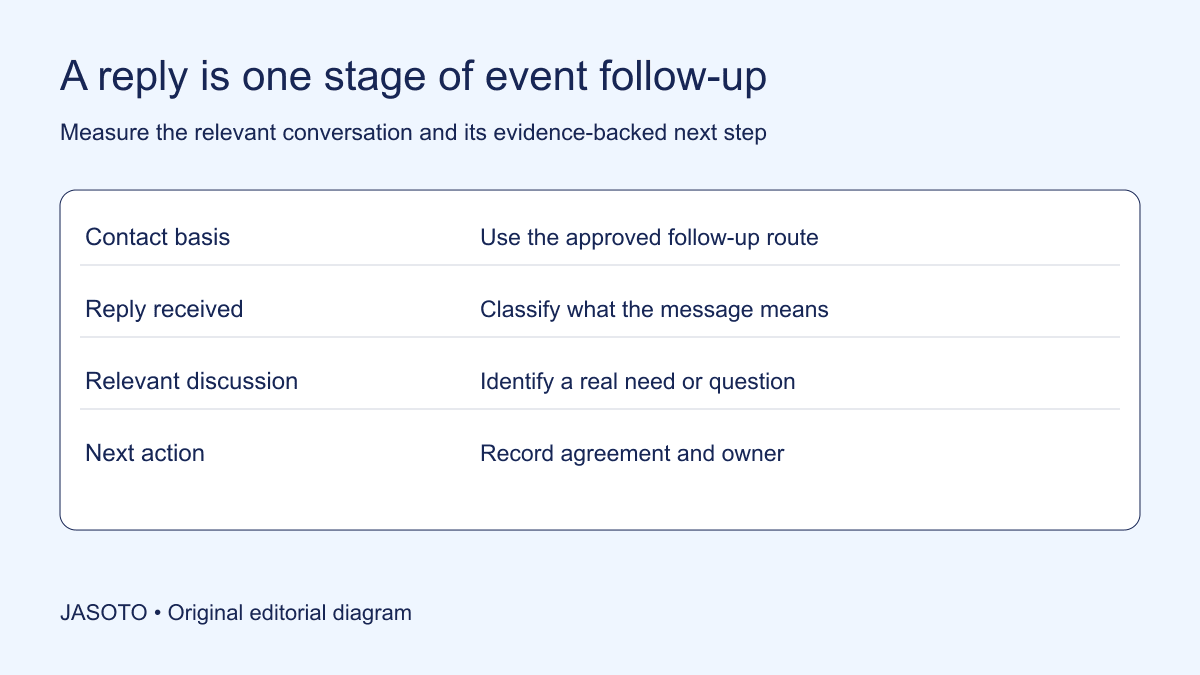
Original JASOTO editorial diagram. Its complete workflow is explained in the article; no actual customer outcome is depicted.
Measure event follow-ups by defining what a useful conversation means, tracking the actual contact and reply stages and recording any agreed next action with an owner. Keep permission and preferences accurate before sending messages. A reply count can include courtesy responses, automated notices and requests to stop contact, while a valuable discussion may require several exchanges before a relevant next step becomes clear.
Start with the event's actual purpose and audience. The fictional examples here concern a United States business reviewing ordinary business-development follow-up. Use the responsible process and appropriate advice for contact permissions and information handling. The measurement should describe real conversations without manufacturing leads, opportunity values or revenue attribution.
The practical answer
- Define a useful conversation from the event's actual purpose.
- Keep contact permission and follow-up ownership explicit.
- Separate sending, replies, relevant discussion and agreed next steps.
- Review quality and uncertainty without inventing pipeline or revenue.
Define the event's intended business task
Record why the team attended and what a useful subsequent discussion would concern. A supplier meeting, recruitment event and customer demonstration have different outcomes. Avoid a broad objective such as maximize leads when the service team has not defined who is suitable or what the next step should be.
Keep audience suitability connected to the actual offer. A genuine interested person may be outside current scope, while another may provide useful market feedback without becoming a customer. Define those outcomes separately. The review should support the event's purpose rather than classify every contact as a sales prospect by default.
Establish the approved contact basis
Check the actual event arrangement, preferences and relevant requirements through the responsible owner. Identify which contacts may be followed up, for what purpose and through which route. A badge scan, business card or shared list can have different contexts. Do not infer unlimited permission from the presence of contact data.
Keep restrictions and opt-out handling in the appropriate controlled process. The learning worksheet can reference the status without copying unnecessary personal details. If a contact should not receive a message, exclude it from sending through the authorized workflow while keeping the measurement scope clear. Performance goals should not override the agreed communication boundary.
Assign follow-up ownership before measuring
Name the role responsible for reviewing each relevant contact and accepting the next action. Distinguish queue coverage from case ownership where needed. A team may send messages quickly while nobody handles the resulting substantive question. The measure should reveal whether a conversation has an accountable owner.
Set coverage and backup arrangements through the actual business process. Avoid promising a response period or meeting availability the team cannot support. The review should connect customer expectations to staffing, not reward activity detached from useful handling. Record unassigned or unresolved cases rather than hiding them from completed-contact summaries.
Define stages with observable evidence
Use stages such as eligible contact, follow-up sent, reply received, relevant discussion and agreed next action. Explain what establishes each stage. A booked meeting needs an actual agreement, while an expression of interest may remain exploratory. Avoid moving every positive-sounding reply into a qualified opportunity category without a defined basis.
Keep stages appropriate to the purpose. [SBA's market-research guidance](https://www.sba.gov/counseling/plan-your-business/) describes learning about customers and demand through research. An event conversation can contribute relevant evidence within that context. It is not automatically a representative sample or a sales outcome, and the local stage definitions should preserve that distinction.
Choose a proportionate tracking record
Record a controlled contact reference, event context, relevant interest, approved follow-up route, owner, stage and next action. Add dates and evidence references where useful. Keep private conversation details in the proper system. A broad spreadsheet should not become a duplicate unrestricted database of personal information.
Define unknown states explicitly. A message without a recorded reply is not proof of rejection or lack of need. A contact awaiting owner review is different from a completed unsuitable case. The record should let a colleague identify the current position and evidence without needing the original team member's memory.
Separate actual sending from delivery and reading
Use the evidence the actual communication system provides and understand its limits with appropriate technical support. An accepted send request does not necessarily establish delivery or reading. Avoid treating an absent reply as proof that the recipient considered and rejected the offer.
Record relevant technical problems and corrected contact routes through the approved process. If a campaign tool reports opens or clicks, ask what those events mean and what limitations apply before interpreting them. The central task is whether a useful conversation developed, so proxy activity should remain a supporting observation rather than the entire definition of success.
Classify replies by their role
Distinguish relevant questions, a request for later contact, a polite decline, automated response, unrelated message and a preference not to continue. Adapt the categories to actual needs. Do not count every non-empty reply as a useful discussion or every decline as evidence of poor event quality.
Keep the customer's stated meaning accurate. A later-contact request should not become an immediate opportunity simply because the team wants a stronger pipeline. Preserve uncertainty and specific conditions. A useful classification helps the owner choose a respectful next action and gives the review a more honest account of progress.
Define a relevant conversation
Ask whether the exchange identifies a real task, question or fit with the business's offer. Record what evidence supports the stage. A brief clarification can be valuable, while a long exchange can remain unrelated to the service. Length and enthusiasm alone are weak measures of quality.
Keep market learning distinct from sales progression. A person explaining why the service does not fit can provide useful evidence without becoming a lead. Record that outcome appropriately. The review can value learning while avoiding the misleading impression that every interesting conversation represents demand ready to purchase.
Record the agreed next step precisely
State what was agreed, by whom, who owns it and what confirmation remains. A suggestion to meet is different from a confirmed appointment. If the next action needs a document or specialist review, record that dependency. Avoid promising a site visit, quotation or delivery date the business has not authorized.
For a genuine meeting, research subsequent travel after the relevant arrangement is agreed. Keep journey planning separate from the evidence of customer interest. A booking made by the team does not establish that the other party accepted the meeting. The stage should reflect the actual shared agreement.
Work through a fictional demonstration follow-up
Imagine a business meets several visitors at a demonstration event. One asks a relevant technical question, another requests information for a later project and another gives a polite courtesy reply. The log preserves those different meanings. The technical question receives an assigned owner and an agreed next action through the actual service process.
The review reports relevant discussion and future interest separately, without assigning invented sales values. This fictional example shows why total replies can exaggerate or obscure the event's useful outcomes. It provides no claim about conversion rates, revenue or an ideal number of follow-ups.
Compare event results with context visible
Record audience, purpose, staffing, contact scope and observation period. Different events may attract different stages of interest, so raw reply counts may be incomparable. Show unresolved cases and known limits. A new follow-up template introduced alongside a new audience cannot be credited automatically with every observed difference.
Avoid declaring a causal improvement from a small uncontrolled sample. Inspect the case evidence and plausible explanations. The review can still identify a definite handover gap or a relevant audience mismatch. Describe those findings precisely rather than replacing uncertainty with a broad claim that the event worked or failed.
Review handling effort and customer burden
Consider staff effort, repeated clarification and whether messages matched the recipient's actual interest. A high conversation count may be costly or confusing if the initial message misstates the service. Keep the customer task and approved contact process central. More activity is not inherently a better outcome.
Research event or sales support with the actual workflow and evidence when needed. If ongoing ownership requires capacity, define it before exploring customer development roles. The role should support appropriate questions and follow-through, not simply maximize messages sent.
Check records across team members
Ask appropriate colleagues to classify selected exchanges using the agreed stage definitions. Compare whether they identify the same relevant need and next action. A message interpreted as a confirmed meeting by one person may be recorded as an exploratory suggestion by another. Resolve the evidence and improve the definition rather than averaging incompatible statuses.
Keep the calibration proportionate and protect private contact details. Record any changed classification and its reason. The exercise should make the report more accurate, not pressure staff to move more contacts into promising categories. If an agreed next step has no accepted owner, treat that as an operational gap requiring action even when the conversation itself was useful. This helps the business preserve both honest measurement and reliable follow-through.
Choose and verify the next improvement
Select a focused action such as clearer service context, better ownership or a corrected next-step route. Record the expected benefit and evidence to review. Preserve earlier wording and a rollback path. Do not claim the implemented change has already produced the intended outcome.
Maintain appropriate records and retire unnecessary tracking through the responsible process. Revisit findings when the offer or audience changes. The practical result is an event follow-up review grounded in real contact states, relevant conversations and accountable next actions, with commercial outcomes and uncertainty represented honestly.
Put the guide into practice
- Record the event purpose and relevant audience.
- Confirm appropriate contact handling and owner.
- Define conversation stages and evidence.
- Track actual replies and agreed actions.
- Review context and choose a focused improvement.
Frequently asked questions
Does every reply count as a useful conversation?
Define the intended task and inspect what the reply accomplishes. A relevant question, agreed discussion or useful clarification differs from an automated message, courtesy response or request not to be contacted. Keep those categories distinct so the report reflects actual progress.
Can a scanned badge be treated as permission for any follow-up?
Use the actual event arrangement, customer preferences and relevant requirements, reviewed through the responsible process. Do not assume one data-capture event authorizes every message or channel. Keep contact handling and permissions accurate before evaluating follow-up performance.
Should we assign revenue to every event contact?
Record actual outcomes and an appropriate evidence trail. A contact, conversation and completed sale are different stages, and several influences may contribute. Avoid inventing opportunity values or claiming revenue attribution the records cannot support.
Explore JASOTO tools
Continue with JASOTO
Compare your next step
Discover UK businesses, compare services and request written quotes before making a decision.