
Business Growth · UK Guide 2026
Plan Event Pack-Down Before Opening the Doors
JASOTO · Updated 5 November 2026 · 1,610 words
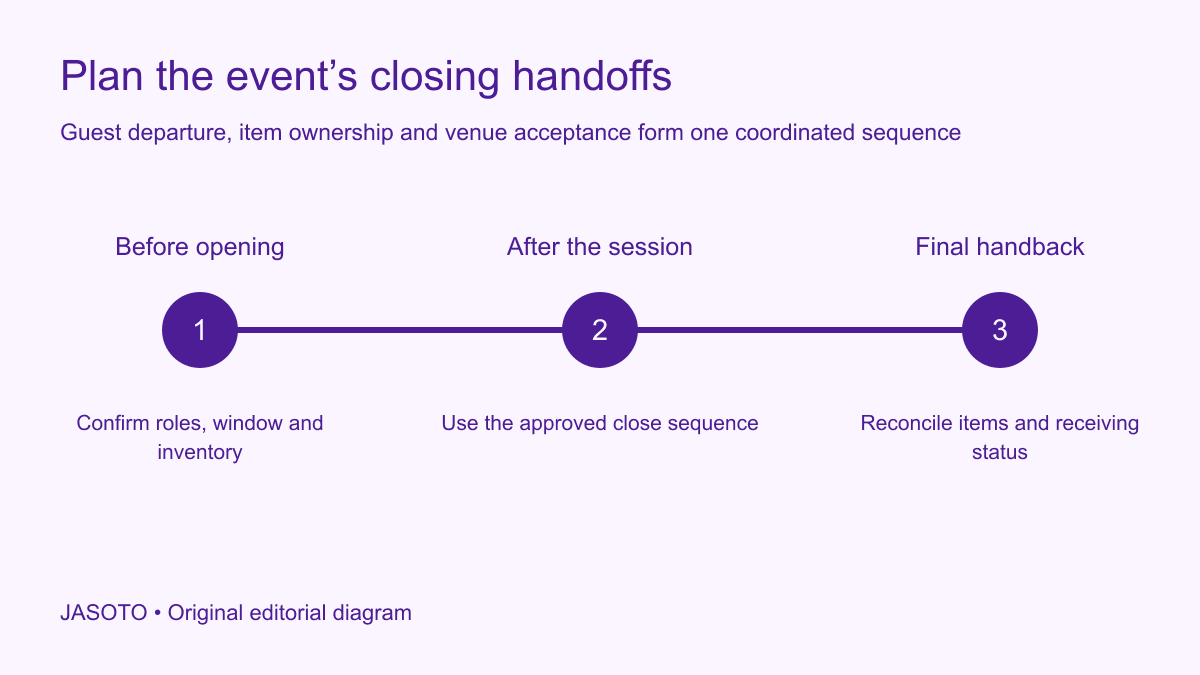
Original JASOTO editorial diagram. Its complete workflow is explained in the article; no actual customer outcome is depicted.
Plan pack-down before guests arrive by agreeing what happens after the public session, who owns each item and how the venue is handed back. Confirm the actual access and collection windows with the venue and providers. The end of the program is a transition into another phase of work, with equipment, guests and staff needing a coordinated sequence rather than a general request for everyone to start clearing.
This original guide supports small UK events. HSE's event-management guidance includes setup and breakdown within event responsibilities and emphasizes coordination. Use the venue's actual arrangements and competent people for technical or safety decisions. The plan below organizes ownership and handovers, helping a team close the event without assuming every volunteer may disconnect, move or dispose of every item they see.
The practical answer
- Confirm the venue’s actual handback requirement.
- Assign items and tasks to appropriate owners.
- Keep guest departure and work activity coordinated.
- Close with a reconciled inventory and venue status.
Define what the venue handback requires
Ask the venue what condition the booked area must be in, when the relevant access ends and who receives the final handback. Confirm any requirements for furniture, borrowed equipment, waste or stored material through the actual agreement. A room being empty is not necessarily the same as the venue accepting it as returned. Keep the practical checklist tied to what the responsible contact has confirmed.
Record the difference between public finish, pack-down window and final access. Guests may leave at one point while providers need another agreed period to collect items. Do not assume a building's general opening hours extend your booking or that staff can stay beyond the actual arrangement. Resolve a timing conflict before opening the event. The program and provider schedule may need adjustment if the work cannot be completed through the confirmed window.
Inventory what will need an owner afterwards
List equipment, display materials, signs, borrowed items, registration records and other things that must be returned, retained or removed. Identify who owns each category and the appropriate destination. A case brought by a supplier should not be treated like general event stationery, and a participant record needs a different handling route from a reusable poster.
Keep the inventory proportionate. You may not need a separate line for every pencil, but items whose ownership or destination could be unclear deserve a record. Add references or identifiers that the receiving team can use. For an invented workshop, the venue's projector, a facilitator's demonstration kit and printed attendee material have different owners and next steps. The plan should preserve those distinctions instead of expecting a tired volunteer to decide them from appearance at the end of the evening.
Separate guest departure from work activity
Agree how the public session ends, who guides guests and when the relevant area is available for pack-down under the venue's arrangements. A speaker finishing does not establish that everyone has left or that technical work can begin around the audience. Ask the responsible venue or event owner about the sequence, with appropriate competent review for the actual tasks.
Keep the close clear for guests. If a final question or collection point remains available, identify where and who owns it. Avoid starting an improvised teardown that leaves participants unsure whether they should leave, retrieve an item or continue speaking with the facilitator. A planned transition supports both the guest experience and the work that follows. It gives the team a defined point to begin the approved close process instead of relying on different people's guesses about whether the event is over.
Assign roles by competence and authority
Name who handles general materials, who manages technical equipment, who receives providers and who can resolve an unexpected issue. Confirm those responsibilities with the people involved. A volunteer willing to help should not be assumed competent or authorized for specialist disconnection, lifting or other technical tasks. Route those activities through the actual venue and provider arrangements.
Provide the team a simple escalation contact for items outside their role. They should know what to leave in place and whom to ask. HSE's event-management guidance distinguishes coordination from taking over every third party's technical work. The pack-down owner should connect the sequence and information without pretending to replace competent specialists. Clear boundaries make it easier for people to help usefully and avoid an unplanned task becoming assigned simply to whoever is last in the room.
Build a sequence around dependencies
Identify which tasks must happen before others through the responsible process. A provider may need access before a storage area is closed, while a borrowed item may need checking before its owner leaves. Use the actual venue plan and competent advice to establish technical sequencing. Do not arrange simultaneous work solely to make the timetable look shorter when the activities share the same route or resource.
For the workshop example, the registration owner secures the appropriate records, general volunteers collect approved reusable materials and the technical contact handles the supplied equipment through the venue's process. The receiving provider is contacted at the agreed point. This is an illustrative ownership sequence, not an instruction for handling specific equipment. The actual event should use its confirmed arrangements and the people authorized to perform the tasks.
Confirm collection and transport arrangements
Check which provider or owner collects each item, the pickup point, expected window and contact route. Keep collection requested separate from collection confirmed. An outgoing delivery is not complete merely because a message has been sent asking a supplier to return. Ask what happens if the provider is delayed and who can approve another arrangement.
Include the actual route out of the venue and relevant access requirements. Do not assume a loading entrance used during setup remains available after the public session. Keep special handling and safety questions with the appropriate competent people. A coordinator can record the need and obtain confirmation without improvising a way to move an item through a public exit. The plan should give each collection a usable handoff, with the venue knowing what remains onsite and who is responsible for it.
Prepare a decision route for unexpected items
Agree what the team does with an unlabeled case, forgotten attendee item or material that does not match the inventory. Use the venue and event's appropriate process rather than making assumptions about ownership or disposal. Record the relevant fact and contact the responsible owner. Do not open, discard or send an item away merely to clear the room quickly.
Keep potentially sensitive records and personal belongings through their proper handling routes. A general lost-item box may be unsuitable for participant information or business documents. The pack-down plan should identify whom to ask, while the actual organization determines its record and property arrangements. A visible unresolved item with an owner is more useful than a falsely complete inventory that quietly omits the object nobody knew how to handle.
Give the team a short closing brief
Before opening, explain the public finish, start of the close process, role boundaries and final check. Use the maintained plan and tell people how changes will be communicated. A brief delivered only after the event ends can fail when several helpers have already left or when the technical contact is no longer available. Confirm the necessary people can cover the actual pack-down window. Record when each role hands responsibility to a replacement, especially if a helper leaves before the final inventory check.
Keep the instruction simple enough to use at the end of a busy event. A few clear responsibilities with accessible supporting detail may work better than a long document nobody can scan onsite. Identify the person maintaining the current status and the contact who can make a venue or business decision. The goal is an understood shared sequence, rather than a large checklist in which every task appears important but nobody knows who must act first.
Review the handback against the actual inventory
Check the confirmed requirements with the responsible venue contact. Reconcile returned, removed, stored by agreement and unresolved items. Note any discrepancy through the appropriate process and record who owns the next action. Do not mark the venue handed back solely because the event team has left. The actual receiving arrangement and outstanding material should determine the status.
Discover suitable providers through business listings and confirm the specific collection or support directly. Agree the pack-down window before planning staff or provider travel. If event closing coordination is a recurring responsibility, describe it accurately in relevant roles, including the distinction between maintaining the inventory and performing specialist work. That clarity makes a small team's final effort more accountable and helps the venue understand who can resolve a later question.
Learn from the close before repeating the event
Afterwards, identify the actual problem that affected pack-down: unclear ownership, missing provider confirmation, insufficient access or a technical dependency omitted from planning. Assign a specific improvement and retain the relevant record through the organization's arrangements. Avoid claiming that a faster close automatically demonstrates a safer or better event. Review the actual requirements and evidence, including any issue that needs the venue's formal process.
If the close plan becomes overloaded, restore the essential sequence from guest departure to item ownership and venue acceptance. Preserve specialist tasks under their proper arrangements and remove unsupported timing assumptions. The practical rollback is to obtain an approved revised window or reduce nonessential event material before opening, rather than rely on unplanned late work. A useful pack-down plan gives the event a clear end state that the venue, providers and team can recognize and confirm together.
Put the guide into practice
- Agree access and provider collection windows.
- Brief the team before opening.
- Prepare an unexpected-item decision route.
- Assign every unresolved close action.
Frequently asked questions
When should pack-down be planned?
Before opening, once the actual venue and provider arrangements are understood. Confirm the public finish, work window and handback requirement. A brief given only after the session can leave essential people unavailable or collections unconfirmed.
Can any volunteer help with technical equipment?
Assign tasks according to actual competence, authority and venue or provider arrangements. General willingness does not establish readiness for specialist disconnection, movement or handling. Give helpers a clear route to ask about something outside their role.
What if an item remains at the venue?
Record its status, owner and agreed next action through the appropriate process. Confirm any storage or later collection with the venue. Do not silently omit the item to make the inventory appear complete or assume the venue accepts responsibility because the team has left.
Explore JASOTO tools
Discover providers and check support for your specific task.
Explore roles and responsibilities →Consider the practical responsibilities involved when recruiting or joining a team.
Plan work-related travel →Research a journey when joining, training or meeting colleagues in person.
Continue with JASOTO
Compare your next step
Discover UK businesses, compare services and request written quotes before making a decision.