
Business Growth · UK Guide 2026
Coordinate a Photographer’s Brief With an Event Schedule
JASOTO · Updated 5 November 2026 · 1,602 words
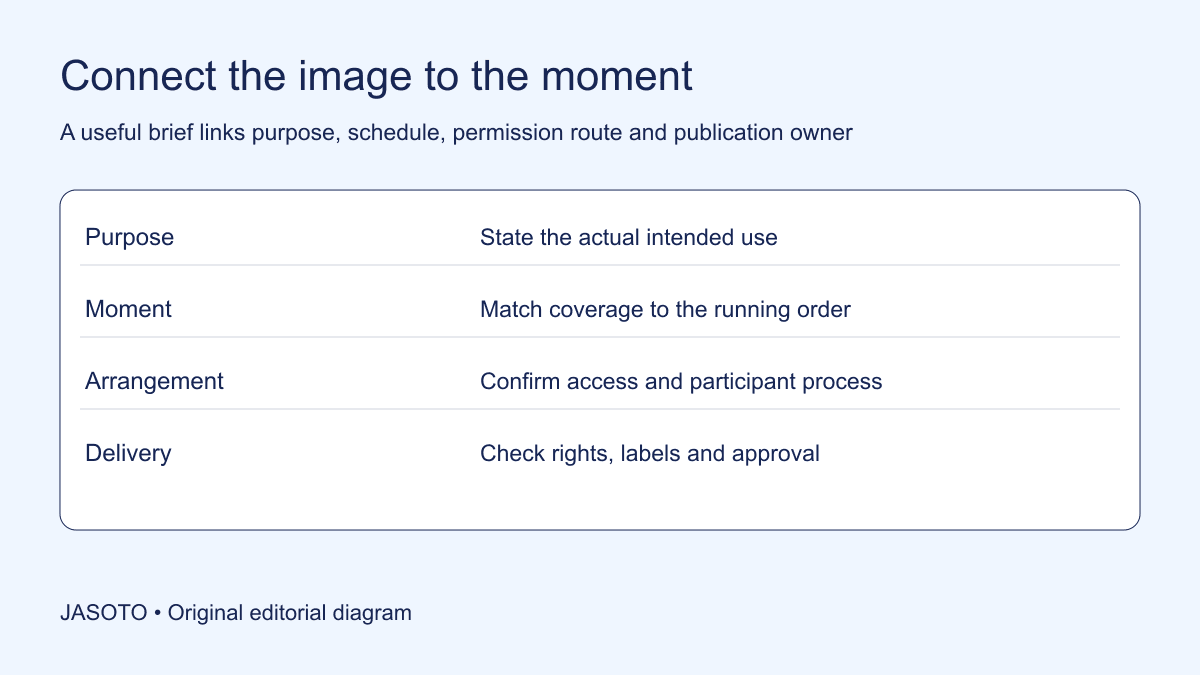
Original JASOTO editorial diagram. Its complete workflow is explained in the article; no actual customer outcome is depicted.
Coordinate a photographer's brief by connecting each requested image to its purpose, the moment it can be captured and the access or arrangement needed. Use the current running order and identify who can resolve a change. A list of desired photographs is difficult to deliver when it ignores the session sequence, room movement or the people whose cooperation the image requires.
This original guide is for UK small events commissioning or organizing photography. Intellectual Property Office guidance explains that ownership of commissioned work depends on the actual arrangements. Confirm usage rights and relevant privacy, permission and event policies through the appropriate owners or advisers. The scheduling method below helps create a practical brief without assuming a camera booking automatically authorizes every photograph or every later use.
The practical answer
- Start with actual image purposes.
- Prioritize coverage against the running order.
- Schedule arranged images with named owners.
- Confirm access, rights and publication routes.
Define what the images will be used for
List the actual intended purposes, such as an event report, an approved website update or a private record for the organizer. Give the photographer enough context to choose appropriate coverage. A general request for “marketing photos” can mean many different things and may lead to material unsuitable for the actual publication or layout. Confirm the purpose before choosing a long list of subjects.
Keep intended use distinct from permission and rights. The organizer's desire to publish an image does not settle whether the actual agreement or relevant policy permits that use. Ask the responsible person to resolve the question and record the approved scope. The photographer should know which requested images are cleared through the event process and which remain pending, rather than discover after capture that the team never agreed how the material would be handled.
Build the brief from the running order
Read the current schedule and mark moments that matter to the image purpose. Note the actual session, room, expected participants and whether the moment is fixed or likely to move. A welcome speech, hands-on activity and final group gathering require different positioning and timing. Keep the photographer connected to the schedule owner so changes reach the brief rather than remaining in a private organizer conversation.
Avoid assuming every item can be photographed at once. If important activities overlap in different rooms, identify the priority or consider another actual arrangement through the responsible process. The brief should expose the conflict before the event. A professional-looking list with two simultaneous must-have images leaves the photographer choosing the organizer's priority onsite, potentially while being blamed for an impossible schedule that nobody reviewed.
Separate essential, useful and optional requests
Choose a small number of images that are central to the actual purpose. Explain why they matter and what makes the image usable. Other coverage can be useful or opportunistic, but should not compete invisibly with the essential moment. Keep priorities realistic for the agreed scope and event arrangement. More requested images do not necessarily create a better record if they prevent attention to the relevant activity.
For an invented community workshop, the organizer needs a permitted image showing the activity setup and an agreed portrait of the facilitator for the event report. General room atmosphere is useful but secondary. The brief identifies the preparation window and the planned portrait point. This gives the photographer a workable sequence. It does not promise that every guest will appear or that a staged portrait is evidence of the workshop's measured impact.
Describe the useful content of a shot
Write the subject, context and purpose in plain language. Instead of asking only for “people networking”, explain which agreed activity or interaction matters to the report and whether the image needs room for a caption or particular layout. Keep the request focused on the communication need while leaving appropriate creative judgement to the photographer within the agreed brief.
Distinguish an actual event moment from an arranged image. If a group portrait or demonstration needs staging, schedule it and identify who organizes the participants. Do not present an arranged image later as documentary evidence of an unprompted customer reaction or a measured business result. Clear labels and an accurate account preserve the image's usefulness without turning a normal event photograph into an unsupported claim about what attendees thought or achieved.
Confirm access and movement with the venue
Ask where the photographer may work, which routes they should use and what arrangement applies to the relevant rooms or activities. Confirm any technical or event restriction through the responsible venue contact. A camera does not give independent permission to enter backstage areas, move equipment or interrupt a session. The photographer needs a practical route that fits the actual event plan.
Discuss specific positioning or lighting needs where they affect the venue or activity, with appropriate competent advice. Do not improvise changes to required routes or controls to improve an image. Keep the brief and venue decision connected so an essential shot does not depend on access nobody approved. If a requested moment cannot appropriately be captured, the organizer and photographer should choose a suitable alternative before it becomes a missed expectation on the day.
Establish the permission and information route
Use the event's actual privacy and permission arrangements, with the appropriate professional or policy guidance where needed. Explain who resolves a participant question and how the photographer receives the practical instruction. Do not assume a sign, ticket or general attendance automatically settles every legal or individual issue. The planning record should identify the decision owner and the current approved arrangement without inventing a universal consent rule.
Handle individual information discreetly and share only the practical detail needed for the task. If a person or area should not be photographed under the confirmed plan, make the operational instruction clear through the appropriate route. General volunteers should know where to direct a question instead of offering an improvised legal assurance. The photographer should not be left to infer permission from whether someone appears comfortable or from an organizer's casual comment made during a crowded session.
Schedule arranged images as actual activities
If a portrait, group image or product setup is required, reserve the relevant time and people. Confirm who gathers participants, where they meet and what happens if someone is unavailable. A request to “get a group photo at some point” can consume the closing period or fail after important people have left. Treat the arrangement as a bounded activity with an owner.
Keep the time commitment proportionate and communicate it to the relevant people in advance. Avoid surprising a speaker or participant with an unplanned photography session that conflicts with travel or another responsibility. For the workshop example, the facilitator portrait happens during an agreed preparation window rather than after pack-down begins. The brief identifies the actual location and contact. This makes the image feasible without assuming the photographer can create time by interrupting whatever work happens nearby.
Agree the response to a schedule change
Name who updates the photographer when a session moves or a required person is delayed. Use a practical contact route monitored during the event. The schedule owner should identify the consequence for priorities and obtain the appropriate decision if coverage conflicts. A live running-order document is helpful only if the photographer can actually access it and knows when it changed.
Keep a fallback for a missed essential moment where one is legitimate and useful. It might be a clearly arranged later image or another approved view that serves the purpose. Do not recreate a moment and then describe it falsely as the original event. The organizer should understand the difference between documentary coverage and an alternative illustration. The brief can preserve usefulness while keeping the account of what was captured accurate.
Confirm delivery and use through the agreement
Ask how images will be selected, delivered and identified, and who approves their use through the event's actual arrangements. Keep relevant rights, credits and usage conditions in the proper agreement or record. IPO guidance is useful background on commissioned-work ownership, but it does not settle the particular contract or every privacy question. Obtain suitable advice for uncertainty instead of assuming payment creates unrestricted use.
Find potential photography support through business listings, then confirm scope and suitability for the actual event. Share the confirmed venue and coverage window before planning travel. If event content coordination is ongoing work, describe it accurately in relevant roles, including who briefs, who updates the schedule and who approves publication. These responsibilities may be separate even in a small organization, and a clear handoff prevents images being published simply because a file has arrived.
Review the result against the actual brief
After delivery, compare the images with the agreed purposes and priorities. Identify any missing context, permission question or factual caption issue through the responsible route. Do not infer participant satisfaction, sales or event impact merely from an attractive photograph. A usable visual record supports communication while any outcome claim still needs appropriate evidence of its own.
Keep the practical lesson for the next event: an overlap requiring earlier prioritization, a portrait window that needed a named host or a delivery label that made selection easier. If the brief becomes overloaded, restore the essential image purposes and the actual schedule, then remove unsupported requests. A useful photography plan lets the photographer concentrate on an achievable sequence, with the organizer owning the access, priority and publication decisions needed to make the material appropriate for its intended use.
Put the guide into practice
- Resolve simultaneous essential requests.
- Agree how schedule changes reach the photographer.
- Keep staged and documentary material accurate.
- Review delivered images against the approved brief.
Frequently asked questions
Should every requested photograph be marked essential?
Prioritize the images central to the actual purpose and distinguish useful or optional coverage. A brief with overlapping must-have moments can be impossible to deliver. Resolve the conflict with the schedule owner before the photographer must choose priorities onsite.
Does commissioning photography settle all usage rights?
Check the actual agreement and relevant privacy or permission arrangements. Ownership and permitted use depend on the circumstances, and payment alone should not be treated as an answer to every question. Route uncertainty to the appropriate owner or adviser.
Can a missed event moment be recreated later?
An arranged alternative may be useful if it is appropriate and approved, but describe it honestly. Do not present a recreated or staged image as evidence that the original moment occurred in that way or that it demonstrates a measured attendee or business outcome.
Explore JASOTO tools
Discover providers and check support for your specific task.
Explore roles and responsibilities →Consider the practical responsibilities involved when recruiting or joining a team.
Plan work-related travel →Research a journey when joining, training or meeting colleagues in person.
Continue with JASOTO
Compare your next step
Discover UK businesses, compare services and request written quotes before making a decision.