
Business Growth · UK Guide 2026
Keep a Decision Log When Your Event Plan Changes
JASOTO · Updated 5 November 2026 · 1,598 words
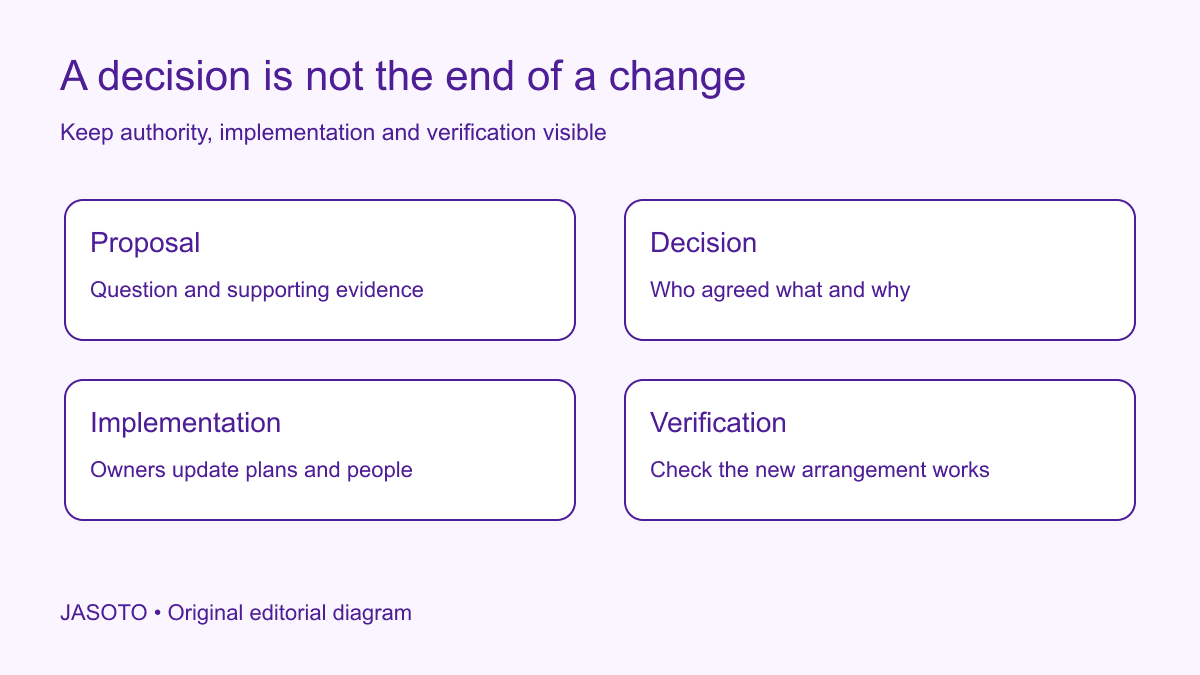
Original JASOTO editorial diagram. Its complete workflow is explained in the article; no actual customer outcome is depicted.
Keep an event decision log by recording what changed, why it changed, who authorised it and what must happen next. Link the entry to affected plans and communications, then check that the new arrangement was actually implemented. A decision made in a meeting is not the same as a revised room booking, an informed supplier or an updated instruction reaching the person who needs it.
For a small business event, a shared table can be enough if the team agrees how to use it. This guide offers a practical editorial method for UK event planning, with a fictional room-change example. It does not authorise changes to contracts, technical arrangements or safety plans. Those decisions remain with the responsible people and the event's actual approval process.
The practical answer
- Separate proposals, authorised decisions and completed actions.
- Record the evidence and reason behind each material change.
- Identify affected documents, people and supplier arrangements.
- Keep earlier decisions traceable when a later decision supersedes them.
Decide which changes belong in the log
Define a material change in terms of consequences. A revised room, supplier, access time, participant instruction, budget commitment or responsibility may deserve an entry. A spelling correction with no change in meaning may sit in normal document history. Choose a threshold that preserves important reasoning without forcing the team to record every harmless edit as a separate event.
Discuss the threshold with people who deliver the plan, not only the organiser writing it. A small change in wording can alter what a supplier understands they must provide. A revised entrance name can affect every arriving participant. Judge significance by its effect on the day and existing commitments. This makes the log a practical coordination tool instead of a list selected according to how dramatic each change sounds.
Separate a proposal from an authorised decision
Use clear states such as proposed, awaiting decision, approved, rejected, implemented and verified. Define who can move an entry into each state. An option discussed enthusiastically in a meeting may still require venue confirmation or budget approval. Keep that uncertainty visible so a colleague does not start implementing the idea because it appears in the same table as agreed instructions.
Record the decision authority appropriate to the change. Approval of a schedule edit does not automatically approve additional supplier expenditure or a technical alteration. If more than one permission is required, identify the separate dependencies. The entry should explain the current position accurately, including conditions, rather than compressing every kind of approval into one reassuring tick.
Give each entry a stable identifier
Use a short identifier that remains unchanged when details develop. Include the date raised, subject, current status and links to supporting records. A title such as “Room change for afternoon discussion” is easier to recognise than “Update seven.” The identifier lets emails, meeting notes and revised documents refer to the same decision without copying the entire explanation.
Keep the log in a location the relevant team can access, with appropriate editing permissions. Avoid private copies that become competing records. If somebody needs an export for offline use, label it with the export time and point to the live source. A spreadsheet is adequate only if colleagues know which version governs the plan and who resolves disagreements about its contents.
Write the decision and its reason separately
The decision states the authorised choice. The reason explains the evidence, constraint or trade-off that led to it. “Move the afternoon discussion to Room B” is a choice; “the confirmed participant arrangement no longer fits Room A” is part of the rationale. Keep supporting evidence linked so another person can distinguish a verified constraint from an assumption still being checked.
[Scottish Government guidance on construction change control](https://www.gov.scot/publications/project-initiation-business-cases-handbook/pages/16/) illustrates the broader principle of recording changes and decision reasoning for accountability. Its construction governance does not prescribe the process for your event. The lighter method here uses that general principle while keeping authority, documentation and review proportionate to the business's own event arrangements.
Capture the alternatives considered
List the realistic alternatives and why the selected option was preferred. This does not require a long essay. A few clear lines may explain that changing the session format was rejected because it would remove a required activity, while moving rooms retained the activity with a manageable schedule adjustment. Avoid inventing options after the fact merely to make the decision appear rigorous.
Record what remains uncertain about the chosen option. If the venue has proposed an additional room but not confirmed it, that is a condition, not an established fact. An honest entry can show that the decision is provisional pending confirmation. Preserving uncertainty helps the team know what to check next and prevents a recommendation from becoming a commitment through repeated retelling.
Identify the documents and people affected
For each decision, ask which plans, bookings, briefings and public instructions now require review. A room change may affect signs, reception notes, the presenter brief, equipment setup and participant information. Link those items in the entry and name an owner for each update. “Tell everyone” is not enough when different people control different channels and supplier relationships.
Check dependencies outside the immediate event plan. If the new session ends later, review travel arrangements and identify people with arrival or departure responsibilities. If a supplier's setup sequence changes, confirm through the authorised contact rather than assuming the venue has informed them. The log should connect decisions across the plan without claiming that recording a dependency has already resolved it.
Work through a fictional room change
Imagine a small workshop whose afternoon discussion requires a different layout after the participant plan is confirmed. The event lead raises entry E12 and links the revised requirement. The venue proposes another room. The organiser records the option, checks availability and asks the relevant budget owner to consider any documented commercial consequence. Until those points are settled, the entry remains awaiting decision.
Once authorised, E12 states which session moves, the effective date and the confirmed room reference. Separate actions update the participant agenda, signage, reception briefing and technical plan. Each owner records completion. A final check compares the room name and session time across those documents. This example does not establish a universal approval hierarchy; it shows why the rationale, authority and follow-through deserve distinct fields.
Define what counts as implementation
Choose evidence appropriate to each action. An updated document link may establish that the agenda changed. A supplier confirmation may establish that a revised arrival arrangement was accepted. Sending an email establishes that information was issued, but not necessarily that a critical change was understood or agreed. Be precise about what the evidence actually shows.
Give unresolved actions a review point and escalation owner. A decision can be approved while its implementation remains incomplete, and the status should show that. If the original plan is no longer workable but the replacement is not ready, raise the gap explicitly. Avoid marking the entire entry green because one visible task, such as editing the agenda, has been completed.
Preserve earlier entries when circumstances change
If a later decision replaces an earlier one, link both records and identify which now governs the plan. Retain the earlier reasoning and mark it superseded. Deleting history can make old messages look inexplicable and prevent a reviewer from understanding costs or work undertaken before the reversal. A clear relationship between entries is usually more helpful than trying to rewrite the past into one tidy story.
Ask what must be undone as well as what must be done. Revised printing may already have been ordered or a supplier may have accepted the earlier arrangement. The reversal needs its own consequence check. Do not assume that restoring a previous document version automatically restores bookings, expectations or external commitments. The log should make those differences visible to the people authorised to resolve them.
Keep urgent decisions traceable without obstructing action
Agree how the team records a decision made during the event. A concise contemporaneous note can identify the situation, authorised choice, decision-maker and affected people, with fuller supporting details added through the established process afterwards. Do not invent a special authority merely because a matter is urgent. Use the event's actual escalation and emergency arrangements where applicable.
Make clear who captures the record if the decision-maker is occupied delivering the response. After immediate coordination, check that the note accurately reflects what was decided and implemented. Keep observations, assumptions and confirmed facts distinguishable. An event log should support accountable action, while avoiding the misleading impression that an incomplete note was a detailed assessment performed before the decision.
Review the log for learning and staffing needs
After the event, ask which decisions were avoidable, which dependencies were missed and whether the record helped colleagues act consistently. Look for specific improvements, such as confirming room layouts earlier or naming one supplier communication owner. Do not treat the number of changes as a performance score without context; a team can have few recorded decisions because important changes went undocumented.
If coordination work repeatedly exceeds the team's capacity, define the gap before seeking business support providers or exploring project coordination roles. Retain the log according to the organisation's document arrangements and carry forward only useful, verified lessons. The record should explain the actual event's decisions and unresolved issues, providing evidence for the next plan rather than a manufactured story of flawless delivery.
Put the guide into practice
- Define what changes need an entry and who can authorise them.
- Record the decision, reason, scope and effective point.
- Link affected plans and communications.
- Assign implementation and verification owners.
- Review unresolved consequences before closing the entry.
Frequently asked questions
Is a decision log the same as meeting minutes?
No. Minutes may provide supporting context, while the decision log makes the authorised choice and its consequences easy to find. Link to the relevant meeting record where useful. Do not require someone to read every discussion note to discover which room, schedule or supplier arrangement is currently approved.
Should we record small wording changes?
Set a proportionate threshold. Changes affecting a commitment, cost, schedule, participant instruction or delivery responsibility are strong candidates. A harmless editorial correction may belong in ordinary document history instead. If wording changes the meaning of an instruction or promise, treat it according to its consequence rather than its size.
What if a decision is reversed?
Create a new entry that references and supersedes the earlier decision. Explain what changed in the evidence or circumstances, and check the consequences of reversing work already completed. Keep the previous record available so colleagues can understand why different versions existed without mistaking the earlier instruction for the current one.
Explore JASOTO tools
Brief suppliers with approved changes and clear document references.
Explore project coordination roles →Define ownership when event change tracking needs dedicated capacity.
Review team travel plans →Check whether an event decision affects booked journeys or arrival responsibilities.
Continue with JASOTO
Compare your next step
Discover UK businesses, compare services and request written quotes before making a decision.