
Business Growth · UK Guide 2026
Prepare an Event Supplier Arrival Route That Works
JASOTO · Updated 5 November 2026 · 1,596 words
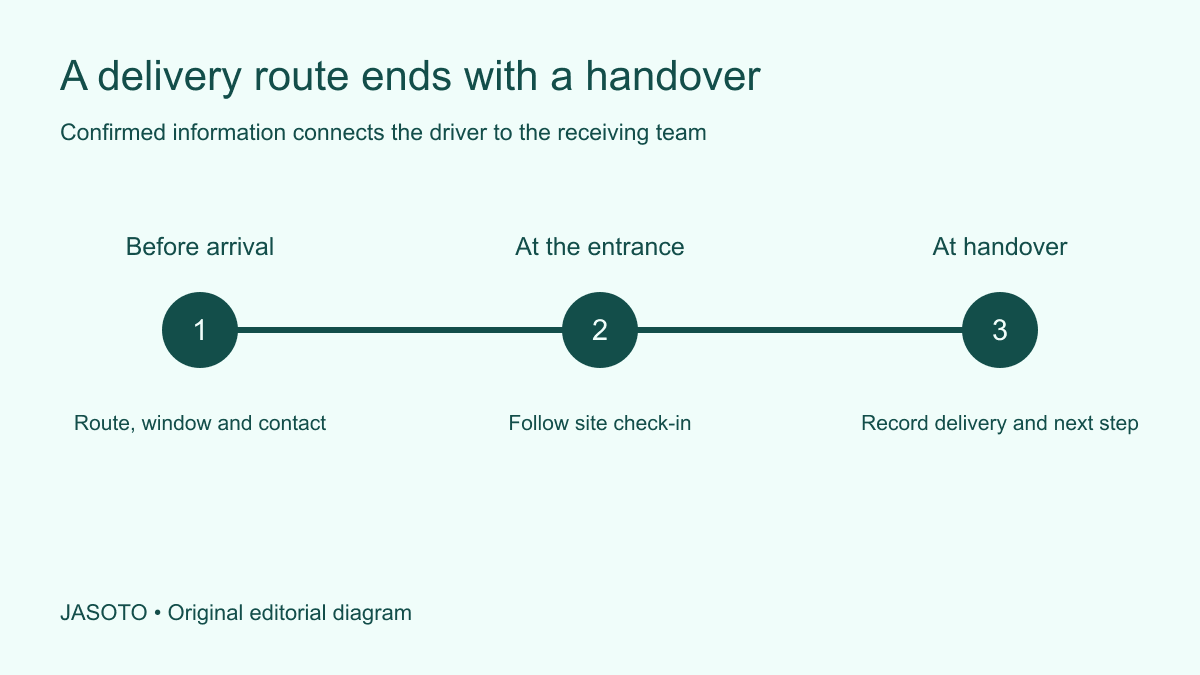
Original JASOTO editorial diagram. Its complete workflow is explained in the article; no actual customer outcome is depicted.
Prepare a supplier arrival route by obtaining the venue's approved access instructions, confirming the supplier's actual vehicle and delivery needs, and giving the arriving crew one current set of directions, timing and contacts. Include what happens after they reach the gate. A supplier who finds the right address can still be unable to enter, unload or locate the person authorised to receive the delivery.
This guide concerns the information handover for an ordinary UK business event. It does not design a traffic management plan or authorise vehicle movements. Site safety, unloading methods and specialist work require the appropriate responsible people. The examples are fictional and should be adapted to the actual venue and delivery arrangement.
The practical answer
- Obtain the approved site arrangements before writing delivery directions.
- Describe the correct entrance and check-in rather than only the postal address.
- Coordinate vehicle, unloading and handover requirements with the responsible team.
- Confirm receipt and provide a controlled route for changes or delays.
Start with the approved site arrangements
Ask the event or venue lead which document governs supplier arrivals and who can approve changes. Obtain the current supplier entrance, access period, check-in procedure and relevant restrictions. Use these as the source for your arrival sheet. Do not create a second route from a consumer map and assume it is suitable because it appears shorter or closer to the event room.
[HSE's event transport guidance](https://www.hse.gov.uk/event-safety/transport.htm) addresses planned onsite vehicle movements and separation from people. Refer transport design and safety questions to the responsible site team. Your information pack should communicate its approved instructions accurately. If the source arrangement is incomplete, record the gap and get it resolved rather than filling it with a confident-looking arrow on a diagram.
Identify what is actually arriving
Ask the supplier for the delivery contents, number of vehicles where relevant, vehicle type and any information the site team needs to assess access. Confirm whether the driver is also installing equipment, collecting empties or returning later. A parcel drop and a crew arriving to build a display have different coordination needs even if both are labelled “delivery” in the event schedule.
Keep the request proportionate and explain why details are needed. Pass technical or handling information to the responsible team rather than interpreting it yourself. If the supplier changes the vehicle or load, require confirmation through the agreed process. An access decision made for one arrangement should not silently be carried over to a substantially different arrival because the supplier name has stayed the same.
Describe the entrance so it is recognisable
Give the venue name, address and the exact supplier entrance identified by the site team. Add a plain description or approved image where helpful. Distinguish the public entrance, delivery entrance and any check-in point. If the site has several gates, use its own names consistently; “rear entrance” becomes ambiguous when a driver approaches from the opposite direction.
Check any map pin or diagram against the confirmed entrance. Include the issue date and source of the information so colleagues know what they are looking at. Avoid inventing vehicle routing advice for public roads. Where external access depends on local restrictions or event arrangements, obtain the relevant instruction from the people managing it and identify where the supplier should check for updates.
Separate the arrival window from the event start
Record the supplier's agreed arrival period, the check-in time where different, and the deadline for the completed handover. A supplier arriving before guests may still need setup time, inspections or coordination with another contractor. Place these activities in the event schedule rather than leaving them as an assumption behind one calendar entry.
State whether the window is confirmed or awaiting agreement. If several suppliers depend on the same area, ask the arrival coordinator to check the sequence. Do not promise every supplier exclusive access to the same space. A practical schedule can include a review point for delays, but should avoid creating a false guarantee that a vehicle arriving at a particular minute will immediately be ready to unload.
Explain check-in and who receives the supplier
Describe the first action on arrival: report to the named check-in point, contact the designated person or follow the site's confirmed procedure. Provide a working contact method and backup, using role names as well as individuals where appropriate. Verify that the person knows they are listed and will be available during the window. A contact number borrowed from an old event pack may belong to someone off duty.
Tell the supplier what reference to quote and what information the receiving team expects. Keep passwords, private access codes and sensitive arrangements out of broadly circulated sheets; use the site's approved method for restricted details. The general pack should still be sufficient to reach legitimate help without forcing a driver to call several unrelated organisers from a gate.
Connect unloading to the responsible team
Ask who coordinates the unloading location, equipment and people, and how the supplier receives the relevant onsite instructions. Identify the receiving location and delivery reference without prescribing an unassessed handling method. If the supplier expects assistance, confirm exactly what has been agreed through the responsible team. “Someone will help” is not a usable resource commitment.
Clarify what happens to packaging and any empty cases, and whether the vehicle leaves or stays in an authorised area. Keep these decisions linked to the approved site arrangements. An arrival sheet should not imply that reaching the unloading point authorises parking there for the whole event. The next step matters because vehicles, people and equipment continue moving after the first box has been received.
Record dependencies between deliveries
List any sequence that affects another supplier or activity. A display delivery may depend on a room being released, while technical setup may depend on that display being assembled. Give the coordinator enough information to spot conflicts before the day. Avoid circulating the entire supplier schedule when a focused dependency note would provide the relevant information more clearly.
For a fictional example, a printer delivers registration material before a reception briefing. The handover location must be available and the receiving colleague must know where the boxes go. If the material arrives late, the reception lead needs an update, not simply a revised driver estimate in a private message. This example concerns information flow; it does not establish an appropriate access or unloading arrangement for another site.
Confirm the actual crew received the instructions
Send the pack through the supplier's agreed contact and ask how it will reach the people attending. A sales contact acknowledging an email does not demonstrate that a subcontracted driver has the correct gate or reference. Request confirmation of the operational recipient where appropriate, especially if the supplier uses an external carrier or changes crews close to the event.
Keep a record of the version sent, recipient and outstanding questions. Ask for a practical read-back of important details: arrival window, entrance and first contact. This is a check of the instructions, not a test of memory. If the supplier interprets a detail differently, correct the shared document before arrival rather than expecting the check-in team to resolve a preventable misunderstanding.
Provide one route for delays and changes
Tell the supplier who to contact if timing, vehicle or delivery contents change. The coordinator should assess the implications with the relevant site people and issue an approved update. Do not let separate organisers make contradictory gate or parking decisions through parallel messages. Keep the change reference with the delivery record so the receiving team can recognise the current instruction.
Prepare the internal team to distinguish an estimate from a confirmed new arrangement. “Driver expects to arrive later” does not mean the site has accepted a later access window. Record both facts separately. If the original arrangement no longer works, communicate the next authorised step clearly and confirm who has informed the actual crew. The process should remain usable when the event lead is occupied elsewhere.
Keep staff travel and supplier access distinct
Use JASOTO travel when researching staff journeys, but avoid treating those directions as vehicle access instructions. A walking entrance used by an employee may be unsuitable or unauthorised for a delivery. If staff are receiving equipment before travelling themselves, reflect that responsibility in their schedule so they do not leave while the supplier is still expected.
If additional coordination support is needed, brief event logistics providers with the defined arrival task. When considering event coordination roles, specify whether the work involves check-in administration, supplier communication or specialist site management. Those responsibilities should not be conflated. Clear role boundaries help the person receiving a delivery know when to act and when to refer a decision to someone else.
Close the delivery and improve the next pack
Record arrival, receipt, exceptions and any follow-up in the event's delivery record. Identify missing or damaged items accurately through the normal receiving process and tell the relevant owner. If a later collection is required, create that next action explicitly. A successful arrival does not automatically mean the supplier's equipment, packaging and return obligations have all been resolved.
After the event, review which instructions needed clarification and whether the arriving crew had the correct version. Update the reusable pack structure while retaining the site-specific evidence separately. The useful measure is whether people could find the approved entrance, reach the right contact and complete the agreed handover. Do not claim a safety or efficiency improvement from the document alone without evidence of what actually happened.
Put the guide into practice
- Confirm the approved supplier entrance and arrival window.
- Check relevant vehicle and load details with the site team.
- Name the arrival contact and backup.
- Link the route to the current site information.
- Confirm the supplier has briefed the actual arriving crew.
Frequently asked questions
Can the supplier use the guest postcode?
Only if the responsible site team confirms it leads to the appropriate supplier entrance. A postal address or map pin may lead to a public reception instead. Include the entrance name, confirmed approach information and check-in instruction so the driver is not expected to infer an authorised route.
What should we do when a supplier is late?
Use the agreed contact route to notify the person coordinating arrivals. They should assess the effect on the site's current arrangements and authorise the next step. Do not tell the driver to use an alternative gate or unload elsewhere without checking with the responsible team.
Does an arrival sheet replace a traffic management plan?
No. The sheet communicates the instructions relevant to that supplier. Site transport management, safety assessment and any specialist requirements remain with the responsible people and documents. Keep the arrival sheet aligned with those arrangements and refer unresolved questions back to the site team before issuing it.
Explore JASOTO tools
Continue with JASOTO
Compare your next step
Discover UK businesses, compare services and request written quotes before making a decision.