
Business Growth · UK Guide 2026
Write an Event Volunteer Briefing People Can Use
JASOTO · Updated 5 November 2026 · 1,622 words
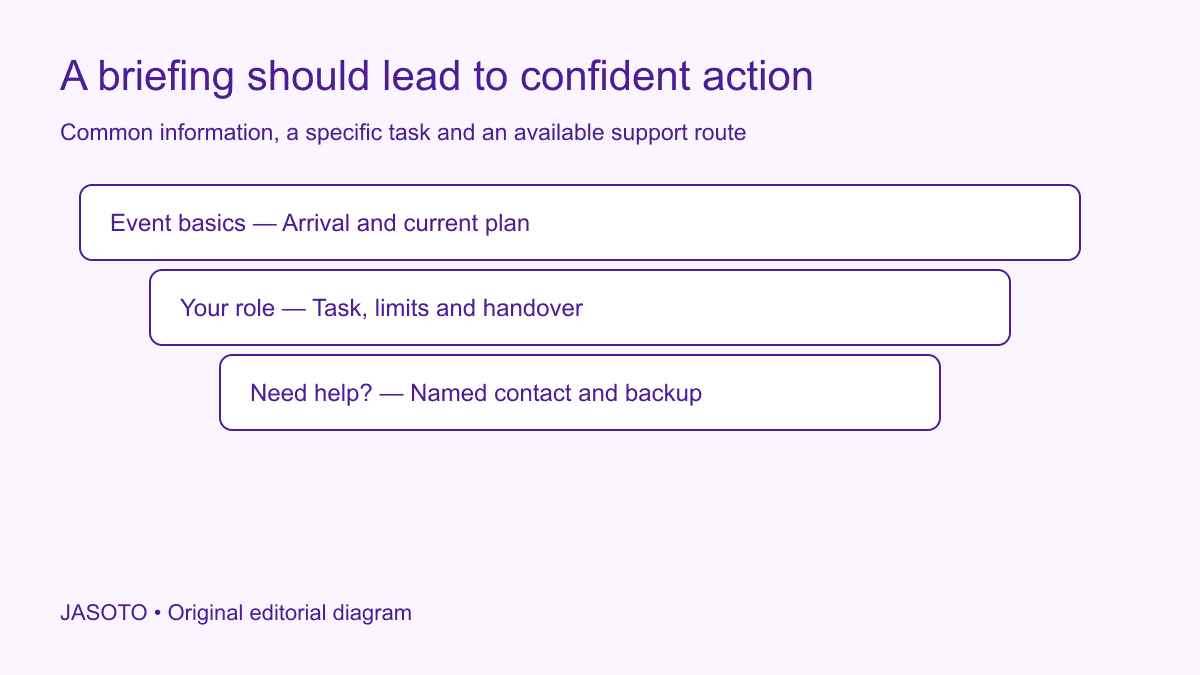
Original JASOTO editorial diagram. Its complete workflow is explained in the article; no actual customer outcome is depicted.
Write an event volunteer briefing around four questions: where do I go, what am I doing, what decisions can I make, and who helps when something is unclear? Combine a concise written reference with an introduction and a chance to practise the role. A long event overview is not enough if a volunteer still cannot find their supervisor or explain the next step to a visitor.
This guide offers a practical briefing structure for ordinary event support in the United Kingdom. It does not replace role-specific training, safeguarding arrangements or the organiser's approved safety procedures. The sample situations are fictional. Adapt the briefing to the actual people, venue, activity and responsibilities rather than treating volunteering as a reason to leave preparation informal.
The practical answer
- Tell each volunteer what their role includes and who can make exceptions.
- Combine a concise written briefing with a chance to ask questions.
- Use the event's approved safety and concern-reporting arrangements.
- Test a realistic handover before volunteers begin their tasks.
Describe the role before writing the briefing
Define the task in terms of observable actions. “Help on reception” could mean welcoming visitors, checking names, directing queues, answering questions or handling unexpected arrivals. Decide which of these the volunteer is expected and prepared to do. State which decisions belong to the reception lead. A role description becomes more useful when it identifies both the routine work and its limits.
Separate roles that need different knowledge or preparation. A person greeting guests should not quietly inherit responsibility for technical equipment because both activities happen near the entrance. Ask the event lead to resolve gaps before the briefing is issued. If a specialist function remains unfilled, record it as an operational issue rather than disguising it under “other duties as needed.”
Put arrival instructions on the first page
Give the event date, reporting time, meeting point and a contact for arrival difficulties. Distinguish the volunteer entrance from the public entrance if they differ. Include a plain description of the check-in location and what happens after arrival. A full postal address alone may not help someone facing several buildings, a locked gate or a reception desk that opens later.
Check the instructions against the actual venue arrangement and research travel options before implying a particular route is available. Explain how late arrival should be reported and who reallocates a missed task. Avoid asking volunteers to make private arrangements with each other that the organiser cannot see; the event lead needs an accurate picture of who is present and which roles are covered.
Separate the common briefing from each task sheet
The common briefing can cover event purpose, key locations, support arrangements, current schedule and shared expectations. The task sheet should identify the station, assigned period, immediate supervisor, materials and handover. Linking the two avoids repeating everything while ensuring that a role is not hidden in a general document. Keep both versions dated and make the current edition obvious.
[NCVO's induction guidance](https://www.ncvo.org.uk/help-and-guidance/safeguarding/certain-roles/volunteer-managers/recruiting-safely/getting-volunteers-started/) stresses clear responsibilities, access to support and preparation appropriate to the role. Use that resource when planning the wider introduction. The task-sheet format here is an editorial way to make local event information easy to retrieve; it is not a claim that a particular document length guarantees a successful induction.
Explain authority through ordinary situations
Write down what the volunteer can do without asking. A reception volunteer might direct a visitor to the correct desk using the approved information, but refer a disputed booking to the lead. Avoid abstract language such as “exercise discretion” unless the team has discussed what that means. Specific examples make boundaries easier to understand when people are busy.
Include a truthful phrase for uncertainty: “I can help you find the person handling that question.” Pair it with the actual contact route. If the volunteer must leave a station to ask, define who covers it. A boundary is only useful when the escalation path works in practice. Otherwise volunteers may feel compelled to guess, promise an exception or abandon a task to seek help.
Use approved information for safety and concerns
Ask the organiser for the current information relevant to the role, including how to report concerns, obtain help and follow the event's emergency arrangements. Carry those instructions accurately into the briefing and identify who explains them onsite. Do not improvise evacuation, medical or safeguarding procedures from a generic template. The briefing should connect people to the event's arrangements and responsible personnel.
Check that the named contact exists in the staffing plan and that a backup is available. Explain how volunteers can raise a concern about the person they normally report to. Keep sensitive personal information out of the general briefing. A useful document can state a role and contact method without distributing private case histories or turning every volunteer into the custodian of confidential attendee records.
Make the information usable for the people attending
Ask volunteers what they need to participate in the introduction and carry out the role. Provide information early enough for questions, and use clear language with explicit locations and actions. A dense photographed sheet may be difficult to read or adapt. Choose a practical format and check it on the device or printed copy volunteers will actually use.
Discuss language needs without assuming them from a person's name or background. Explore language support on JASOTO if additional communication assistance is needed. Keep translated task instructions aligned with the current source version and confirm who checks important changes. Do not make an unverified translation the only available route to understanding a safety-sensitive instruction or a substantial responsibility.
Rehearse a question instead of reading every sentence
After the introduction, give each volunteer a realistic situation and ask what they would do. For reception, that might be a visitor whose name is absent from the list. The volunteer should locate the instruction, explain their next action and identify the decision-maker. The purpose is to test the briefing and support route, rather than catch someone out for failing to memorise it.
Notice where people hesitate. Perhaps the task sheet says “contact control” while the contact list calls the same function “event office.” Fix the terminology before work starts. If several people ask the same question, treat it as evidence that the explanation needs improvement. Repeating the wording more loudly will not resolve a missing contact, a contradictory schedule or a task that has not been assigned.
Plan breaks and changes in coverage
Specify how breaks are arranged, who confirms cover and how volunteers signal that they need assistance. A rota that assumes people remain at a station indefinitely is incomplete. Make the arrangement realistic for the length and demands of the task. Clarify which periods require a formal transfer and where a volunteer should wait if the incoming person has not arrived.
Use a short handover: current position, unresolved question, relevant commitment and incoming contact. For example, “One guest is waiting for the reception lead to confirm a room change; no alternative room has been promised.” This gives the next person enough context to continue honestly. Avoid a handover that transfers only equipment while leaving a visitor's pending question known to nobody else.
Distinguish volunteer tasks from paid staffing needs
Review whether the event plan depends on expertise, availability or accountability that has not actually been arranged. If a function needs professional delivery, obtain appropriate support rather than widening a volunteer's role during the event. Find event service providers to research a defined requirement. A volunteer's willingness to help does not demonstrate that a technical or specialist assignment has been adequately prepared.
Keep recruitment language clear about the nature of the opportunity. When a paid role is required, explore event jobs and describe the responsibilities honestly. Within the briefing itself, avoid confusing titles that make volunteers appear responsible for decisions the organiser retains. Clear distinctions help visitors find the right person and help team members recognise when they should pass a question to someone else.
Control updates once the event is underway
Tell volunteers how a genuine change will reach them. A revised room assignment should identify who approved it, which task it affects and when it takes effect. Ask the lead to check that people at relevant stations received the update. Posting a message in a group does not establish that the volunteer helping a visitor has seen it.
Keep one current reference at each station and explain how obsolete information is withdrawn. If a colleague brings an unverified update, volunteers should know where to confirm it before directing visitors elsewhere. This is especially useful when the event uses both printed sheets and online messages. The practical goal is that a visitor receives the same current answer at the entrance and the reception desk, with uncertainty passed to the person authorised to resolve it.
Close the shift and improve the next briefing
Explain sign-out, equipment return and the final handover before volunteers start. Confirm where unresolved issues should be recorded and who closes them. Thank people for their work without treating departure as the end of every outstanding action. An incident or concern raised near closing time still needs to reach its designated owner through the event's process.
Collect a few specific observations after the event: which instruction was hard to find, which question was unexpected, and whether the help route worked. Keep the answers factual and avoid attributing blame to a volunteer when the briefing omitted essential information. Revise the document using those observations, preserve the earlier version and note what changed. The next event then begins with a clearer local plan rather than an enlarged file of generic advice.
Put the guide into practice
- Confirm arrival, check-in and role allocation.
- Explain the task, its limits and the support contact.
- Include current event arrangements and accessible information.
- Practise a realistic question and escalation.
- Confirm sign-out, equipment return and feedback.
Frequently asked questions
Can we send the briefing by email and skip the live introduction?
Email is useful for preparation, but delivery is not the same as understanding. Give volunteers a way to ask questions and confirm local changes when they arrive. The amount of introduction and training depends on the role; a short message should not substitute for preparation needed to perform the task safely.
What should volunteers say when they do not know an answer?
Give them an honest phrase and a reliable help route. For example: ‘I will check with the reception lead rather than guess.’ Explain how to contact that lead and what to do if they are unavailable. This works only if somebody is actually assigned to respond.
Should every volunteer receive the whole event plan?
Provide the information relevant to their task and a clear route to further help. A concise role sheet can sit alongside the common briefing and controlled event documents. Avoid distributing private attendee information or sensitive operational detail merely because it is included in a larger planning folder.
Explore JASOTO tools
Research specialist support where a volunteer role requires additional expertise.
Explore paid event roles →Keep employee vacancies and volunteer arrangements clearly distinguished.
Plan event journeys →Research arrival options before issuing the volunteer meeting point.
Explore language support →Consider language needs when preparing volunteer information.
Continue with JASOTO
Compare your next step
Discover UK businesses, compare services and request written quotes before making a decision.