
Business Growth · UK Guide 2026
Build an Evidence Note Before Changing a Service Offer
JASOTO · Updated November 5, 2026 · 1,612 words
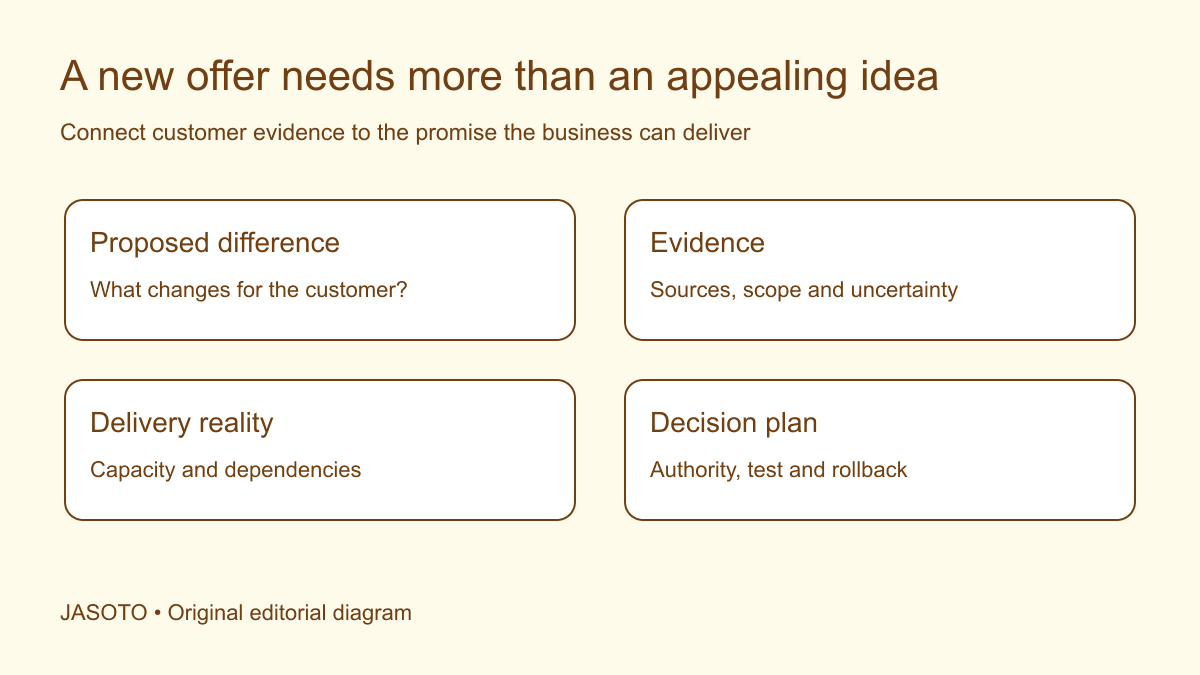
Original JASOTO editorial diagram. Its complete workflow is explained in the article; no actual customer outcome is depicted.
Build an evidence note before changing a service offer by stating the problem, the proposed difference and the evidence connecting them. Review customer need, delivery capacity, alternatives and consequential dependencies. Record what is known, what remains assumed and who can authorize the next step. The note should make a proposed customer promise reviewable before persuasive copy turns it into an apparent available service.
This guide uses fictional United States business scenarios and no invented market prices or forecasts. It supports a practical decision record. Commercial, legal, technical and other specialist matters need their appropriate owners and advice. The useful outcome can be a limited investigation, a clearer existing offer or a decision not to change, as well as an approved new service arrangement.
The practical answer
- State the proposed change and the problem it should solve.
- Separate observed demand from assumptions and selected feedback.
- Check delivery capacity and the consequences of new promises.
- Compare alternatives and define a proportionate reversible next step.
Describe the current offer and proposed difference
Record what the business currently provides, to whom and under which relevant process. State the proposed change in concrete terms: scope, delivery method, area, availability or another actual feature. Avoid a broad label such as premium package when nobody has agreed what changes for the customer.
Identify the customer promise the proposal would create. A faster review, onsite visit or wider service area requires a supporting operating arrangement. Keep aspirations separate from current capability. The note should let a reviewer understand the difference without reading a promotional draft or relying on the person proposing it to explain the idea privately.
Define the problem the change should solve
Write the observed difficulty and its consequence. Customers may struggle to choose between existing services, ask for a missing capability or misunderstand an assessment step. Those situations do not automatically require a new offer. Describe the evidence before selecting a solution so the team can compare realistic alternatives.
Keep internal preferences distinct from customer problems. A desire to increase average order value may be a business objective, but it does not establish that customers need a particular package. Record both where relevant and examine how they connect. A clear purpose helps prevent the evidence note becoming a collection of favorable anecdotes selected to support a decision already made.
Inventory the evidence and its limits
List customer questions, actual requests, existing outcomes, operational records and relevant research with their dates and scope. Identify whether each is observed, reported, estimated or assumed. A controlled reference may be enough; avoid copying unnecessary personal details into a widely shared proposal.
[SBA's market-research guidance](https://www.sba.gov/counseling/plan-your-business/) connects understanding customers and demand with business planning. Use appropriate research for the actual offer decision. A selected group of inquiries can reveal a need worth investigating while remaining insufficient to establish market size, willingness to pay or a reliable forecast. Keep that distinction visible in the note.
Separate requested features from underlying needs
Ask what task the customer was trying to accomplish when they requested a feature. A request for an urgent visit might reflect uncertainty about the existing response route rather than broad demand for a new rapid service. Preserve the customer's actual statement and label the interpretation. Do not convert every suggested solution into a proven requirement.
Look for repeated patterns with context and exceptions. Several similar requests may come from one campaign or a particular customer group. Record that selection. The note should help the team investigate the underlying task and assess whether the current offer, clearer information or another arrangement could meet it appropriately.
Check who the offer would fit
Define the intended customer and relevant eligibility or scope boundary. Use evidence rather than inventing a detailed persona. Identify genuine requests the proposed offer would still not meet. A broader package can create more confusion if its limits remain vague or if it combines tasks that require different assessment.
Keep existing customers in view. A new option may change how people interpret the current service or what they expect from earlier arrangements. Identify communication and operational consequences through the responsible owner. The note should not assume that adding a page is isolated from the rest of the customer journey.
Verify delivery capacity and authority
Ask the people doing the work what is needed to deliver the proposed promise. Consider staffing, skills, scheduling, equipment and supplier dependencies appropriate to the actual service. Record which capability exists and which is only planned. A recruitment intention or supplier conversation does not establish readiness.
Use delivery-role research where staffing is a genuine dependency, while keeping vacancies separate from current capacity. Give the relevant owner authority to assess readiness. The writer should not publish a firm availability claim because the offer description is complete. Operational verification and customer-facing communication need to refer to the same approved state.
Identify commercial and specialist questions
Record unresolved scope, pricing basis, terms and any legal, technical, data or other specialist issue relevant to the actual proposal. Assign appropriate review. Do not improvise a regulation, price or guarantee to make the note look finished. An explicit dependency is more useful than a plausible unsupported answer.
Keep the effect on the decision clear. A question may prevent launch, require a narrower scope or simply need confirmation before final wording. The responsible owner should determine that consequence through the actual process. The note organizes evidence and decisions; it does not replace the expertise needed to settle consequential matters.
Compare realistic alternatives
Include retaining the current offer where reasonable, improving its explanation, changing a process or investigating further. Describe how each option addresses the observed problem and what evidence is missing. Avoid a comparison designed only to make the preferred idea look attractive through unrealistic alternatives.
Record material trade-offs. A wider area may increase scheduling complexity; a bundled service may reduce one decision while obscuring another. Use actual operating evidence and suitable advice rather than generic assumptions. The comparison should let the reviewer choose proportionately, including a simpler correction when it solves the verified problem.
Design the next evidence step
If uncertainty remains, define the question and suitable way to investigate it. That could involve appropriate customer research, an operational feasibility check or review of existing cases. Do not call ordinary publication a test without planning what will be observed and how customers' expectations are handled.
Keep any trial within approved capacity, terms and relevant requirements. State its actual scope clearly. A limited offer still creates a customer promise. Seek appropriate design and analysis support where needed, and avoid inventing a universal sample size or duration for every service decision.
Work through a fictional service-area proposal
Imagine a business receives requests from an adjacent area and proposes expanding coverage. The note records the actual requests and their service types, while scheduling review identifies a capacity dependency. The team compares expansion with a clearer individual-review route and further investigation of relevant demand.
Before customers plan visits or expect attendance, any published boundary must reflect the approved arrangement. This fictional example supplies no travel-time rule, price or demand forecast. It illustrates how customer evidence and operational feasibility can lead to a narrower next step rather than an immediate broad promise.
Define approval and the launch condition
Name who can authorize the offer and what evidence they need. Record the exact decision, conditions and effective point. Keep a recommendation distinct from approval. A meeting can endorse further investigation without authorizing customer bookings or a new price list.
If approved, identify the pages, forms, profiles, templates and team briefings affected. Give implementation and verification owners. A new offer can be described accurately on one page while older routes still imply something different. The note should connect the decision to a complete reviewable change plan without making unrelated edits automatically.
Plan measurement and rollback
State the intended customer benefit and appropriate evidence to review after release. Preserve relevant baseline definitions and context where available. Do not promise a performance improvement before observing it. Keep unsuitable requests, operational burden and customer understanding visible alongside any convenient volume measure.
Record conditions that would trigger correction, limitation or rollback, with an owner. Preserve earlier content and process references. A rollback must restore an accurate available state and account for commitments already made; it is not merely deleting a new page. Give consequential decisions to the responsible people through the actual workflow.
Read back the promise before approval
Ask a reviewer unfamiliar with the proposal to explain what a customer could obtain, what remains conditional and what is not yet available. Compare that interpretation with the evidence note and operating decision. A proposal can use careful individual sentences while its combined presentation implies broader readiness or certainty than intended.
Correct the source of the mismatch before launch materials are produced. If the business has approved investigation only, make that status unmistakable. If it has approved a limited offer, preserve the boundary in the next-step plan. This check helps ensure the decision-maker is approving a concrete customer promise rather than an appealing phrase whose practical meaning differs across the team.
Keep the note concise and maintain its conclusions
Summarize the problem, proposal, evidence, limits, alternatives, dependencies and next decision. Link supporting records rather than reproducing every detail. Research relevant providers with a defined unmet need when support is appropriate. The note should be usable by a reviewer unfamiliar with the original conversations.
Revisit assumptions when new evidence or operating conditions change. Preserve earlier reasoning so later decisions remain understandable. The practical result is an offer change grounded in a visible evidence trail, with delivery readiness and customer promises aligned and uncertainty turned into accountable next actions rather than fabricated certainty.
Put the guide into practice
- Describe the current offer and proposed difference.
- Inventory evidence with source, scope and limits.
- Confirm operational and specialist dependencies.
- Compare realistic alternatives and risks.
- Record authority, verification and rollback conditions.
Frequently asked questions
Does a few customer requests prove we should add the service?
They can reveal a useful question, but review suitability, frequency, context and the effort required to deliver. Selected requests may not represent broader demand. Preserve what customers actually asked and distinguish it from an assumption that enough people will buy the proposed offer.
Should the note include a sales forecast?
Include only appropriately supported estimates where they help the decision, clearly labelled with assumptions and uncertainty. Do not invent demand, prices or returns to make the proposal appear complete. An evidence gap can lead to a focused next investigation instead of a fabricated forecast.
Can a trial offer be published before every detail is settled?
The actual customer promise, capacity, terms and relevant requirements need appropriate approval. A limited trial still creates expectations. Define its scope and handling clearly, and do not use the word trial to excuse misleading or unsupported information.
Explore JASOTO tools
Continue with JASOTO
Compare your next step
Discover UK businesses, compare services and request written quotes before making a decision.