
Business Growth · UK Guide 2026
Prepare an Exhibitor Delivery Schedule for a Shared Venue
JASOTO · Updated 5 November 2026 · 1,621 words
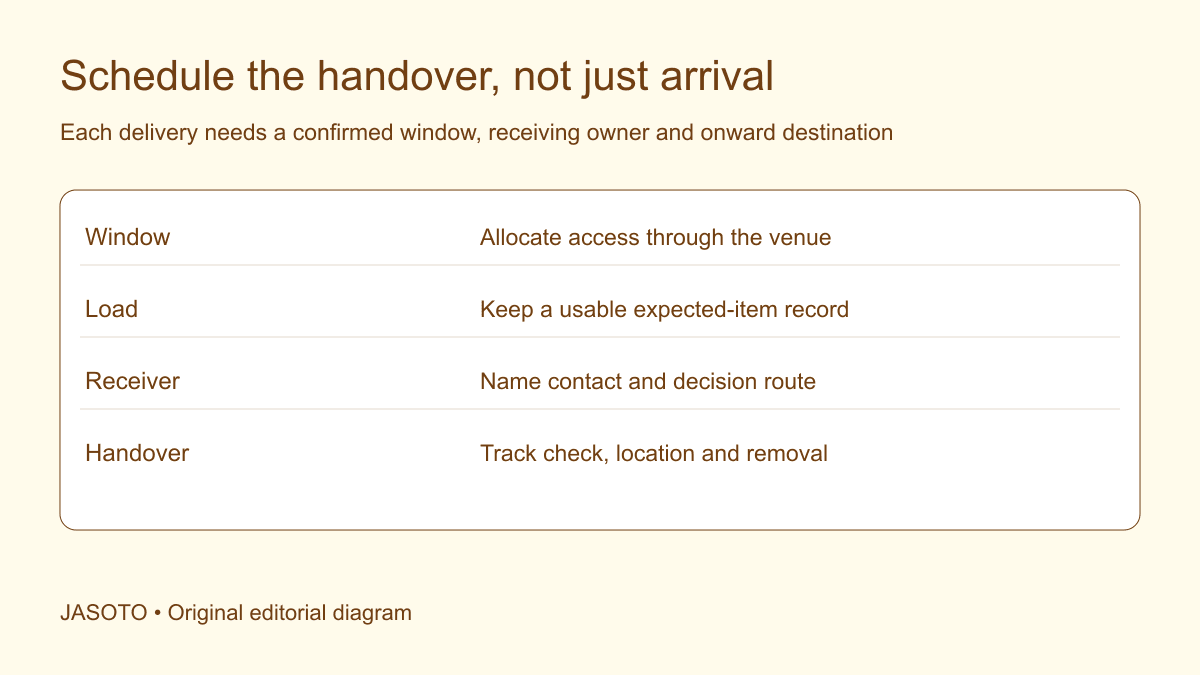
Original JASOTO editorial diagram. Its complete workflow is explained in the article; no actual customer outcome is depicted.
Prepare an exhibitor delivery schedule by connecting each incoming load with a confirmed access window, receiving person and usable item record. Check how the delivery reaches its allocated space and what happens if it arrives early, late or incomplete. A list of supplier arrival times does not establish that a shared venue can receive, store and hand over every item through the same entrance at once.
This original guide is for UK organizers using a shared event venue. HSE's loading and unloading guidance addresses the need for appropriate arrangements and coordination around those activities. Technical handling and safety decisions belong with the relevant competent people and venue process. The schedule below organizes information and ownership, helping the team ask the right questions before a delivery vehicle reaches the site.
The practical answer
- Confirm the venue’s actual receiving process.
- Separate requests from allocated windows.
- Name a receiving owner and escalation route.
- Connect arrival, item check and removal.
Establish the venue's receiving arrangement
Ask the venue which entrance or delivery area applies, what access windows are available and who controls them. Confirm whether other events or activities share that route. A room booking does not automatically reserve a loading area or make it suitable for every vehicle and item. Use the actual venue instruction and identify the contact authorized to resolve a conflict.
Record restrictions relevant to scheduling without attempting to design the handling operation yourself. The venue or competent provider should confirm appropriate arrangements for the specific delivery. Mark unresolved questions and the person obtaining the answer. A precise-looking timetable can conceal an unapproved route if the organizer copies a postal address into a delivery field. The schedule should reflect the confirmed receiving point and the actual process, with changes reviewed by the responsible people.
Collect one useful brief per exhibitor
Ask for the exhibitor name, relevant contact, provider or carrier where known, intended arrival and the items to be received. Include the number and practical description of packages, along with dimensions or handling information where the responsible venue process requires it. Keep the facts reliable and label estimates. “Display materials” may be insufficient if the venue needs to distinguish a small parcel from a substantial case.
Avoid collecting unnecessary personal or commercial information in a broadly shared timetable. The operational record needs enough context to identify the load and ask the appropriate question. Sensitive booking or supplier details can remain in the proper private record. Give exhibitors a clear route to update the brief when packaging or transport changes. An item list prepared before the final shipment should not silently become the receiving team's statement of exactly what is expected.
Separate requested and allocated windows
Treat an exhibitor's preferred time as a request until the venue schedule owner allocates it. Record the confirmed window and tell the exhibitor which instruction is current. Several suppliers choosing the same convenient morning hour can overwhelm a shared entrance even when each individual delivery appears modest. The organizer needs a coordinated view of the actual receiving capacity through the venue's approved process.
Identify the dependency between arrival, unloading, onward movement and access to the exhibition space. A vehicle reaching the site does not mean the next stage can begin immediately. Ask the responsible people about the actual sequence and schedule accordingly. Do not resolve a conflict by promising faster handling or using an unapproved waiting area. The plan should make room for the confirmed process, rather than require the process to fit an optimistic timetable.
Assign a receiving owner for every load
Name the person who will recognize the delivery, check the relevant record and connect it with the exhibitor or allocated space. Confirm that the person is available during the window and understands their authority. A volunteer may be able to identify a package without approving acceptance of an unexpected item or signing an unfamiliar document. State who resolves that decision.
Provide a backup or escalation route where appropriate. A carrier should not arrive to discover that the named contact is in a session and nobody else knows the item. Keep the receiving information accessible to the authorized team, with a current contact route. Include the allocated space identifier so the receiver can distinguish similar deliveries intended for different exhibitors without relying on a supplier name alone. The receiving owner does not become responsible for technical handling outside their competence. Their coordination task is to connect the actual load, appropriate staff and record so the handover can proceed through the agreed arrangements.
Create an item record that supports a handover
Use identifiers that match the exhibitor, delivery and intended location. Record expected package count, a brief description and where the item should go after acceptance. Ask suppliers to use the agreed labels where appropriate, while retaining their own required documentation. The schedule should help distinguish two similar cases without requiring staff to open or move them unnecessarily.
Keep arrived, checked and handed over as separate states. A vehicle being onsite does not prove every package was received, and a signature does not necessarily establish the condition or completeness the exhibitor expects. Follow the actual receiving process and record relevant uncertainty. If an item is missing or appears damaged, route the question to the appropriate owner and provider rather than silently rewriting the expected count to match what is in front of the desk.
Plan the move beyond the receiving point
Confirm where items wait or go after the agreed receiving step and who owns that movement. Ask the venue and relevant competent people about the appropriate route and arrangements. The organizer should not assume a corridor, empty room or public entrance is available for storage because it is temporarily clear. Shared venues often have another activity or required access using the same space.
For an invented exhibition, one supplier brings small printed materials while another brings a display case requiring a reviewed handling arrangement. The schedule connects each with the correct receiving contact and destination. It does not ask general volunteers to improvise moving the larger case. This distinction makes the planning useful without pretending every item can be processed through a standard parcel routine. The actual load and venue process determine what support and timing are needed.
Agree the early and late arrival response
Tell exhibitors and providers whom to contact if the planned window changes. Confirm the venue's actual waiting or rescheduling process. Do not promise that any vehicle can wait nearby or enter through another gate without permission. The schedule owner should obtain the relevant venue decision and communicate a current instruction to the receiving team.
Keep a changed arrival separate from a confirmed new slot. A carrier's message that it expects to arrive later is information, not acceptance by the venue. Record the request, response and affected dependencies. If the exhibitor cannot be ready in time, identify who decides whether to alter setup or another event activity. The coordinator should not conceal the impact by marking the delivery complete merely because the provider has contacted someone.
Keep collection and removal in the same plan
Ask how each exhibitor's items will leave after the event, including any collection provider and receiving handoff required. A successful inbound delivery does not establish that the same route or window is available during pack-down. Confirm the actual venue arrangement and dependencies with other users. Keep the removal schedule connected to the event finish and the appropriate safe working process.
Record who can release items and how ownership is checked through the agreed arrangement. Do not assume any person wearing an exhibitor badge can collect every case. The required process should be appropriate to the event and provider, with uncertainty routed to the responsible owner. Keeping inbound and outbound records connected helps identify what remains onsite and who must resolve it, rather than leaving anonymous materials after the event team has dispersed.
Share one current operational view
Maintain a schedule showing allocated window, exhibitor, receiving contact, relevant item summary and current status. Show the update time and identify who can change it. Keep technical or sensitive detail in the appropriate supporting record and ensure the relevant competent person can access it. A wide table containing every private document is unlikely to be the most usable view at the receiving point.
Discover potential support through business listings, then confirm suitability for the actual load and venue. Arrange staff and exhibitor journeys after the receiving instruction is settled, using travel research with provider checks. If delivery coordination is a recurring responsibility, describe it accurately in relevant jobs, distinguishing the schedule owner from technical handlers and acceptance decision makers. The shared view should connect those responsibilities rather than flatten them into one unassigned task.
Review readiness before the first vehicle arrives
Walk through the first few deliveries with the venue and receiving team. Ask where each provider reports, who receives the item and what happens when an expected detail differs. Resolve the practical gap before the active window begins. A rehearsal can reveal that the contact route is unavailable outside the building or that an exhibitor label does not match the allocated space.
After the event, review the specific scheduling issue and improve the next brief. Preserve only the records appropriately needed and close unresolved collection actions with named owners. If the schedule becomes too complex, restore the core link between window, load, receiving person and destination, with supporting detail accessible through the proper route. A useful delivery plan makes each handover visible, giving a shared venue a coordinated sequence instead of a series of independent arrival promises.
Put the guide into practice
- Collect accurate exhibitor delivery briefs.
- Review specialist handling through competent owners.
- Agree changed-arrival instructions.
- Reconcile remaining items before venue handback.
Frequently asked questions
Does a delivery time request reserve venue access?
Treat it as a request until the responsible venue or schedule owner confirms the window and relevant process. Arrival, handling and movement onward may share resources with other activities. Tell the exhibitor which allocated instruction is current and how to report a change.
Who should receive an unexpected item?
Use the event’s agreed acceptance and escalation route. A receiving volunteer may identify the load without having authority or competence to accept or handle every item. Route the discrepancy to the responsible exhibitor, venue or provider contact and record the actual status.
Should removal be planned separately after the event?
Confirm it in advance and connect it with the inbound item record. The venue route and access window may differ during pack-down. Identify collection ownership, release arrangements and any material remaining onsite so the final handback is clear.
Explore JASOTO tools
Discover providers and check support for your specific task.
Explore roles and responsibilities →Consider the practical responsibilities involved when recruiting or joining a team.
Plan work-related travel →Research a journey when joining, training or meeting colleagues in person.
Continue with JASOTO
Compare your next step
Discover UK businesses, compare services and request written quotes before making a decision.