
























Business Growth · UK Guide 2026
Explain Assembly Requirements Before a Purchase
JASOTO · Updated November 5, 2026 · 1,630 words
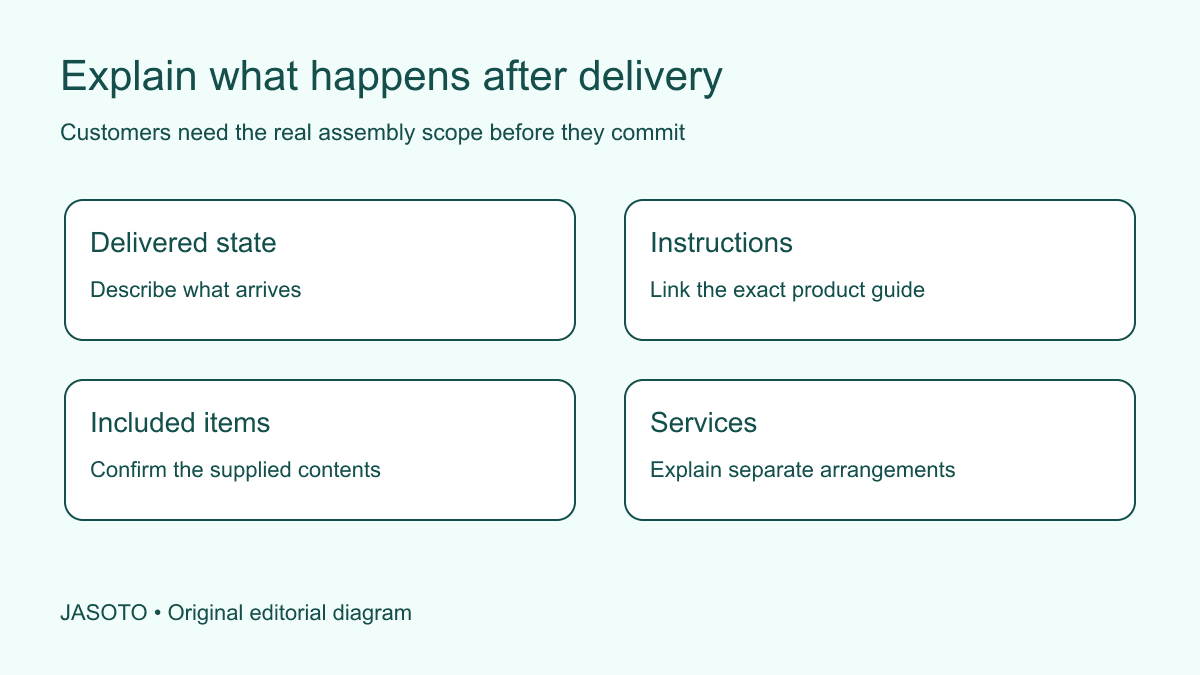
Original JASOTO editorial diagram. Its complete workflow is explained in the article; no actual customer outcome is depicted.
Explain assembly requirements before purchase by stating how the product arrives, linking the exact instructions and clarifying what the customer must arrange separately. Use verified product information for parts, tools and relevant conditions. Avoid replacing those facts with a vague promise that assembly is quick or easy, which may mean something different to every customer.
This guide offers an original product-information review for small retailers in the United States selling ordinary self-assembly goods. It is about communicating the purchase accurately. Product-specific assembly, installation and safety decisions belong in the appropriate manufacturer guidance and competent service process. The worked example uses an invented flat-pack shelving unit whose delivery and assembly options are separate.
The practical answer
- State the delivered condition and assembly requirement clearly.
- Link the exact current instructions before the purchase.
- Distinguish included items from tools or services arranged separately.
- Use verified information rather than invented difficulty or completion-time claims.
State the delivered condition near the buying decision
Tell the customer whether the item arrives assembled, partly assembled or in components, using the actual product information. Keep that statement close enough to the purchase details that it is not easily missed. A photograph of an assembled item shows the intended appearance, but may leave the delivered condition unclear. Do not assume that customers recognise a product category as inherently flat-pack.
Check every relevant sales channel and variant. A product family might contain versions delivered differently or sold with different service options. Preserve that distinction rather than copying one generic line across the range. The customer should understand the exact item and service they are selecting, while staff need an identifiable source for the statement if a question arises.
Find the correct instructions before summarising them
Use the product and version reference to locate the appropriate current guide. As one brand-specific example, [IKEA's U.S. guidance](https://www.ikea.com/us/en/customer-service/knowledge/articles/1656c41a-1a58-4e59-a77a-bae69f28f1bb.html) explains that assembly documents can be found through its product pages. Other manufacturers may organise information differently. Check the actual source rather than using a manual from a visually similar model found in a general search.
Keep the guide reference and review date with the catalogue record. If the manufacturer changes the instructions or product version, someone should review the customer-facing summary. Do not assume a saved PDF remains current forever. Preserve appropriate historical information for existing customers while making the current purchasing information easy for staff to identify and use.
Describe the customer's task at the right level
Summarise the actual requirement without writing an improvised instruction sequence. For example, explain that the supplied unit requires assembly according to the identified manufacturer guide. If a particular preparatory condition materially affects the purchase, confirm it from the appropriate source and present it accurately. Avoid adding a shortcut or alternative method to make the product sound simpler.
Distinguish assembly from installation or other work that may be required for intended use. A customer can complete one stage while another remains outstanding. Use the manufacturer's exact relevant guidance and appropriate advice to clarify those boundaries. This article does not determine which requirements apply to a particular product; the retailer's information process should establish and communicate them from suitable sources.
Make included and separate items clear
Check which components and accessories are supplied with the actual item. A staged photograph may include storage boxes, tools or decorative objects sold separately. The product description should identify the relevant contents rather than relying on the image alone. If an accessory is necessary for the customer's intended configuration, verify the appropriate information and explain the separate choice before purchase.
Use a concise contents reference connected to the product guide. Do not reproduce an incomplete list that conflicts with the manufacturer's current document. Ask the responsible product specialist to resolve uncertainty. A customer should not discover that an assumed included item was merely a showroom prop or that a separate service was never part of the order.
Communicate tool and preparation information from evidence
If the manufacturer identifies tools or preparation requirements, make the relevant information accessible and accurate. Do not invent a generic toolkit or tell customers to substitute whatever they own. Some questions require product-specific advice. Link the current source and give an appropriate support route rather than asking a sales assistant to improvise instructions during checkout.
Keep the communication proportionate. Customers may need to know that they should review the guide before deciding whether to self-assemble or arrange a suitable service. They do not need a retailer-written repair manual that omits important conditions. Use the actual guide as the authoritative source and make the product reference visible so the customer can confirm they are reading the correct document.
Avoid unsupported difficulty and timing claims
A staff member's experience can reveal a question to investigate, but it does not establish that every customer will finish in the same time. Avoid statements such as anyone can build this in minutes unless a properly supported and appropriate basis exists. Even then, explain relevant conditions. Accurate practical information helps a customer decide without turning one person's confidence into a universal promise.
If a supplier provides an estimate, record its source and limits. Keep an estimate distinct from a booked service duration or guaranteed completion time. A customer arranging help may need different information from someone comparing products casually. Ask what they need to plan and give verified facts or an appropriate enquiry route instead of smoothing the uncertainty away.
Explain service options and their boundaries
State whether the purchase includes any assembly service and how a separate service is arranged. Delivery to a specified point may not include room placement, assembly or installation. Check the actual service purchased rather than a broad brand advertisement. If a partner provider performs work, make the relevant booking and scope clear through the business's appropriate process.
Use current confirmed terms for price, availability and timing. Do not promise an appointment before the provider confirms it, or imply a technician can complete work outside the agreed service. Keep the customer informed about dependencies such as product delivery and appropriate access. A useful offer explains the next practical step without inventing a complete solution from a list of possible services.
Give staff a consistent pre-purchase answer
Prepare a short response tied to the actual product: how it arrives, where the guide is, which relevant contents are included and how separate service questions are handled. Keep unsupported technical claims out of the script. Staff should know when to ask the manufacturer or specialist rather than feeling they must answer every compatibility or installation question immediately.
Preserve the customer's actual question in an enquiry record where follow-up is needed. A question about carrying a package upstairs differs from a question about assembling the product in its final location. Route it appropriately. Do not combine delivery handling, product assembly and property suitability into a single reassuring yes when each depends on different evidence and responsible people.
Worked example: a shelving unit with separate assembly
Imagine a retailer offering a flat-pack shelving unit with delivery and an optional separately arranged assembly service. The product page identifies the delivered condition and links the correct guide. It explains which pictured storage boxes are separate products. The service information states the actual booking boundary rather than suggesting the delivery driver will assemble the unit automatically.
A customer can review the guide and ask the appropriate provider about their particular arrangement before committing. This invented example does not claim that the unit suits every space or that any specific assembly method is safe. It shows how product identity, instructions, contents and service scope can be connected into a clear buying decision without unsupported ease or time claims.
Test the information with a fresh reader
Use a specific scenario in the review: the customer wants the shelving and the pictured boxes but has selected delivery only. Ask the reader to identify what is included, what remains a separate product and what service has been booked. This reveals ambiguity more effectively than asking whether the page is clear in general.
Ask a colleague unfamiliar with the item to explain what will arrive, what remains to be done and where they would find the relevant guide. Then ask whether they think delivery includes assembly and which accessories they expect in the package. Compare their interpretation with the actual offer. Correct the specific wording or placement that caused a mismatch.
Check the page and confirmation formats used by customers. A link may work on the catalogue page but disappear from a marketplace description or printed quotation. Assign an owner to maintain the appropriate information across relevant channels. Preserve the previous version so a correction can be reviewed, and avoid claiming fewer support requests without measuring comparable evidence after the change.
Keep the information current after the sale
Retain an appropriate connection between the order and product version so support can identify the right guide later. If an instruction link changes, update the current record and consider how existing customers find relevant information. Use the manufacturer's proper support and safety processes for significant product issues. A retailer's concise care or assembly summary should not obscure an important official update.
Review recurring pre-purchase questions and improve the relevant field. If customers repeatedly confuse delivery with assembly, clarify the service boundary where they choose the option. If they cannot identify the correct guide, improve the reference and link. A focused improvement is easier to validate and reverse than a large rewrite built around assumptions about what customers ought to know.
Use JASOTO businesses to discover appropriate assembly or support providers and verify capability directly. If product-information maintenance becomes continuing work, explore product-support roles within a staffing review. For a confirmed showroom visit, research travel after checking the relevant display item. Clear assembly information gives customers a realistic view of the purchase and a reliable source for the work that follows.
Put the guide into practice
- Confirm the product and instruction version.
- Explain what arrives and what remains to be assembled.
- Check tools, parts and service boundaries against appropriate sources.
- Test whether a fresh reader understands the purchase.
Frequently asked questions
Can we say assembly is easy?
Prefer specific verified information over an unsupported difficulty label. Customers have different experience, access and circumstances. Show the appropriate instructions and explain the actual delivered condition and service options so they can make an informed decision.
Should a product page give an assembly time?
Use a supported estimate only with appropriate context and source. Avoid inventing a universal time from one staff member's experience. If timing is uncertain, say so and provide the information a customer needs to plan appropriately.
Does delivery include assembly?
Check the actual purchased service. Delivery, room placement, assembly and installation can be separate tasks. Make inclusions and exclusions clear before purchase, and confirm any separate booking rather than assuming the delivery team will perform it.
Explore JASOTO tools
Discuss the exact product and appropriate service scope directly.
Explore product-support roles →Consider support when maintaining pre-purchase information becomes ongoing work.
Research a confirmed showroom journey →Plan travel after confirming the relevant display item and appointment.
Continue with JASOTO
Compare your next step
Discover UK businesses, compare services and request written quotes before making a decision.