
Jobs & Careers · UK Guide 2026
Explain a Team Project Without Claiming Others’ Work
JASOTO · Updated 5 November 2026 · 1,637 words
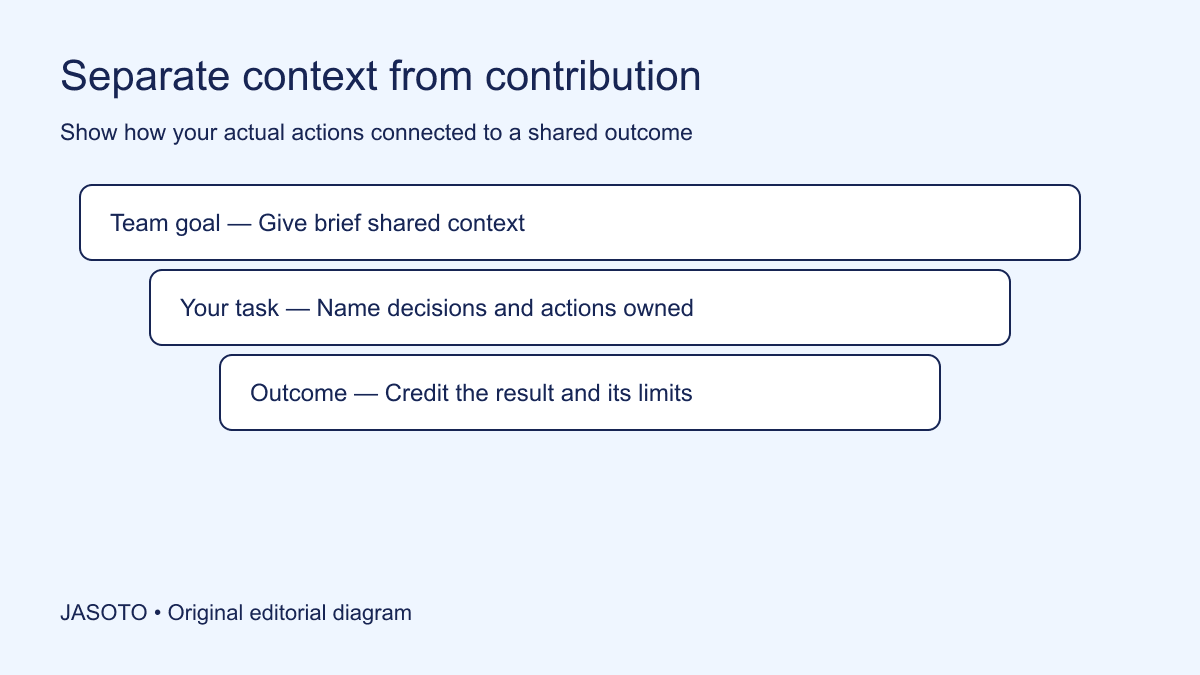
Original JASOTO editorial diagram. Its complete workflow is explained in the article; no actual customer outcome is depicted.
Explain a team project by giving the shared goal briefly, then identifying the task, decisions and actions you personally owned. Credit other contributions where they matter to understanding the result. Use “we” for the team's work and “I” for your own actions, without making either word do the job of a precise explanation. A clear boundary lets an interviewer assess your capability and collaboration together.
This original guide helps UK applicants prepare team examples for interviews and applications. The National Careers Service describes the STAR method as situation, task, action and result. The contribution map, attribution checks and invented examples below are editorial tools for adding accuracy to that structure. They do not require you to claim leadership, invent a metric or reveal confidential information to make an ordinary contribution sound impressive.
The practical answer
- Separate the shared goal from your task.
- Name adjacent responsibilities accurately.
- Use concrete actions and honest outcomes.
- Practise follow-up questions on your decisions.
Identify the responsibility the example should show
Read the role requirement and decide what the team project demonstrates about you. It might show how you checked information, managed a handoff, explained a problem or completed a defined piece of work. Choose one main capability for the answer. A long project can contain many interesting events, but the interviewer needs a clear connection between the question and the evidence you provide.
Avoid selecting only the largest or best-known project in your history. A smaller piece of work can provide stronger evidence if your contribution is clear and you can explain its decisions. If the interviewer asks about teamwork, show how you connected with others rather than describing a solitary task that happened near a team. If they ask about analysis, show the reasoning you performed rather than relying on the project's overall success to imply it.
Draw the shared goal and personal task separately
Write one sentence describing what the team was trying to achieve, then another describing what you were asked or agreed to do. Keep these distinct. For an invented community exhibition, the team organized the event while one volunteer maintained the exhibitor arrival list and updated the venue contact. The shared goal provides context; the personal task establishes the part the candidate can legitimately explain in detail.
Add the constraints relevant to that task, such as an agreed deadline, incomplete information or a handoff to another person. Do not overload the introduction with the entire organization's history. The background should help the interviewer understand your choices. If the task changed during the project, explain the change accurately and who agreed it. Taking on an additional responsibility can be useful evidence without claiming you owned the work from its beginning.
Map who owned the adjacent work
List the roles that supplied information, approved decisions and received your output. This is a private preparation tool, not a requirement to recite an organization chart. It helps you avoid accidentally describing a colleague's research or a manager's approval as your own. Include external contributors where their work materially shaped the result, while keeping names and details within appropriate disclosure boundaries.
For a design example, identify who set the brief, who gathered user information, who made the layout and who approved publication. If you performed several roles, state that fact precisely. If the boundaries were genuinely shared, explain how the team divided or jointly made the decision. “We reviewed the options together; I prepared the comparison and recorded the agreed choice” provides more useful evidence than either claiming complete ownership or erasing your contribution inside a vague group account.
Replace broad verbs with inspectable actions
Review phrases such as “supported”, “helped”, “managed” and “delivered”. Ask what you actually did. Perhaps you checked the entries, called the responsible contact, drafted the summary or compared two versions. Concrete actions give the interviewer something to ask about. They also reduce the temptation to inflate the title of your contribution simply because a broad verb sounds more senior.
Describe the decision behind an action where relevant. “I moved the unclear address into a question for the venue because the map and invitation disagreed” shows judgement. “I handled logistics” leaves the work undefined. Keep the level of detail proportionate; the interviewer does not need every click or email. Select the actions that demonstrate the capability in the question and explain why those actions mattered to the next stage of the team's work.
Use a shared outcome without claiming sole causation
State the team's result and distinguish what you can connect directly to your contribution. A project may have reached its deadline through many people's work. You can accurately say that your handover was completed and used by the next person, without claiming you personally caused the entire project to succeed. If the overall result is not known, explain the observed endpoint of your own task.
Avoid manufactured percentages and unsupported causal statements. “The team launched the revised page; I wrote the approved help text” is useful if true. “My copy increased sales” needs appropriate evidence and a justified connection. Where a metric is available and permitted to discuss, identify its scope and your relationship to it. Do not adopt a team-wide figure as a personal achievement simply because it makes the answer more memorable.
Prepare an honest example of collaboration
Choose a moment where your work depended on another person. Explain what information you needed, how you asked for it and how you handled uncertainty or disagreement. Teamwork evidence is often strongest at a handoff or decision boundary. The aim is not to manufacture conflict for a dramatic story; an ordinary clarification can demonstrate respectful coordination and practical judgement.
In the invented exhibition example, an exhibitor's delivery time conflicts with the venue's access window. The candidate gathers the relevant information, asks the venue owner which options are possible and updates the arrival list after the decision. They do not claim to have negotiated a policy change if someone else made that agreement. The interviewer can still assess initiative, clarity and follow-through through the candidate's actual actions, without converting every interaction into a leadership claim.
Handle a question about what others did
Be ready to explain adjacent work at the level you genuinely know. If another colleague built the technical component, say so and explain your interface with it. You might have supplied requirements or checked a result without writing the code. Knowing the boundary of your understanding is more useful than attempting to bluff detailed expertise because the component appeared in the same project.
If asked what would have happened without your contribution, avoid an exaggerated counterfactual. You may be able to explain the responsibility you fulfilled and what dependency it supported. You usually cannot prove that the project would have failed without you. A precise answer can say that your work gave the coordinator an up-to-date arrival list and made outstanding confirmations visible. That establishes value without inventing a world in which every other team member was unable to act.
Rehearse with follow-up questions
Tell the story aloud, then ask a trusted listener to identify your personal task and the team's result. If they cannot distinguish them, revise the account. Invite questions about an alternative you considered, a limitation and the next person who used your work. This tests whether the answer is grounded in actual decisions rather than a polished paragraph that collapses when examined.
Keep the answer conversational. You do not need to repeat every prepared sentence if the interviewer asks about a different aspect. Return to the contribution map and select the evidence relevant to the question. If you forget an exact date or figure, say what you know and avoid inventing precision. A measured answer with a clear factual boundary is better preparation than a memorized story containing details you cannot substantiate.
Keep the account consistent across materials
Compare the example with your CV, portfolio captions and application answers. The emphasis can change with the question, but the role, dates, ownership and outcomes should remain factual. Correct a misleading caption before it becomes the basis for an interview claim. If a submitted document contains a material error, use an appropriate recruitment route to clarify it rather than silently building a different account around the same project.
When exploring job opportunities, maintain a private evidence list organized by capability and contribution. If a business service provider helps edit your application, check that their wording does not enlarge your responsibility. You remain the source for what you actually did. If the interview becomes an in-person portfolio discussion, confirm the requested materials and venue before planning travel, while keeping any shared project work within the relevant permission boundaries.
End with learning tied to your own work
Identify a specific improvement you would make to your contribution next time. Perhaps you would ask for an approval owner earlier, separate confirmed information from assumptions or provide a clearer handoff. Avoid assigning blame to colleagues to make yourself appear more capable. A useful reflection explains the part you can change and recognizes the constraints under which the team worked.
If the prepared story still depends on claiming other people's work, choose a different example or narrow the task until the evidence is accurate. That is the practical rollback: restore the actual responsibility, remove unsupported outcome claims and show the decision you really made. A good team-project answer does not require you to have done everything. It lets the interviewer understand how you contributed to a shared result and how you worked with the people whose contributions were different from yours.
Put the guide into practice
- Select a role-relevant capability.
- Map your task and collaborators.
- Check CV and portfolio wording.
- Remove unsupported personal impact claims.
Frequently asked questions
Should I avoid saying “we” in an interview?
Use it for shared work and outcomes, then specify your own task and actions. The problem is ambiguity, rather than the word itself. An interviewer should be able to identify what you did, which decisions you owned and how your work connected with other people’s contributions.
What if I had only a small part in a successful project?
Explain that part precisely and connect it to the capability being assessed. A bounded task can show accurate work, judgement or reliable collaboration. Do not enlarge ownership of the whole project to make the example seem valuable; choose the specific decisions and actions you can discuss in detail.
Can I use the team’s results figure?
Only if it is accurate, appropriate to share and clearly identified as a team or project measure. Explain your contribution separately and avoid claiming a causal link you cannot support. If the result was not measured, describe the observed output or endpoint without inventing a percentage.
Explore JASOTO tools
Discover providers and check support for your specific task.
Explore roles and responsibilities →Consider the practical responsibilities involved when recruiting or joining a team.
Plan work-related travel →Research a journey when joining, training or meeting colleagues in person.
Continue with JASOTO
Compare your next step
Discover UK businesses, compare services and request written quotes before making a decision.