
Business Growth · UK Guide 2026
Record a Failed Assumption After a Marketing Test
JASOTO · Updated November 5, 2026 · 1,533 words
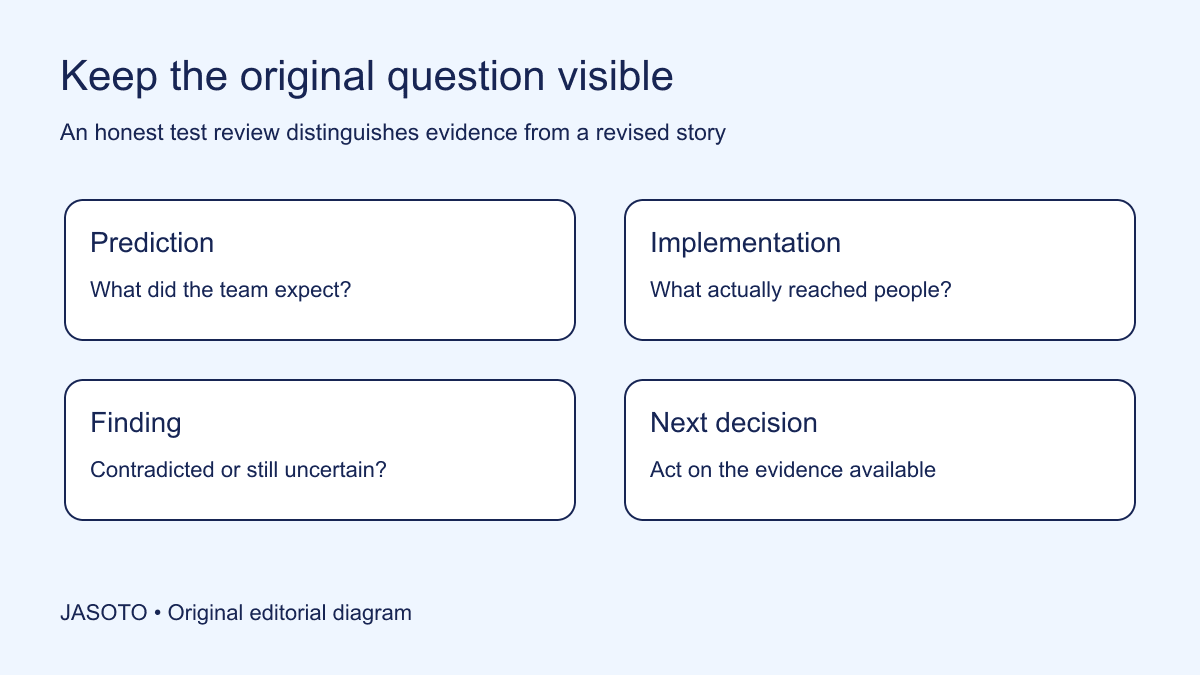
Original JASOTO editorial diagram. Its complete workflow is explained in the article; no actual customer outcome is depicted.
Record a failed marketing assumption by preserving the original prediction, checking what actually ran and stating what the evidence supports now. Distinguish a contradicted assumption from one the test did not adequately assess. Keep implementation failures, unexpected observations and remaining uncertainty visible. The review should guide a useful next decision without rewriting the original test into a success story after seeing the result.
Start with a specific campaign or content change and its actual plan. The examples below are fictional and use no invented performance figures. This workflow serves a small United States business and supports practical review. Use appropriate analytical expertise when a causal or statistical conclusion matters, and keep customer information within the organization's responsible processes.
The practical answer
- Preserve the original assumption and expected observation.
- Check implementation and measurement before interpreting the result.
- Separate unsupported, contradicted and inconclusive findings.
- Choose a focused next action with a clear evidence need.
Recover the original assumption and prediction
Find the plan, draft or decision note created before the test. Write the assumption and the observation the team expected if it held. Avoid substituting a vague goal such as more customers for a particular explanation of behavior. A useful assumption links a proposed change to a customer task or response that could be investigated.
If the original was never recorded clearly, say so. Reconstruct it cautiously from dated evidence and label the limitation. Do not invent a precise pre-registered hypothesis that nobody actually agreed. The first learning may be that the next test needs a clearer question, which is a process finding rather than proof about customer demand.
Preserve the original decision criteria
Record the intended measure, observation period, comparison and next decision. Check whether the target had an evidence-based rationale or was an aspiration. A missed aspirational number does not by itself diagnose why the test performed as it did. Keep that distinction in the review.
Preserve later exploratory findings separately. A different measure may reveal something useful, but it should not silently replace the one the test was designed to assess. The decision record should make clear which question was planned and which emerged afterwards. That keeps the learning useful without creating a misleading account of foresight.
Verify what actually ran
Check the published version, audience route, timing and operational support. A planned message may differ from the one delivered, or a broken form may prevent the intended next action. Use appropriate technical and operational evidence rather than relying solely on a campaign dashboard or a recollection of the launch.
Record deviations with dates and owners. They may limit the test's ability to assess the assumption. Do not treat an implementation failure as proof that customers rejected the proposition. Conversely, do not excuse every unfavorable observation as a technical problem without evidence. The review needs the actual state, including what remains unknown.
Check measurement before explaining behavior
Ask whether the events and categories represented the intended customer task. Confirm what a click, inquiry or completion actually meant through suitable review. Duplicate events, changed tracking or incomplete channel coverage can alter the result. Record limitations rather than selecting whichever source gives the preferred interpretation.
[NIST's experimental-design steps](https://www.itl.nist.gov/div898/handbook/pri/section1/pri14.htm) include checking assumptions and interpreting results within a planned process. Use appropriate methods for the actual test. The local review structure here organizes evidence and decisions; it does not make an informal campaign comparison equivalent to a controlled statistical experiment.
Describe the observation without adding a cause
State what happened within the defined scope. Keep raw counts, relevant rates and unresolved cases interpretable through the approved measurement plan. An observation such as fewer recorded requests does not establish that the message was unpersuasive. Exposure, suitability, technical friction and other factors may contribute.
Use language that reflects confidence. If evidence is incomplete, describe the limitation directly. Avoid a precise financial or behavioral claim unsupported by the record. A factual account can be useful even when the team cannot yet explain the outcome. That is the starting point for a better investigation.
Classify the assumption's current status
Use clear distinctions such as contradicted by suitable evidence, unsupported in this test, unresolved because of implementation or measurement limits, or still requiring investigation. Define the local labels so reviewers apply them consistently. Do not force every test into success or failure when the evidence answers only part of the question.
Record the reason for the classification and a supporting reference. A reviewer should understand what would change the conclusion. Keep the status tied to the actual audience and conditions rather than declaring that an idea can never work. The record should help the business avoid repeating an unsupported assumption while remaining open to appropriate new evidence.
Inspect alternative explanations proportionately
List plausible alternatives supported by the context, such as a changed traffic source, different service availability or a conflicting message elsewhere. Separate evidence from speculation. Do not generate an endless list of hypothetical excuses that prevents any decision, and do not ignore a material known change because it complicates the story.
For location-dependent campaigns, review actual coverage, appointments and journey expectations where relevant. A proposition can attract interest while promising attendance the service cannot deliver. Keep operational facts with their owners. The review should identify which explanation needs investigation and what evidence would help settle it.
Examine customer evidence behind the summary
Use appropriate inquiries, task observations or feedback to understand specific misunderstandings. Keep quotations and summaries accurate and handle personal information responsibly. One comment can reveal a concrete defect without representing every customer. Record its scope and avoid treating a selected anecdote as the complete explanation for an aggregate result.
Look for the customer decision the test was meant to support. Did people understand the offer and next step? Were unsuitable visitors correctly excluded? A lower inquiry count might accompany clearer boundaries, while higher contact might reflect confusion. The original purpose should guide interpretation rather than a general preference for larger numbers.
Work through a fictional message assumption
Imagine a business tests a shorter service message expecting more suitable requests. The published version removes a condition that customers need to understand scope. Recorded contact increases, but case review shows repeated misunderstanding. The team records that the larger count does not establish the intended quality benefit and assigns a correction to the scope explanation.
The review preserves the original assumption and identifies what the evidence actually shows. This fictional example supplies no fabricated lift, conversion rate or revenue result. It illustrates a test whose convenient headline measure points in a different direction from the customer task the business meant to improve.
Record the decision and its trade-off
Choose whether to stop the variation, restore an accurate earlier version, revise a specific feature or gather more evidence. State the owner and reason. Do not default to running another campaign merely to avoid acknowledging uncertainty. The next action should address the evidence gap or verified problem identified in the review.
Keep commercial changes with the responsible owner. Research marketing support using the original plan and actual findings if outside help is needed. A provider should not be asked to guarantee a result the business has not defined or measured properly. The brief can identify a distinct unmet analysis or implementation responsibility.
Design the next question narrowly
If further testing is appropriate, specify what remains unknown and what observation would help. Avoid changing several unrelated elements while hoping the next result will explain the earlier one. Keep essential customer information and approved claims intact. A small focused correction may be more useful than a large new experiment.
Seek appropriate analytical support for assignment, sample and interpretation where the decision requires it. Do not invent a minimum test duration or universal sample size. Record the design limits and the practical decision it can support. The next plan should improve the evidence, not merely produce another set of activity metrics.
Keep the failed assumption discoverable
Store a concise note with the assumption, versions, implementation evidence, findings, uncertainty and decision. Link it to relevant future briefs. An organization can repeat the same unsupported idea when the only record is an old presentation titled results. Use a searchable label describing the actual question.
Avoid turning the note into blame. Identify responsibilities and process defects accurately while keeping the focus on what the evidence supports. Explore analysis roles if continuing review needs capacity. The owner should maintain the connection between plans, measurement and decisions rather than simply collect favorable charts.
Revisit the conclusion when meaningful evidence changes
Preserve earlier interpretations and record why a later view differs. A changed audience, offer or implementation may justify new investigation, while an old unsupported claim should not return without that rationale. Keep rollback and correction paths available for misleading live content.
The practical result is an honest learning record: the business can identify what it assumed, what was tested, what the evidence contradicted or left unresolved and what it chose next. That supports better decisions without manufacturing outcomes or pretending one test settled every question about the service or audience.
Put the guide into practice
- Save the original plan, versions and decision criteria.
- Review what actually ran and who encountered it.
- Inspect the evidence and alternative explanations.
- Record the assumption's current status honestly.
- Assign a proportionate next test or correction.
Frequently asked questions
Is a result below target proof that the idea was wrong?
Check the target's basis, actual implementation and measurement first. A weak or incomplete test may not answer the intended question. Record whether evidence contradicts the assumption, fails to support it or remains inconclusive, rather than treating every missed target as the same finding.
Should the team call every test useful learning?
Identify what was actually learned and what decision it supports. A test may reveal an implementation defect or lack enough evidence to assess the assumption. That can be worth recording, but it should not be repackaged as a measured customer insight or commercial success that the results did not establish.
Can we change the success criteria after the test?
Preserve the original criteria and distinguish any later exploratory observation. New questions can be useful, but they should not silently replace the original plan to create a favorable result. Record the reason for a new criterion and use it transparently in subsequent work.
Explore JASOTO tools
Continue with JASOTO
Compare your next step
Discover UK businesses, compare services and request written quotes before making a decision.