
Customer Communication · UK Guide 2026
Check Whether a FAQ Reduces Repeated Clarification
JASOTO · Updated 5 November 2026 · 1,532 words
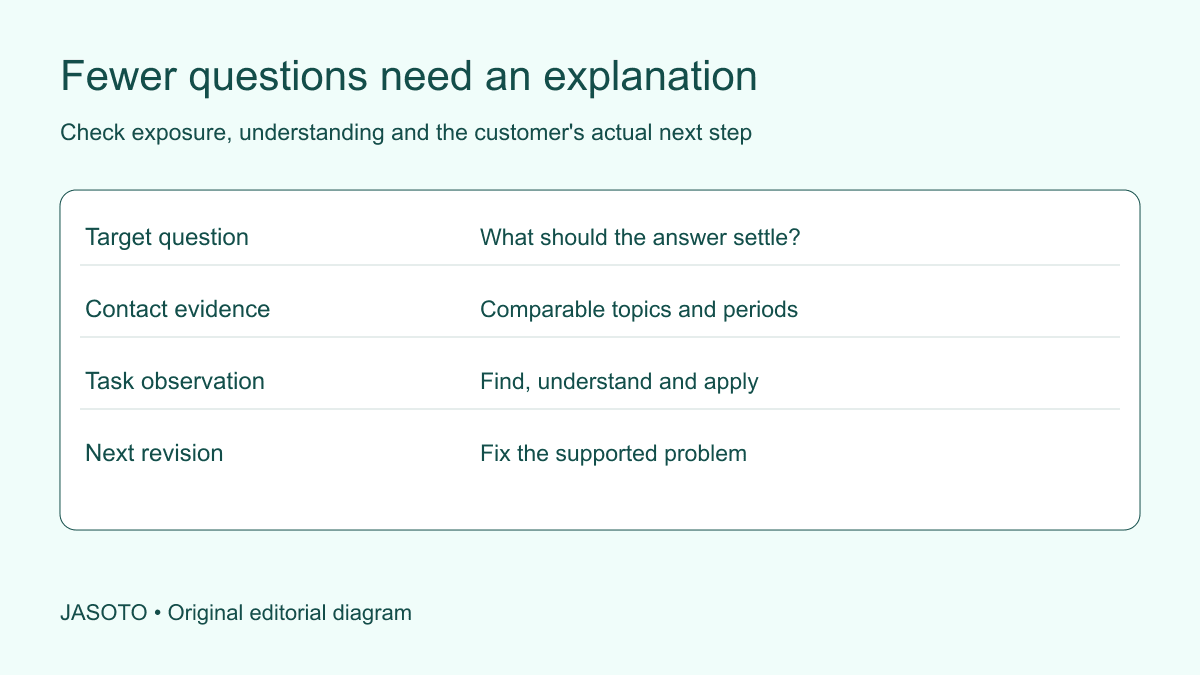
Original JASOTO editorial diagram. Its complete workflow is explained in the article; no actual customer outcome is depicted.
Check whether a FAQ reduces repeated clarification by defining the question it should settle, reviewing comparable customer contact and testing whether readers can find and apply the answer. Include traffic, exposure and service context. A fall in messages can have several causes, while a customer asking an individual question may be using the information appropriately. Measure the intended task rather than treating every conversation as avoidable work.
Start with one answer or a small related set for a UK business. This guide uses fictional examples and provides a practical review method. It builds on an accurate maintained FAQ by examining what happens after publication. Keep customer evidence appropriately controlled and avoid claiming a causal effect that the observation design cannot establish.
The practical answer
- Define the specific clarification the answer should resolve.
- Record comparable question evidence and relevant exposure.
- Test whether readers can find and apply the answer.
- Keep legitimate individual questions and uncertain causes visible.
Define the clarification you intend to reduce
Write the customer question in practical terms, such as whether a request confirms an appointment or how an agreed collection works. Identify the general answer and its limits. A broad goal to reduce support is too vague to guide measurement. Some contact is necessary and valuable, especially when the service needs an individual assessment.
Record why the question matters and where existing evidence shows difficulty. Distinguish a repeated general clarification from a new circumstance the answer cannot reasonably cover. The review should help customers make an informed next step, including contacting the business when the actual case requires it. Avoid designing a measure that rewards making help harder to obtain.
Preserve the answer and publication context
Keep the exact wording, page location, relevant links and publication point. Record any changes to service process, forms or support templates at the same time. Customers may encounter several versions or enter through different routes, so a single date does not establish which information each person saw.
Identify the answer owner and source of its facts. If accuracy is unresolved, settle that through the responsible process before evaluating effectiveness. A popular or easily found answer can still be wrong. The measurement question should not encourage retaining a misleading promise merely because it appears to reduce immediate contact.
Choose a consistent question classification
Define categories for the target clarification, legitimate individual cases, unrelated topics and uncertainty. Use examples to help reviewers distinguish them. A message mentioning an appointment may concern date availability, confirmation status or arrival access. Group by the decision needing clarification rather than a shared keyword alone.
Keep duplicates and follow-up contacts interpretable. One customer asking twice differs from two independent cases, depending on the measure's purpose. Record the unit and channel coverage. Do not change classification rules after seeing a favorable pattern or silently exclude awkward cases to make the answer appear effective.
Establish the available baseline honestly
Use suitable earlier contact evidence where it exists and state its scope. A recollection that everyone used to ask is not a precise baseline. If earlier records cannot support a direct comparison, say so and focus on current task observations and specific remaining problems. Do not manufacture a percentage reduction from unmeasured history.
Choose relevant periods and note campaigns, closures, staffing and service changes. A different audience can produce a different question pattern. The review may still be useful, but it should describe those conditions. Preserve the evidence and definitions so another colleague can assess whether the comparison is meaningful.
Consider exposure to the answer
Ask what is known about whether relevant customers could find or saw the FAQ. A page view does not prove reading or comprehension, and a caller may never have visited the site. Record direct evidence, reasonable inference and unknown exposure separately where the distinction matters. Avoid attributing all later contact to the answer's success or failure.
Use the site's appropriate analytics and technical support to understand limitations. Do not collect intrusive information simply to connect every person to a page. A proportionate review can identify useful patterns with uncertainty visible. The task is to investigate whether the answer helps, not create an illusion of complete customer tracking.
Test whether people can find the answer
Give suitable readers a realistic question without telling them the section name that contains the answer. Observe the route and wording they search for. [GOV.UK's usability-testing guidance](https://www.gov.uk/service-manual/user-research/using-moderated-usability-testing) describes observing specific task attempts. Use appropriate research practice and report the limits of a small exercise.
Check the context where the question arises. An answer buried in a central FAQ may be less useful than clear information beside a form or service action. Record whether placement, heading or language caused difficulty. Do not assume the remedy is a longer answer when people never reached the existing one.
Check understanding separately from retrieval
Ask readers to explain the answer and what it means for the scenario. Require the supporting text and compare the interpretation with the approved process. A person can locate a paragraph and still infer a stronger promise than intended. Confidence or speed alone does not establish correct understanding.
Preserve uncertainty where the general answer appropriately requires individual review. The correct interpretation may be that the customer needs to supply particular information before the business decides. Do not simplify the answer into false certainty to make task completion easier. The review should support an accurate decision, not a convenient yes-or-no result.
Follow the next action and linked material
Open the contact, form or directions route in an appropriate review environment. Verify that it preserves the same status and conditions. An FAQ can explain that a time is requested while the linked form announces a confirmed booking. Record that contradiction with its owner rather than blaming the FAQ alone for subsequent questions.
For arrival topics, check that customers can identify the relevant location and appointment arrangement before planning a journey. A correct answer becomes less useful if the next page contains outdated access information. Keep the complete task in scope, while assigning technical or operational changes to the people responsible for them.
Inspect the remaining clarification cases
Review appropriate examples of customers who still ask the target question. Identify what they encountered and what remained unclear where the evidence permits. Some may have used an older message or a third-party description. Keep those sources visible. A new page cannot be judged solely from contact whose exposure is unknown.
Record whether the answer is missing a condition, using unfamiliar terminology or failing to address a legitimate edge case. Distinguish factual and editorial fixes from service-policy decisions. The writer should not invent a broader offer merely to stop a recurring question. Give unresolved scope matters to the approved business owner.
Work through a fictional confirmation question
Imagine a business adds an FAQ explaining that submitting a preferred date does not confirm a visit. Contact review shows fewer general questions but several customers still arrive with an unconfirmed request. A task test finds that the form's success heading says booked. The team corrects that journey contradiction rather than lengthening the FAQ automatically.
The later review records the change and actual evidence without claiming that every customer will now understand. This fictional example illustrates a specific diagnosis. It supplies no fabricated reduction in messages or missed appointments and does not establish that the same wording suits another service's booking process.
Compare evidence without equating silence with success
Show the relevant contact counts, observation scope and unknown cases alongside the task findings. Note changes in traffic and operations. A smaller question count may reflect lower demand or a harder contact route. Investigate plausible alternatives before drawing a strong conclusion about the answer's effect.
Where practical, look for positive evidence of correct action or improved understanding, not only absence of contact. Keep the measure proportionate and respectful of privacy. Do not turn a limited internal exercise into a universal customer-satisfaction claim. The report should explain what was observed, what it suggests and what remains uncertain.
Choose a targeted improvement
Decide whether to retain the answer, revise meaning or placement, correct a linked route or gather more evidence. Record the rationale, owner and expected user benefit. Research website support with the actual task evidence when help is needed. A specific finding gives providers a more useful brief than a request to make the FAQ more effective in general.
Preserve earlier wording and a rollback path. Retest consequential changed tasks and broaden review only when new failures or uncertainty justify it. Avoid changing several unrelated features at once if the business needs to understand the particular clarification issue.
Maintain answer ownership and review triggers
Assign who verifies accuracy and who reviews the observed customer task. Consider support knowledge roles where continuing work needs capacity. Update connected placements when the process changes. A previously effective answer can become misleading after a new service boundary, form or location arrangement.
Keep a concise learning record with definitions, versions, evidence and decisions. Follow appropriate access and retention arrangements. The practical result is an honest assessment of whether an answer supports its intended clarification, with specific improvements grounded in customer tasks and the limits of the evidence kept visible.
Put the guide into practice
- Preserve the answer version and intended customer task.
- Approve question categories and observation boundaries.
- Review findability, meaning and linked next steps.
- Compare evidence with traffic and service context.
- Choose a specific revision or further investigation.
Frequently asked questions
Does fewer support contact automatically mean the FAQ works?
It can reflect lower traffic, a changed service or customers abandoning an unclear process. Review exposure, task understanding and relevant cases alongside contact volume. Keep the conclusion within the evidence rather than treating silence as universal customer comprehension.
Should every question after reading an FAQ count as failure?
Some customers need a legitimate individual assessment or clarification beyond the general answer. Define the intended task and distinguish questions the FAQ should settle from those requiring personal handling. The goal is informed contact and useful understanding, not eliminating every conversation.
What if the answer is correct but people cannot find it?
Investigate placement, headings, terminology and the route where the question arises. A targeted answer beside the relevant action may help more than adding another FAQ entry. Test the actual customer task and keep linked versions maintained to avoid contradictory duplicates.
Explore JASOTO tools
Continue with JASOTO
Compare your next step
Discover UK businesses, compare services and request written quotes before making a decision.