
Business Growth · UK Guide 2026
Fixed Scope or Discovery Visit? A Practical UK Guide
JASOTO · Updated 5 November 2026 · 1,621 words
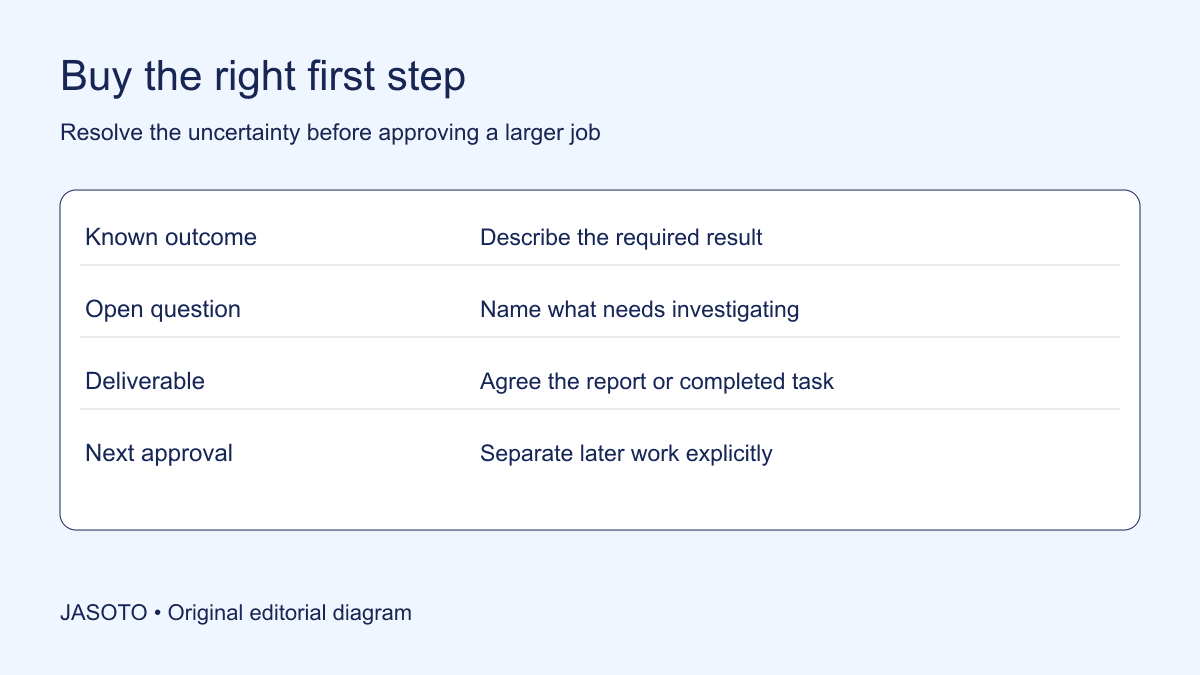
Original JASOTO editorial diagram. Its complete workflow is explained in the article; no actual customer outcome is depicted.
A fixed-scope booking is suitable when both parties can describe the work and recognise its completion. A discovery visit is suitable when an important uncertainty must be investigated before that work can sensibly be specified. Compare the decision each option enables, the evidence you receive and the authority it gives the provider, rather than comparing the headline charge alone.
For a UK small business, this distinction can prevent a familiar disappointment: someone attends expecting to install or repair, while the customer expects only advice. The framework below is an original purchasing tool for service enquiries. It does not diagnose equipment or determine contractual rights. Technical and safety decisions still need the appropriate competent person, and any particular booking depends on its agreed terms.
The practical answer
- Choose fixed scope when the required work can be described and checked.
- Choose discovery when a material question must be investigated first.
- Buy a defined finding or report rather than an unspecified conversation.
- Keep authority for subsequent work explicit.
Start with what you already know
Write a short statement of the present situation, the desired result and the missing information. For example, an office may know that six desks need relocating, but not whether the proposed layout can accommodate the existing equipment. Those are separate matters. Moving identified desks is describable work; checking the feasibility of a layout answers an earlier question. Combining them into “sort the office” leaves the boundary unclear.
List the documents that support what you know: measurements already verified, an equipment inventory, photographs or a previous report. Label estimates and assumptions. Do not turn an uncertain measurement into a firm requirement simply to obtain a quick quotation. If two suppliers receive different information, their prices may reflect different tasks rather than a difference in value. Send the same brief and record any clarification shared afterwards.
Define the fixed-scope option in observable terms
A fixed scope should say what is included, where it happens and how completion will be checked. “Configure the agreed accounts and demonstrate the named workflow” is easier to evaluate than “make everything work”. Ask which materials, preparation, testing, documentation and handover are included. Where your own team supplies something, identify it as a dependency so the supplier does not price on an impossible assumption.
Also describe exclusions that affect the result. If a provider will assemble furniture but will not remove packaging, someone still needs to arrange that task. If a service includes an agreed number of revisions, define how a revision differs from a new brief. The aim is a shared description that a colleague could understand later, without requiring the original telephone conversation to be reconstructed from memory.
Give discovery a deliverable of its own
Discovery should not mean paying for an undefined amount of curiosity. Ask what the provider intends to establish and what you will receive afterwards. Depending on the service, this might be a written findings note, a measured survey, a set of options or an implementation proposal with explicit assumptions. Confirm the limits of the assessment, including what will remain inaccessible or outside the provider's expertise.
Agree whether the visit includes any practical work. A conversation, an inspection and an adjustment are different activities. Do not assume that a provider will make changes because they are already on site. Equally, do not let “while you are here” become an accidental instruction to proceed. For work equipment, [HSE's maintenance guidance](https://www.hse.gov.uk/work-equipment-machinery/maintenance.htm) stresses suitable planning and competent people; a commercial discovery brief does not replace those arrangements.
Compare the complete first-step cost
Put the two proposals beside each other using the same fields: booking charge, travel, materials, report, time allowance, possible follow-up and what happens if access fails. Ask whether a discovery charge is credited against later work and, if so, under what conditions. A credit can be useful, but it should not make an otherwise unsuitable next stage feel compulsory. Record the terms without assuming that every provider offers the same arrangement.
Look at internal effort as well. A cheaper visit that requires three colleagues to attend may consume more business time than a well-prepared assessment with one responsible contact. This is a planning comparison, not a claim that the most expensive option is best. Use your own expected effort and quote details; do not invent a precise saving when the required information is missing.
Ask what could change the recommendation
A useful question is: “Which finding would make you recommend a different approach?” It reveals whether the assessment can influence the decision. If every possible outcome leads to the same product purchase, ask what independent value the investigation provides. This need not imply poor practice; some visits are explicitly product demonstrations or sales surveys. They should simply be understood and compared on that basis.
Ask how the provider handles an inconclusive result. You may receive a shortlist of possibilities rather than a diagnosis, especially with intermittent problems or concealed conditions. Agree whether further evidence, specialist input or another visit would require a new booking. A realistic account of uncertainty is more helpful than an unsupported promise that one appointment will answer every question.
Set a boundary for additional work
Name the person who can approve expenditure and the method of approval. Reception staff may be able to confirm access but may not be able to approve changes. Put that distinction in the appointment note. If the decision maker will be unavailable, agree whether the provider pauses, completes only the original assessment or contacts a nominated substitute. Avoid leaving the attending worker to guess whose instruction counts.
Use a simple follow-on message: “We have received the findings dated [date]. Please quote separately for [defined option]. This message does not authorise implementation.” Adapt it to the actual agreement and obtain suitable advice for consequential contracts. The practical purpose is to keep receipt of a report separate from acceptance of a larger proposal. Silence should not be your working method for communicating a purchasing decision.
Worked example: choosing an office storage service
Imagine a small practice considering new archive storage. It has a list of boxes and an intended room, but no confirmed layout. One provider offers installation based on dimensions supplied by the practice. Another offers a paid assessment that produces a layout and identifies unresolved questions before installation is quoted. These are not equivalent offers, even if both mention the same number of storage units.
The practice checks who is responsible for verifying suitability and asks for the discovery output in a usable form. It then decides whether it can supply reliable information itself or needs the assessment first. This invented example claims no saving or successful installation. Its lesson is that a price comparison becomes meaningful only after the buyer understands which party is resolving the uncertainty and what evidence supports the next decision.
Prepare the appointment so the time is useful
Send the relevant information in advance and ask the provider to confirm any missing essentials. Identify the room, item or process to be considered. Arrange access through the responsible person and confirm who can explain the current workflow. If the provider needs someone who actually uses the equipment, a manager with purchasing authority may not be an adequate substitute for that practical account.
Use JASOTO businesses to discover potential providers, then check their scope directly. If travel is needed, research the journey after the appointment and destination are confirmed. Where appointment preparation and purchasing coordination recur across many projects, explore relevant roles as part of a staffing decision. None of these steps removes the need to verify the particular provider, service and arrangements.
Read the output against the original question
After discovery, check whether the report addresses the question you agreed to investigate. Separate observed facts from recommendations and assumptions. If a proposal says a certain option is preferred, ask which evidence supports that preference and what limitations remain. Keep the report and subsequent quote together, while preserving their dates and versions. A later revised recommendation should not erase the original record.
For fixed-scope work, check the agreed completion points and identify anything outstanding. Do not substitute a general expression of satisfaction for a clear account of unfinished tasks. If an unexpected condition has changed the job, record the revised understanding and the next approval. This keeps practical progress visible without requiring either party to pretend the original brief anticipated everything.
Make the next decision proportionate
Before accepting the first step, ask a colleague to read the proposal and explain what will exist afterwards. Can they identify the completed task or investigation output, the main exclusions and the decision still reserved to the business? If their answer differs from yours, clarify the proposal with the provider. This review tests the purchasing description, not the provider's technical competence. It can reveal an expectation gap while the booking is still easy to revise.
The right first step is the smallest sensible commitment that produces enough reliable information for the next decision. Sometimes that is a tightly described job. Sometimes it is a paid investigation. Sometimes the provider can clarify the issue remotely before either option is booked. Ask what is possible without pressuring someone to give a technical conclusion from inadequate evidence or unsafe photographs.
Save a final decision note stating the chosen route, why it fits the known uncertainty, the agreed deliverable and who owns the next action. Review the choice when the findings arrive rather than automatically expanding the project. That record is useful if another colleague takes over: they can see what was purchased, what remains unapproved and what information should justify the next commitment.
Put the guide into practice
- Write the decision the visit must support.
- Compare deliverables, exclusions and access assumptions.
- Confirm charges, cancellation terms and follow-on approval.
- Save findings with a named next action.
Frequently asked questions
Does paying for discovery commit me to the repair?
Do not assume it does or does not. Ask the provider to state what the initial booking authorises and whether subsequent work needs separate acceptance. Keep that confirmation with the booking so the person attending and the person approving expenditure have the same understanding.
Can a fixed-scope quote include unknowns?
Yes, if the assumptions and treatment of discoveries are clear enough to compare. Ask which conditions would trigger a revised proposal, who may approve it and what happens to the unfinished work while approval is pending. A fixed label alone does not resolve uncertainty.
What if discovery produces no definite diagnosis?
Ask for the observations, checks, remaining uncertainty and a recommended next decision. A useful assessment may narrow the possibilities without identifying a final solution. Judge it against the agreed investigation deliverable rather than treating attendance as proof that the problem has been solved.
Explore JASOTO tools
Discover providers and ask how they separate assessment from implementation.
Explore project coordination roles →Consider staffing when organising visits and approvals becomes regular work.
Research visit travel →Plan a necessary journey after confirming the appointment and location.
Continue with JASOTO
Compare your next step
Discover UK businesses, compare services and request written quotes before making a decision.